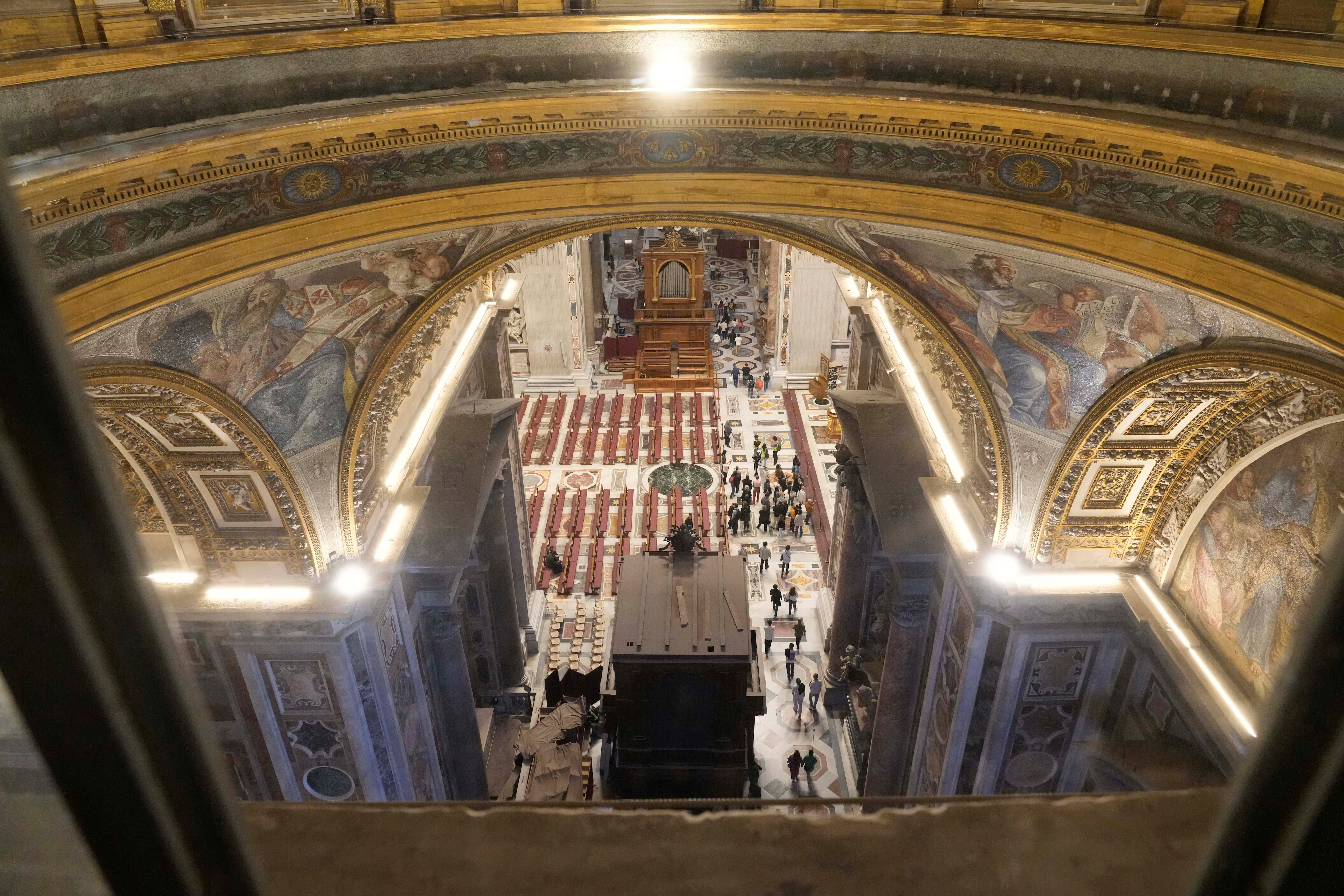
VATICAN CITY (AP) — The Vatican and Microsoft on Monday unveiled a digital twin of St. Peter’s Basilica that uses artificial intelligence to explore one of the world’s most important monument’s while helping the Holy See manage visitor flows and identify conservation problems.

Using 400,000 high-resolution digital photographs, taken with drones, cameras and lasers over four weeks when no one was in the basilica, the digital replica is going online alongside two new on-site exhibits to provide visitors -- real and virtual -- with an interactive experience.

“It is literally one of the most technologically advanced and sophisticated projects of its kind that has ever been pursued,” Microsoft's president Brad Smith told a Vatican press conference.

The project has been launched ahead of the Vatican's 2025 Jubilee, a holy year in which more than 30 million pilgrims are expected to pass through the basilica’s Holy Door, on top of the 50,000 who visit on a normal day.

“Everyone, really everyone should feel welcome in this great house,” Pope Francis told Smith and members of the project's development teams at an audience Monday.

The digital platform allows visitors to reserve entry times to the basilica, a novelty for one of the world’s most visited monuments that regularly has an hours-long line of tourists waiting to get in.

But the heart of the project is the creation of a digital twin of St. Peter’s Basilica through advanced photogrammetry and artificial intelligence that allows anyone to “visit” the church and learn about its history.

The ultra-precise 3D replica, developed in collaboration with digital preservation company Iconem, incorporates 22 petabytes of data — enough to fill five million DVDs — Smith said.

The images have already identified structural damage and signs of deterioration, such as missing mosaic pieces, cracks and fissures invisible to the naked eye, with a speed and precision far beyond human capabilities.

Francis has called for the ethical use of AI and used his annual World Message of Peace this year to urge an international treaty to regulate it, arguing that technology lacking human values of compassion, mercy, morality and forgiveness were too great.

On Monday, he thanked the Microsoft team and basilica workers responsible for the project and marveled at how modern technology was helping spread an ancient faith and preserve a piece of world patrimony, which celebrates the 400th anniversary of its consecration in 2026.

“This house of prayer for all peoples has been entrusted to us by those who have preceded us in faith and apostolic ministry,” he told Smith and the delegation. “Therefore, it is a gift and a task to care for it, in both a spiritual and material sense, even through the latest technologies.”

Smith declined to give a price tag for Microsoft’s investment in the project, saying only it was “substantial” and was borne of Francis’ initiative in 2018 to bring tech companies together to promote ethnically minded AI.

He said Microsoft had done similar AI projects at Mont Saint-Michel in France and Ancient Olympia, in Greece.

___

Associated Press religion coverage receives support through the AP’s collaboration with The Conversation US, with funding from Lilly Endowment Inc. The AP is solely responsible for this content.

Share:
More In Technology
Trump signs executive order to block state AI regulations
President Donald Trump has signed an executive order to block states from regulating artificial intelligence. He argues that heavy regulations could stifle the industry, especially given competition from China. Trump says the U.S. needs a unified approach to AI regulation to avoid complications from state-by-state rules. The order directs the administration to draw up a list of problematic regulations for the Attorney General to challenge. States with laws could lose access to broadband funding, according to the text of the order. Some states have already passed AI laws focusing on transparency and limiting data collection.
San Francisco woman gives birth in a Waymo self-driving taxi
Waymo's self-driving taxis have been in the spotlight for both negative and positive reasons. This week, the automated ride-hailing taxis went viral after a San Francisco woman gave birth inside a Waymo taxi while on her way to the hospital. A Waymo spokesperson on Wednesday confirmed the unusual delivery. It said the company's rider support team detected unusual activity inside the vehicle and alerted 911. The taxi arrived safely at the hospital before emergency services. Waymo's popularity is growing despite heightened scrutiny following an illegal U-turn and the death of a San Francisco cat. The company, owned by Alphabet, says it is proud to serve riders of all ages.
OpenAI names Slack CEO Dresser as first chief of revenue
OpenAI has appointed Slack CEO Denise Dresser as its first chief of revenue. Dresser will oversee global revenue strategy and help businesses integrate AI into daily operations. OpenAI CEO Sam Altman recently emphasized improving ChatGPT, which now has over 800 million weekly users. Despite its success, OpenAI faces competition from companies like Google and concerns about profitability. The company earns money from premium ChatGPT subscriptions but hasn't ventured into advertising. Altman had recently announced delays in developing new products like AI agents and a personal assistant.
Trump approves sale of more advanced Nvidia computer chips used in AI to China
President Donald Trump says he will allow Nvidia to sell its H200 computer chip used in the development of artificial intelligence to “approved customers” in China. Trump said Monday on his social media site that he had informed China’s leader Xi Jinping and “President Xi responded positively!” There had been concerns about allowing advanced computer chips into China as it could help them to compete against the U.S. in building out AI capabilities. But there has also been a desire to develop the AI ecosystem with American companies such as chipmaker Nvidia.
It’s time to unpack Spotify Wrapped...
The end of 2025 is almost upon us. And it’s time to unpack Spotify Wrapped. On Wednesday, the music streaming giant delivered its annual recap — giving its hundreds of millions of users worldwide a look at the top songs, artists, podcasts and other audio they listened to over the past year. Spotify isn’t the only platform to roll out a yearly glimpse of data collected from consumers’ online lives. But since its launch about a decade ago, Wrapped has become one of the most anticipated. And Spotify is billing the 2025 edition to be the biggest yet, with a host of new features it hopes may also address some disappointments users had last year.
Load More