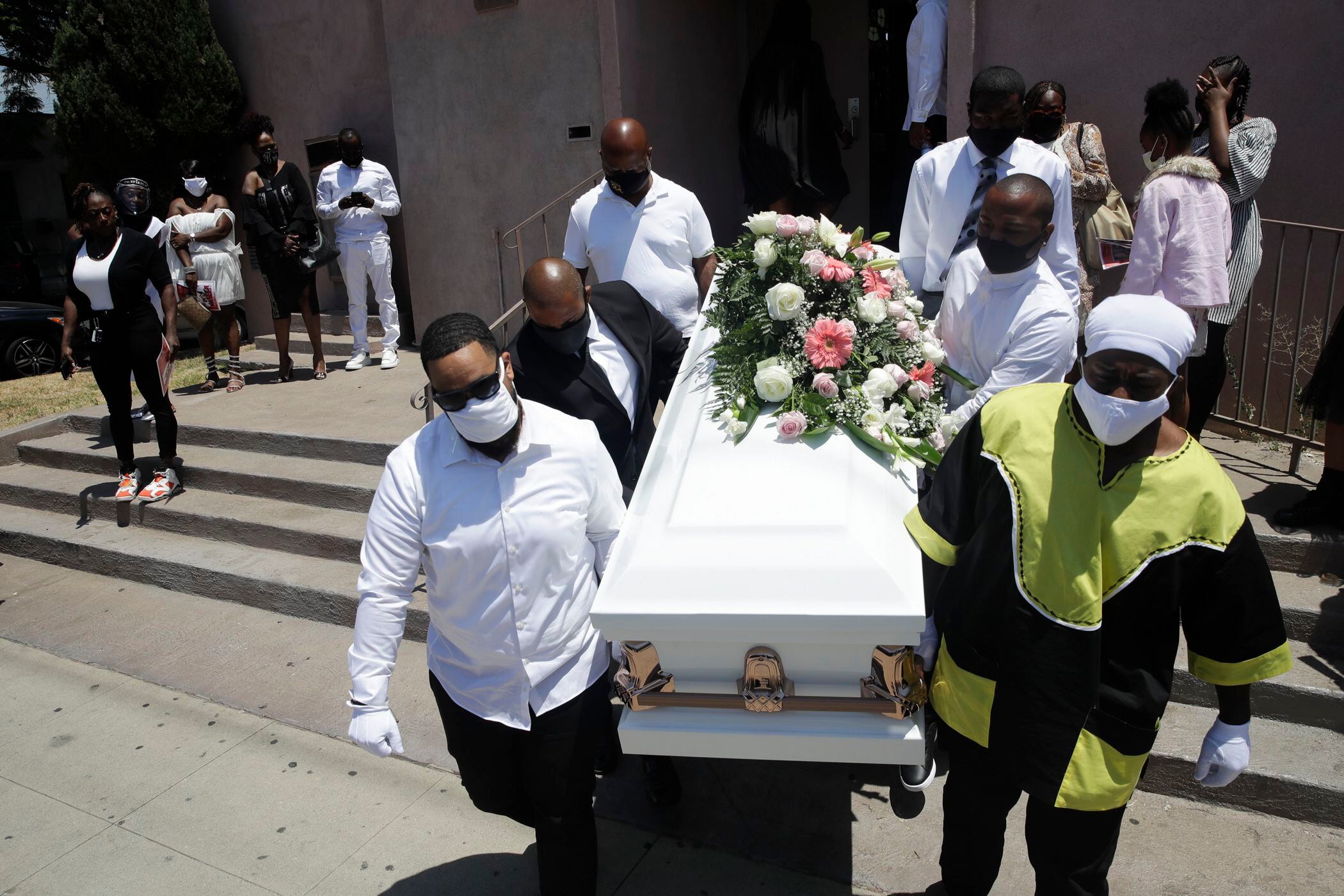
In this July 21, 2020, file photo, pall bearers carry a casket with the body of Lydia Nunez, who died from COVID-19, after a funeral service at the Metropolitan Baptist Church in Los Angeles. The U.S. death toll from the coronavirus has eclipsed 400,000 in the waning hours in office for President Donald Trump, whose handling of the crisis has been judged by public health experts to be a singular failure. (AP Photo/Marcio Jose Sanchez, File)
The U.S. death toll from the coronavirus eclipsed 400,000 on Tuesday in the waning hours in office for President Donald Trump, whose handling of the crisis has been judged by public health experts a singular failure.
The running total of lives lost, as compiled by Johns Hopkins University, is nearly equal to the number of Americans killed in World II. It is about the population of Tulsa, Oklahoma; Tampa, Florida; or New Orleans. It is equivalent to the sea of humanity that was at Woodstock in 1969.
It is just short of the estimated 409,000 Americans who died in 2019 of strokes, Alzheimer’s, diabetes, flu and pneumonia combined.
And the virus isn't finished with the U.S. by any means, even with the arrival of the vaccines that could finally vanquish the outbreak: A widely cited model by the University of Washington projects the death toll will reach nearly 567,000 by May 1.
While the Trump administration has been credited with Operation Warp Speed, the crash program to develop and distribute coronavirus vaccines, Trump has repeatedly downplayed the threat, mocked masks, railed against lockdowns, promoted unproven and unsafe treatments, undercut scientific experts and expressed scant compassion for the victims.
Even his own bout with COVID-19 seemed to leave him unchanged.
The White House defended the administration.
“We grieve every single life lost to this pandemic, and thanks to the president’s leadership, Operation Warp Speed has led to the development of multiple safe and effective vaccines in record time, something many said would never happen," said White House spokesman Judd Deere.
President-elect Joe Biden takes office on Wednesday.
The nation reached the 400,000 milestone in just under a year. The first known deaths from the virus in the U.S. were in early February 2020, both of them in Santa Clara County, California.
While the count is based on figures supplied by government agencies around the world, the real death toll is believed to be significantly higher, in part because of inadequate testing and cases inaccurately attributed to other causes early on.
It took four months to reach the first 100,000 dead. It took just over a month to go from 300,000 to 400,000.
Marvel's "Spiderman: No Way Home" is the third highest-grossing film of the year and could be the only one to reach the $1 billion mark of 2021 with ticket sales already surpassing $750 million.
Although still early in development, blockchain technology, Web3, also known as Web 3.0 has been getting a lot of attention from some top tech names lately. Web3 is based on blockchain technology, which powers NFT’s and cryptocurrencies such as bitcoin. With Web3, users would ideally control their own data, rather than have it be controlled by a few large companies. But, Tesla CEO Elon musk isn't buying into Web3 just yet, tweeting over the weekend that the decentralized iteration of the internet seems more like a marketing "buzzword" right now than reality. Twitter co-founder Jack Dorsey also chiming in to the conversation, expressing doubt over whether or not Web3 would actually be decentralized if ownership still belonged to venture capital firms. Parker McCurley, co-founder & CEO of Decent Labs explains the significance of Web3 catching the eye of the tech giants, and what Web3 could mean for the future of the internet.
Carlo and Baker cover the heartening news on the Covid front ahead of the holiday, plus President Biden punting student loan repayments again, a new space telescope and Love, Hate, Ate: Christmas Eve Eve Edition!
This year's worldwide semiconductor shortage limited the supply of everything from new cars to smartphones; and now, many in the chip industry expect the shortage to continue deep into 2022, and maybe even 2023. Semiconductor senior research analyst for Robert W. Baird & Co., Tristan Gerra, joins Cheddar News' Closing Bell to discuss.
Pavel Bains, the Executive Producer of MixMob and CEO of Bluzelle, joins Cheddar News' Closing Bell to elaborate on an opinion piece he wrote for CoinDesk in which he compares the cultural significance of crypto to hip hop in the 1990s.
Direct health care company Nomi Health recently raised $110 million in a Series A round. Nomi Health lets public and private organizations directly purchase healthcare at reduced costs, and pay providers in real-time. It also delivers healthcare directly to under-served communities via its fleet of mobile care units, which the company says is the largest in the country. Nomi Health says its mission is to improve the health care experience for all Americans. Nomi Health CEO Mark Newman joined Cheddar News' Closing Bell to discuss.
Darby Fox, child and adolescent family therapist, joins Cheddar News to discuss how parents can navigate their child's mental wellness during the holidays.
A new series is looking to advance Black founders who have disruptive ideas and companies. 'Bet on Black' is a new series that allows black entrepreneurs to pitch their businesses in the hopes of securing $200,000 in funding. Revolt TV and Target teamed up to create the show. Detavio Samuels, CEO of Revolt, joins Cheddar News to discuss.