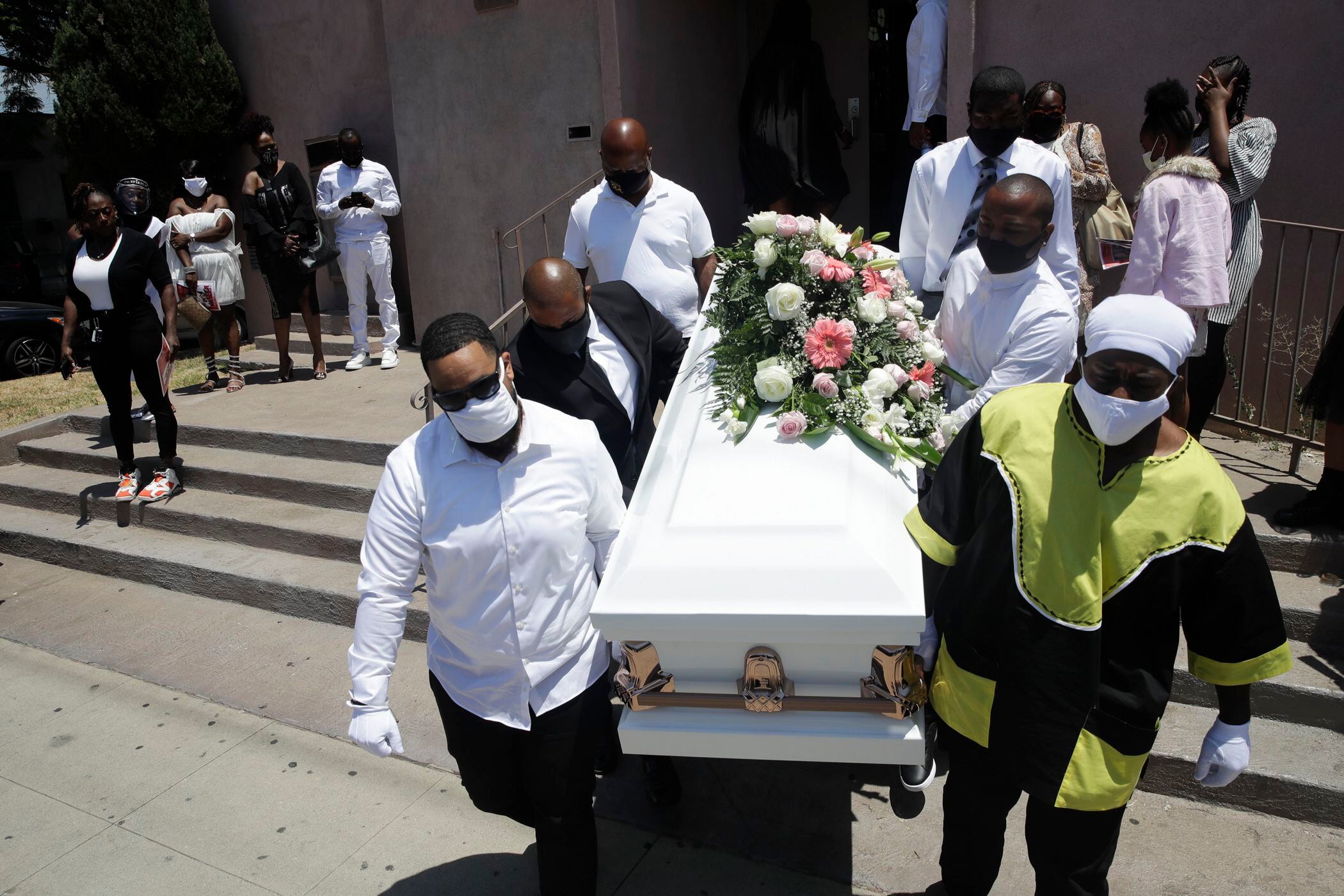
In this July 21, 2020, file photo, pall bearers carry a casket with the body of Lydia Nunez, who died from COVID-19, after a funeral service at the Metropolitan Baptist Church in Los Angeles. The U.S. death toll from the coronavirus has eclipsed 400,000 in the waning hours in office for President Donald Trump, whose handling of the crisis has been judged by public health experts to be a singular failure. (AP Photo/Marcio Jose Sanchez, File)
The U.S. death toll from the coronavirus eclipsed 400,000 on Tuesday in the waning hours in office for President Donald Trump, whose handling of the crisis has been judged by public health experts a singular failure.
The running total of lives lost, as compiled by Johns Hopkins University, is nearly equal to the number of Americans killed in World II. It is about the population of Tulsa, Oklahoma; Tampa, Florida; or New Orleans. It is equivalent to the sea of humanity that was at Woodstock in 1969.
It is just short of the estimated 409,000 Americans who died in 2019 of strokes, Alzheimer’s, diabetes, flu and pneumonia combined.
And the virus isn't finished with the U.S. by any means, even with the arrival of the vaccines that could finally vanquish the outbreak: A widely cited model by the University of Washington projects the death toll will reach nearly 567,000 by May 1.
While the Trump administration has been credited with Operation Warp Speed, the crash program to develop and distribute coronavirus vaccines, Trump has repeatedly downplayed the threat, mocked masks, railed against lockdowns, promoted unproven and unsafe treatments, undercut scientific experts and expressed scant compassion for the victims.
Even his own bout with COVID-19 seemed to leave him unchanged.
The White House defended the administration.
“We grieve every single life lost to this pandemic, and thanks to the president’s leadership, Operation Warp Speed has led to the development of multiple safe and effective vaccines in record time, something many said would never happen," said White House spokesman Judd Deere.
President-elect Joe Biden takes office on Wednesday.
The nation reached the 400,000 milestone in just under a year. The first known deaths from the virus in the U.S. were in early February 2020, both of them in Santa Clara County, California.
While the count is based on figures supplied by government agencies around the world, the real death toll is believed to be significantly higher, in part because of inadequate testing and cases inaccurately attributed to other causes early on.
It took four months to reach the first 100,000 dead. It took just over a month to go from 300,000 to 400,000.
Digital medical care provider Pear Therapeutics rang the closing bell on the Nasdaq Friday and President and CEO Dr. Corey McCann, joined Cheddar to talk about how the company plans to grow the business of software-based therapeutics and how the first FDA authorized prescription digital therapeutics company will go about treating illnesses like insomnia and addiction. "These really are pieces of software. In many cases, they're apps and in the cases of our addiction products, these are based on something called cognitive behavioral therapy or CBT," he said. "These products change the patient's brain circuitry to help them be abstinent, to help them stay in treatment, and that's exactly what we see in randomized clinical trials and that's what we see in the real world." He also addressed the ongoing mental health crises brought on by the pandemic. **copy updated to remove IPO information as Pear Therapeutics went public in December**
James Tattersall, director of sales and marketing for Lake Nona Wave Hotel, talks about the hotel's initiatives to foster diversity and how these amenities champion inclusivity in the Orlando area.
Ben Armstrong, founder of Bitboy Crypto, joins Cheddar News to discuss Bitcoin's downward trend and what's next for crypto after protests in Kazakhstan cause crypto miners to shut down.
Jake Carbone, senior data analyst at InfluenceMap joins Cheddar News to talk about a new report by The Guardian and InfluenceMap that reveals how companies are creating fossil fuel ads designed to look like Google search results.
Desmond Howard, former NFL wide receiver and Modelo college football playoff ambassador, joins Cheddar News to talk about the Modelo sweepstakes honoring the 30th anniversary of his iconic punt return.
The highly transmissible omicron variant of COVID-19 has forced school districts nationwide to return to virtual instruction, but there remain concerns about the quality of education students are receiving online. Andy Bird, CEO of Pearson, an education publisher and assessment service provider, joined Cheddar's "Opening Bell" to talk about steps educators and parents can take to make the remote learning experience an easier one, noting that one of the biggest advantages teachers can have is flexibility. "You cannot take a rigid timetable that works in the analog world and replicate that in the digital world. You need to have flexibility. Asynchronous learning, I think, is a very important part," he told Cheddar.
On this episode of ChedHER: Chief Product Officer at Mathison breaks down how she's building tech to advance diversity, equity, and inclusion in the workplace; Co-Founder and CEO of Carewell.com explains how her platform is easing the pressures that come with caregiving; Founder and CEO of Mentor Agility discusses what goals business owners should set in the new year.
Bianca Padilla, Co-Founder and CEO of Carewell.com, joins ChedHER to discuss how her platform is easing the pressures that come with caregiving, and how she's breaking barriers for women in venture capital.
Elizabeth Spenko, Chief Product Officer at Mathison, joins ChedHER to discuss how she's building tech to advance diversity, equity, and inclusion in the workplace, and an outlook on DEI in 2022.
Julie Elledge, Founder and CEO of Mentor Agility, joins ChedHER to discuss what goals business owners should set in the new year, and what tools are out there for emerging entrepreneurs.