By David Koenig
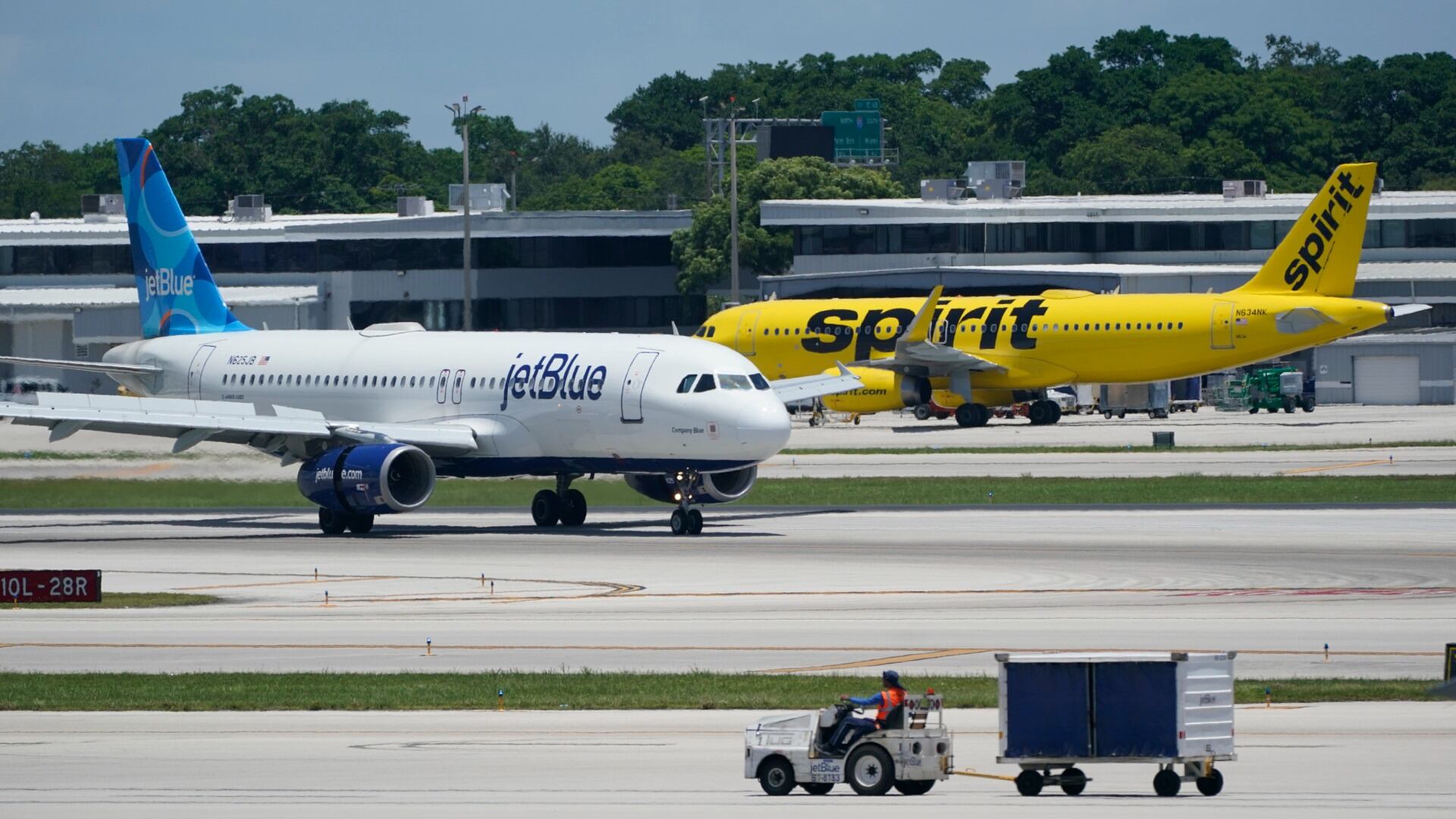
The Biden administration sued to block JetBlue Airways' $3.8 billion purchase of Spirit Airlines, saying Tuesday that the deal would reduce competition and drive up air fares for consumers.
The Justice Department said the tie-up would especially hurt cost-conscious travelers who depend on Spirit to find cheaper options to JetBlue and other airlines.
Attorney General Merrick Garland held a news conference to announce the antitrust lawsuit — a sign of the importance that the administration places on stopping further consolidation in the airline industry.
“If allowed to proceed, this merger will limit choices and drive up ticket prices for passengers across the country" and "eliminate Spirit's unique and disruptive role in the industry,” he said.
The Justice Department lawsuit, filed in federal district court in Boston, stressed that the deal would mean the end of the nation's biggest “ultra-low-cost carrier." Those are airlines that generally provide the cheapest fares but also tend to charge more fees.
The Justice Department lawyers said Spirit's demise would eliminate about half of all ultra-low-cost seats in the market. It cited a Spirit estimate that average fares fall 17% when it enters a route, and a JetBlue calculation that fares rise 30% when Spirit leaves a route.
The airlines vowed to continue fighting to salvage their agreement.
JetBlue CEO Robin Hayes said the merger would boost competition by making his New York-based airline bigger and better able to go up against American, United, Delta and Southwest. He blamed the DOJ for airline consolidation.
“We believe the DOJ has got it wrong on the law here and misses the point that this merger will create a national low-fare, high-quality competitor to the Big Four carriers which — thanks to their own DOJ-approved mergers — control about 80% of the U.S. market," Hayes said.
JetBlue and Florida-based Spirit have anticipated a legal challenge for weeks. The Justice Department had previously requested additional documents and depositions about JetBlue's proposal to buy Spirit, the nation’s biggest budget airline. Negotiations over a possible settlement failed.
As signals grew stronger that the government would challenge the tie-up, JetBlue launched a pre-emptive campaign to make its argument that the deal would help consumers by creating a stronger competitor to the four larger carriers.
Hayes said he was disappointed but not surprised at the lawsuit.
“We said when we got the offer approved by the Spirit shareholders last year that we didn’t think we would close until the first half of 2024, expecting a trial,” he said on “CBS Mornings.”
The lawsuit is the latest by the Biden administration to seek to block mergers in industries including health care, sugar refining, video gaming and publishing. It has already lost the health care and sugar battles.
“They don't seem to be afraid of losing cases. They're hoping that if they win some, that will set a precedent and help them deter other mergers that they view as anti-competitive," said Florian Ederer, an antitrust expert at Yale University. He thinks the government has a strong case against the JetBlue deal.
The Justice Department was under pressure from Democratic lawmakers and consumer advocates who complained about a wave of earlier mergers. In 2021, the administration took a more aggressive approach, suing to kill a limited partnership between JetBlue and American Airlines in the Northeast. A federal judge in Boston is expected to issue a ruling soon, after a non-jury trial last fall.
JetBlue and Spirit would control a little over 9% of the domestic air-travel market, far smaller than American, Delta, United and Southwest. JetBlue executives repeatedly said their deal was not like Pepsi buying Coca-Cola — a line that Hayes repeated Tuesday.
However, their concentration is much higher on certain routes in the East. The Justice Department lawsuit said the two account for nearly 50% of the traffic between Boston and Miami and Fort Lauderdale, and nearly 90% between Boston and San Juan, Puerto Rico.
The Justice Department sued to block the last megadeal, American’s 2013 merger with US Airways, then reached a settlement that required the carriers to give up some gates and takeoff and landing slots at several major airports. Before that, the government allowed Delta to buy Northwest, United to merge with Continental, and it later let Southwest buy AirTran.
Last year, JetBlue torpedoed a deal between Spirit and Frontier Airlines, then beat Frontier in a bidding war. Frontier CEO Barry Biffle argued that regulators would block a JetBlue-Spirit deal but not a tie-up with his airline, a similar discount carrier.
To counter Biffle's argument, JetBlue agreed to pay Spirit shareholders $400 million plus $70 million to the company if the merger dies for antitrust reasons.
The largest union for flight attendants, the Association of Flight Attendants, reiterated its support for the merger Tuesday, which it said would lift pay and benefits for Spirit crews that it represents.
But the American Economic Liberties Project, which opposes corporate consolidation, praised the Justice Department for seeking to block the deal, saying it would let JetBlue “gobble up a low-cost competitor” and boost prices.
New York, Massachusetts and the District of Columbia joined the federal lawsuit. Florida dropped its review of the merger after the airlines agreed to expand in Fort Lauderdale, Orlando and other airports in the state.
UPDATES: adds comment by antitrust expert; other minor edits.