By Francisco Ubilla, Aritz Parra, and Michael Balsamo
The U.S. government on Monday seized a 254-foot yacht in Spain owned by an oligarch with close ties to Russian President Vladimir Putin, a first by the Biden administration under sanctions imposed after the Kremlin's invasion of Ukraine and targeting pricey assets of Russian elites.
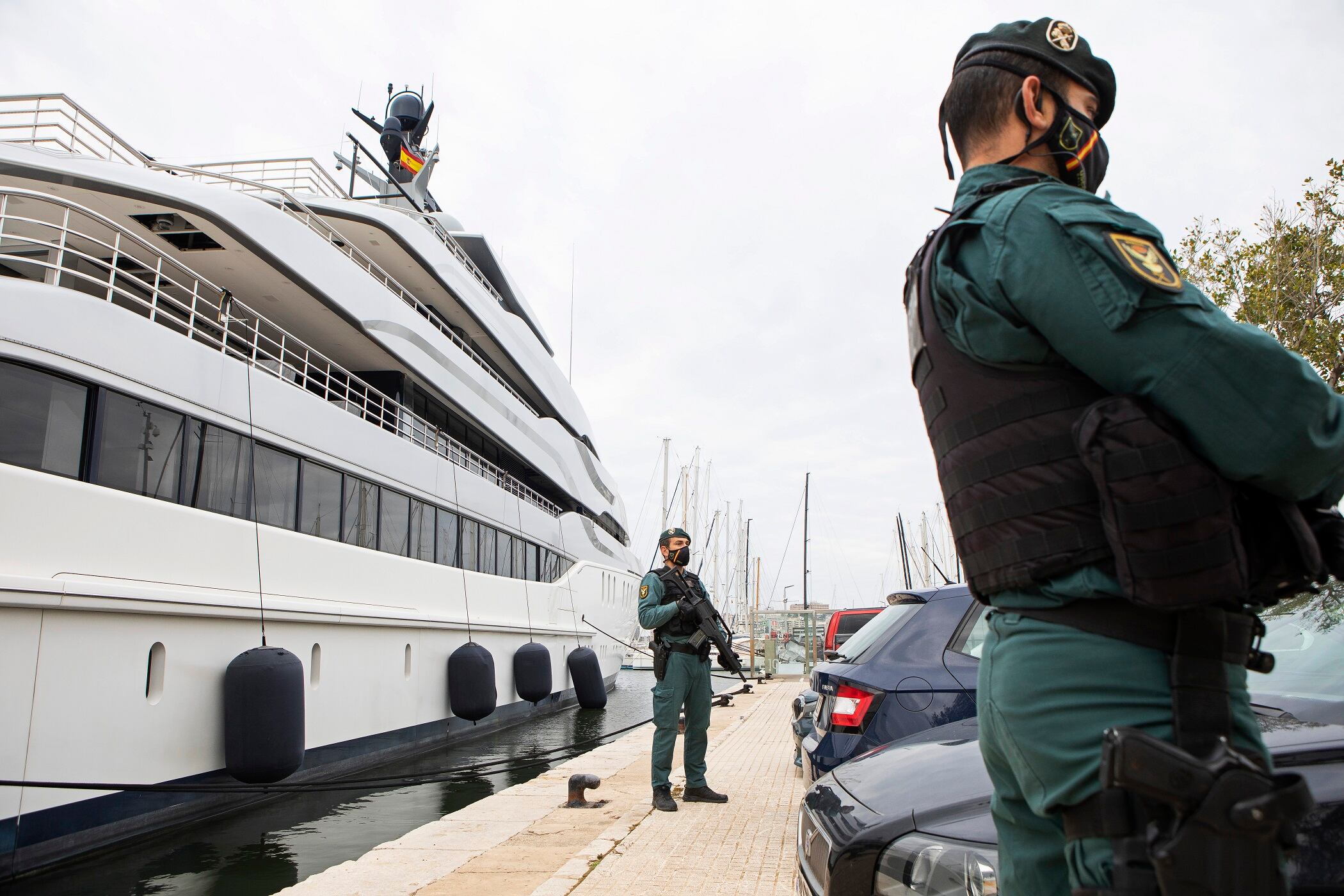
Spain's Civil Guard and U.S. federal agents descended on the Tango at the Marina Real in the port of Palma de Mallorca, the capital of Spain’s Balearic Islands in the Mediterranean Sea. Associated Press reporters at the scene saw police going in and out of the boat.
The U.S. Justice Department, which obtained a warrant from a federal judge in Washington, alleges the yacht should be forfeited for violating U.S. bank fraud, money laundering and sanctions statutes.
Superyachtfan.com, a specialized website that tracks the world’s largest and most exclusive recreational boats, values the 78-meter vessel, which carries the Cook Islands flag, at $120 million.
The yacht is among the assets linked to Viktor Vekselberg, a billionaire and close Putin ally who heads the Moscow-based Renova Group, a conglomerate encompassing metals, mining, tech and other assets, according to U.S. Treasury Department documents.
All of Vekselberg’s assets in the United States are frozen and American companies are barred from doing business with him and his entities. The Ukrainian-born businessman built his fortune by investing in the aluminum and oil industries in the post-Soviet era.
Prosecutors allege Vekselberg bought the Tango in 2011 and has owned it since then, though they believe he has used shell companies to try to obfuscate his ownership and to avoid financial oversight.
They contend Vekselberg and those working for him continued to make payments using U.S. banks to support and maintain the yacht, even after sanctions were imposed on him in 2018. Those payments included a stay in December 2020 at a luxury water villa resort in the Maldives and fees to moor the yacht.
It's the first U.S. seizure of an oligarch’s yacht since U.S. Attorney General Merrick Garland and U.S. Treasury Secretary Janet Yellen assembled a task force known as REPO — short for Russian Elites, Proxies and Oligarchs — as an effort to enforce sanctions after Russia invaded Ukraine in late February.
"It will not be the last.” Garland said in a statement. “Together, with our international partners, we will do everything possible to hold accountable any individual whose criminal acts enable the Russian government to continue its unjust war.”
Vekselberg has long had ties to the U.S., including a green card he once held and homes in New York and Connecticut. He was also questioned in special counsel Robert Mueller's investigation into Russian interference in the 2016 U.S. presidential election and has worked closely with his American cousin, Andrew Intrater, who heads the New York investment management firm Columbus Nova.
Vekselberg and Intrater were thrust into the spotlight in that investigation after the lawyer for adult film star Stormy Daniels released a memo that claimed $500,000 in hush money was routed through Columbus Nova to a shell company set up by Donald Trump's personal attorney, Michael Cohen. Columbus Nova denied that Vekselberg played any role in its payments to Cohen.
Vekselberg and Intrater met with Cohen at Trump Tower, one of several meetings between members of Trump's inner circle and high-level Russians during Trump's 2016 campaign and the transition before his presidency.
The 64-year-old Vekselberg founded Renova Group more than three decades ago. The group holds the largest stake in United Co. Rusal, Russia’s biggest aluminum producer, among other investments.
Vekselberg was first sanctioned by the U.S. in 2018, and again in March of this year, shortly after the invasion of Ukraine began. Vekselberg has also been sanctioned by authorities in the United Kingdom.
The yacht sails under the Cook Islands flag and is owned by a company registered in the British Virgin Islands administered by different societies in Panama, the Civil Guard said, “following a complicated financial and societal web to conceal its truthful ownership.”
Agents confiscated documents and computers inside the yacht that will be analyzed to confirm he real identity of the owner, it said.
The U.S. Justice Department has also launched a sanctions enforcement task force known as KleptoCapture, which also aims to enforce financial restrictions in the U.S. imposed on Russia and its billionaires, working with the FBI, the U.S. Treasury and other federal agencies. That task force will also target financial institutions and entities that have helped oligarchs move money to dodge sanctions.
The White House has said that many allied countries, including German, the United Kingdom, France, Italy and others are involved in trying to collect and share information against Russians targeted for sanctions. In his State of the Union address on March 1, President Joe Biden warned oligarchs that the U.S. and European allies would “find and seize your yachts, your luxury apartments, your private jets.”
“We are coming for your ill-begotten gains,” he said.
Monday's capture is not the first time Spanish authorities have been involved in the seizure of a Russian oligarch’s superyacht. Officials said they had seized a vessel valued at over $140 million owned by the CEO of a state-owned defense conglomerate and a close Putin ally.
French authorities have seized superyachts, including one believed to belong to Igor Sechin, a Putin ally who runs Russian oil giant Rosneft, which has been on the U.S. sanctions list since Russia annexed Crimea in 2014.
Italy has seized several yachts and other assets.
Italian financial police moved quickly seizing the superyacht Lena belonging to Gennady Timchenko, an oligarch close to Putin, in the port of San Remo; the 65-meter (215-foot) Lady M owned by Alexei Mordashov in nearby Imperia, featuring six suites and estimated to be worth 65 million euros; as well as villas in Tuscany and Como, according to government officials.
___
Parra reported from Madrid and Balsamo reported from Washington.