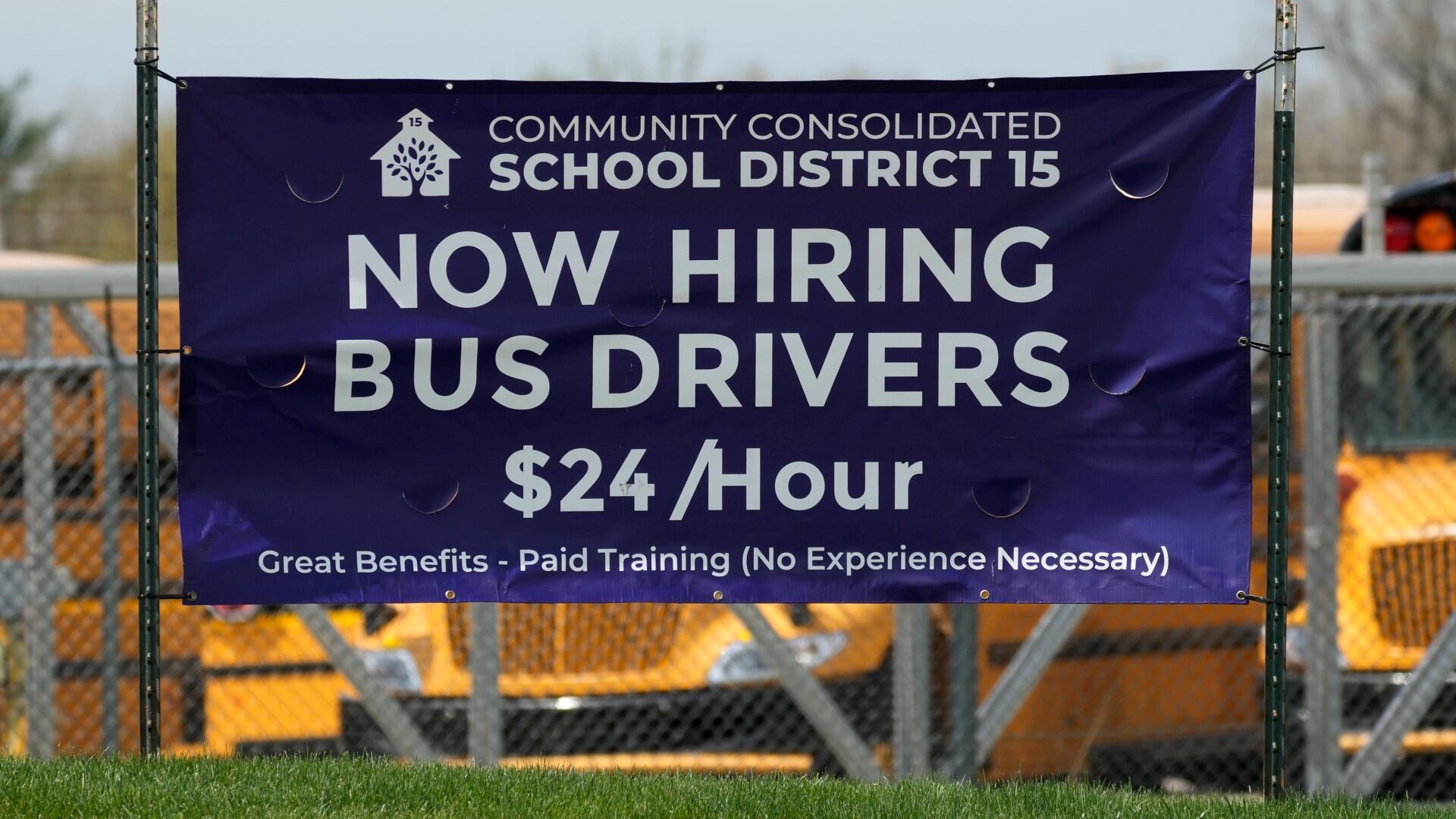
A hiring sign seeking bus drivers is posted in Palatine, Ill., Wednesday, April 19, 2023. On Tuesday, the Labor Department reports on job openings and labor turnover for March.(AP Photo/Nam Y. Huh)
By Paul Wiseman
U.S. job openings fell in March to the lowest level in nearly two years, a sign that the American labor market is cooling in the face of higher interest rates.
Employers posted 9.6 million vacancies in March, down from nearly 10 million in February and lowest since April 2021. The Labor Department's Job Openings and Labor Turnover Summary, out Tuesday, showed that layoffs rose to 1.8 million, the highest level since December 2020.
The number of Americans quitting their jobs — a sign they have confidence they can find better pay or working conditions elsewhere — dropped to 3.9 million, lowest since May 2021.
The American job market is strong but losing momentum. The Federal Reserve has raised its benchmark interest rate nine times in just over a year in a bid to rein in inflation that last year hit a four-decade high. And higher borrowing costs are taking an economic toll.
A hot job market can push up wages — and overall prices.
“Overall the JOLTS report shows a historically tight labor market that is finally starting to slacken more quickly, something Fed officials have been seeking for several quarters,''' Contingent Macro Advisors said in a research note.
The job market is cooling but remains strong by historic standards. Monthly job openings had never exceeded 10 million until 2021, then reeled off 20 straight months above that threshold. The streak ended in February.
The Labor Department on Friday releases the jobs report for last month. Forecasters surveyed by the data firm FactSet expect that employers added fewer than 182,000 jobs in April, which would be the third straight monthly drop since payrolls rose by a robust 472,000 in January.
The unemployment rate is expected to blip up to 3.6% in April, a couple of notches above January's half-century low 3.4%
Lab-created diamonds come with sparkling claims: that they are ethically made by machines running on renewable energy. But many don't live up to these claims or don't respond to questions about their electricity sources, and lab diamonds require a lot of electricity.
Geoff Freeman, president and CEO of the U.S. Travel association, explains why other nations are outcompeting the U.S., and the innovations that would put American back on top.
Tony Drake, founder of Drake & Associates, breaks down the latest CPI report, why ‘inflation is still trending down,’ and why the Fed doesn’t want to cut rates too soon.
Make sure your love don't cost a thing this Valentine's Day to any scammers. Note: we're not talking about your partner that didn't do the dishes after saying they would.
Landing founder and CEO Bill Smith shares how the company’s new Nomad pass and partnership with Frontier Airlines allows subscribers unlimited airfare and accommodations.
The pandemic yielded government financial support and (eventually) a surprisingly strong job market — but racial wealth disparities grew. Why is it so difficult to close the wealth gap?
Plenty of retailers and suppliers are reducing the variety of their offerings to focus instead on what they think will sell best. Many businesses have decided less is better, justifying their limited selection by asserting shoppers don’t want so much choice.
Joe Pompliano, author of the Huddle Up newsletter, breaks down the biggest moments from Super Bowl LVIII, from potentially record-breaking viewership to Taylor Swift’s highly anticipated appearance.