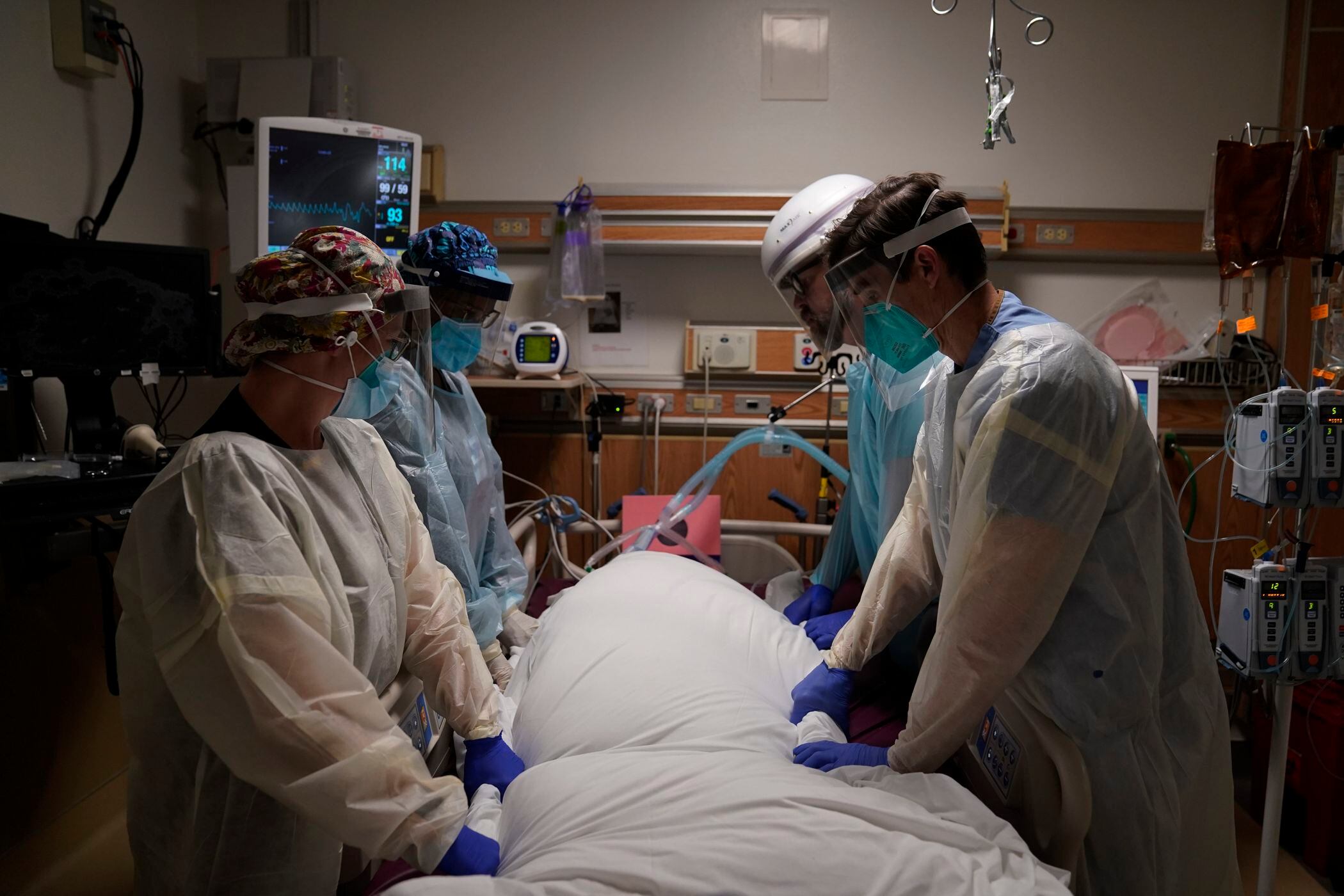
In this Dec. 22, 2020, file photo, medical workers prepare to manually prone a COVID-19 patient in an intensive care unit at Providence Holy Cross Medical Center in the Mission Hills section of Los Angeles. The U.S. registered its highest deaths yet from the coronavirus on the same day as a mob attack on the nation’s capitol laid bare some of the same, deep political divisions that have hampered the battle against the pandemic. (AP Photo/Jae C. Hong, File)
By Carla K. Johnson and Lisa Marie Pane
The U.S. registered more COVID-19 deaths in a single day than ever before — nearly 3,900 — on the very day the mob attack on the Capitol laid bare some of the same, deep political divisions that have hampered the battle against the pandemic.
The virus is surging in several states, with California hit particularly hard, reporting on Thursday a record two-day total of 1,042 coronavirus deaths. Skyrocketing caseloads there are threatening to force hospitals to ration care and essentially decide who lives and who dies.
“Folks are gasping for breath. Folks look like they’re drowning when they are in bed right in front of us,” said Dr. Jeffrey Chien, an emergency room physician at Santa Clara Valley Regional Medical Center, urging people to do their part to help slow the spread. “I’m begging everyone to help us out because we aren’t the front line. We’re the last line.”
Meanwhile, the number of Americans who have gotten their first shot of the COVID-19 vaccine climbed to at least 5.9 million Thursday, a one-day gain of about 600,000, according to the Centers for Disease Control and Prevention. Hundreds of millions will need to be vaccinated to stop the coronavirus.
About 1.9 million people around the world have died of the virus, more than 360,000 in the U.S. alone. December was by far the nation's deadliest month yet, and health experts are warning that January could be more terrible still because of family gatherings and travel over the holidays.
A new, more contagious variant is spreading around the globe and in the U.S. Also, it remains to be seen what effect the thousands of supporters of President Donald Trump who converged this week in Washington, many of them without masks, will have on the spread of the scourge.
Trump has long downplayed the virus and scorned masks, and many of his ardent supporters have followed his example. He has also raged against lockdowns and egged on protesters objecting to restrictions in states such as Michigan, where armed supporters invaded the statehouse last spring.
On Wednesday, the day a horde of protesters breached the U.S. Capitol, disrupting efforts to certify the election of Joe Biden, the U.S. recorded 3,865 virus deaths, according to Johns Hopkins University. The numbers can fluctuate dramatically after holidays and weekends, and the figure is subject to revision.
“The domestic terrorists overran the Capitol police, just as the virus has been allowed to overrun Americans,” said Dr. Eric Topol, head of the Scripps Research Translational Institute. “The U.S. lost control of a Trump-incited mob and a Trump-played-down pandemic virus.”
Some of the forces contributing to the eruption of violence were partially foreseen by experts in global disease planning when they held a tabletop exercise in 2019, said Dr. Eric Toner, a senior scholar at the Johns Hopkins Center for Health Security who directed the drill.
“We did consider the possibility of active disinformation and using a pandemic for political gain,” Toner said. “Real life turned out to be much worse.”
In California, health authorities Thursday reported 583 new deaths, a day after 459 people died. The overall death toll there stands at more than 28,000. The state also registered more than a quarter-million new weekly cases, and only Arizona tops California in cases per resident. Florida broke its record for the highest single-day number of cases with over 19,800, while its death toll reached 22,400.
Los Angeles County, the nation’s most populous with 10 million residents, and nearly two dozen other counties have essentially run out of intensive care unit beds for COVID-19 patients.
“This is a health crisis of epic proportions,” said Barbara Ferrer, public health director for Los Angeles County.
Guidelines posted on the website for Methodist Hospital of Southern California warned: “If a patient becomes extremely ill and very unlikely to survive their illness (even with life-saving treatment), then certain resources ... may be allocated to another patient who is more likely to survive.”
___
Associated Press writers Olga Rodriguez in San Francisco and Tamara Lush in Tampa, Florida, contributed to this report.
Members of Congress have voted to advance a bill meant to address antitrust concerns related to tech giants including Amazon, Apple, Google, and Meta. The 'American Innovation and Choice Online Act' is largely seen as one of the best chances for the government to reign in Big Tech's dominance
Seth Schachner, Managing Director StratAmericas; Digital Business Executive joined Cheddar's Opening Bell to discuss.
American semiconductor company, Intel officially announcing plans to build a new $20 billion chip manufacturing complex outside Columbus, Ohio. This comes as the global chip shortage continues to hamper production of everything from smart phones, to cars. Jennifer Smith - Logistics and Supply Chain Reporter, WSJ joined Cheddar's Opening Bell to discuss.
The U.S. has put more than 8,000 American troops on high alert for possible deployment to Eastern Europe as the West prepares for a potential Russian invasion of Ukraine. With Russia building up more than 100,000 troops near the Ukrainian border, concerns over the country's behavior are mounting. Joel Rubin, Former Deputy Assistant Secretary of State and President of the Washington Strategy Group, joined Cheddar to discuss what this means for U.S.-Russia relations, and where the conflict might be heading next.
As the midterm election looms, things aren't looking too promising for President Joe Biden. One year into his term as president, Biden is facing one of the lowest approval ratings of any modern-day president, threatening his party's control of the House in 2022. Brian Bennett, Senior White House Correspondent for TIME, joined Cheddar's Opening Bell to discuss.
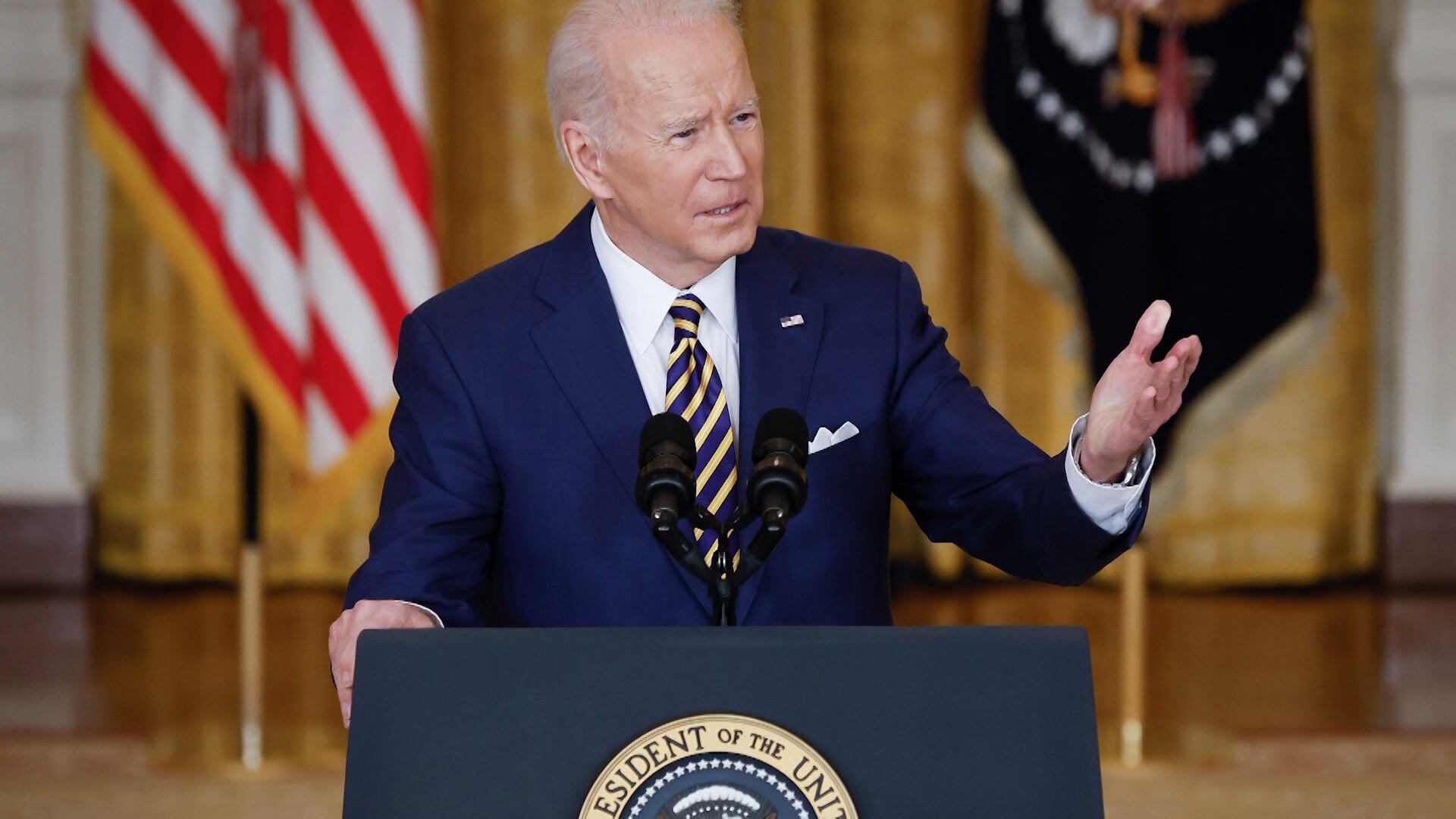
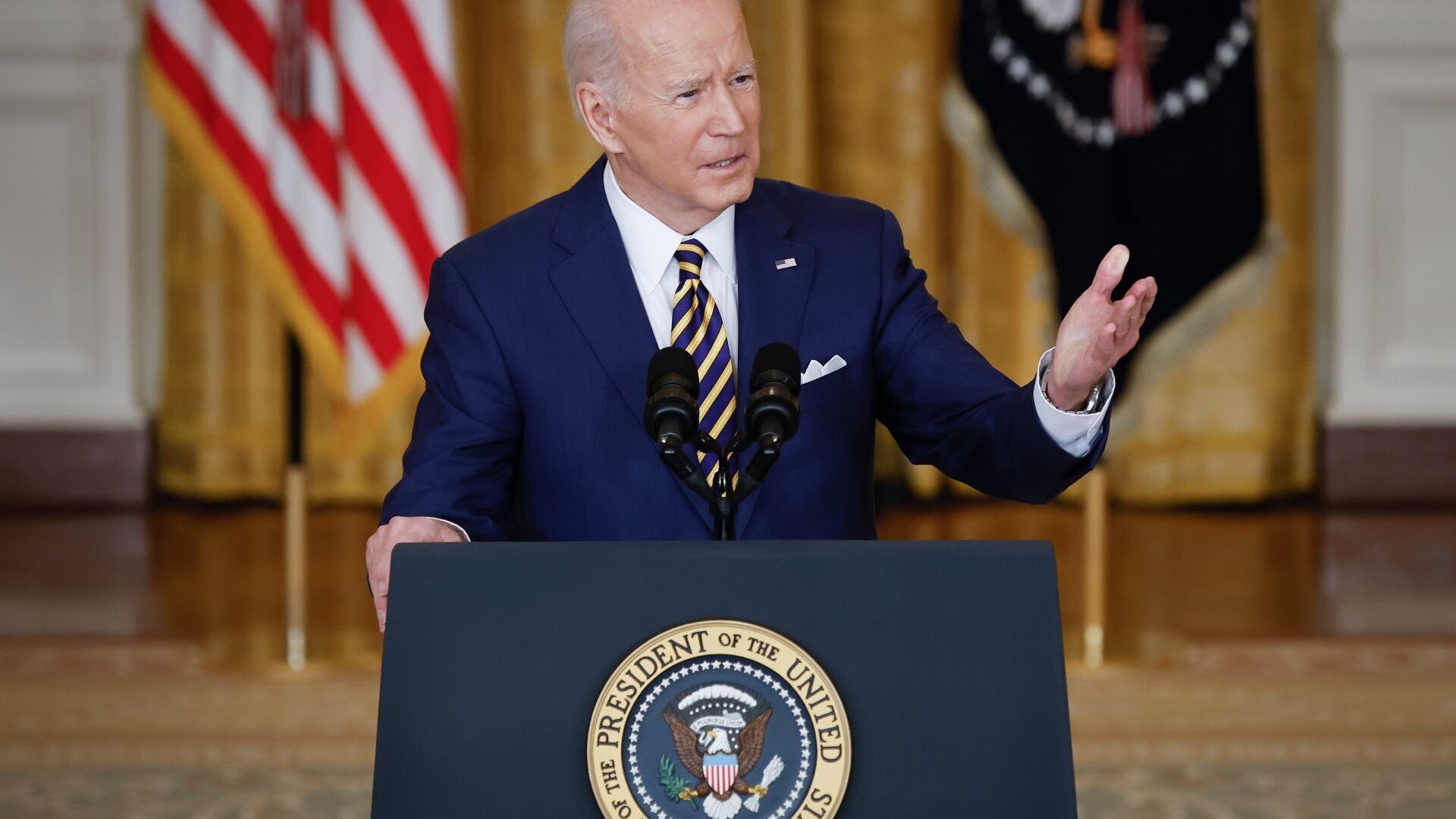
A full one year into his term as President of The United States, President Biden addressed the nation on Wednesday, facing questions on everything from inflation to chip shortages and covid-19. As Biden enters his second year in office, he is facing one of the lowest approval ratings of any modern-day president. Kate Davidson, Reporter, POLITICO joined Cheddar's Opening Bell to discuss.
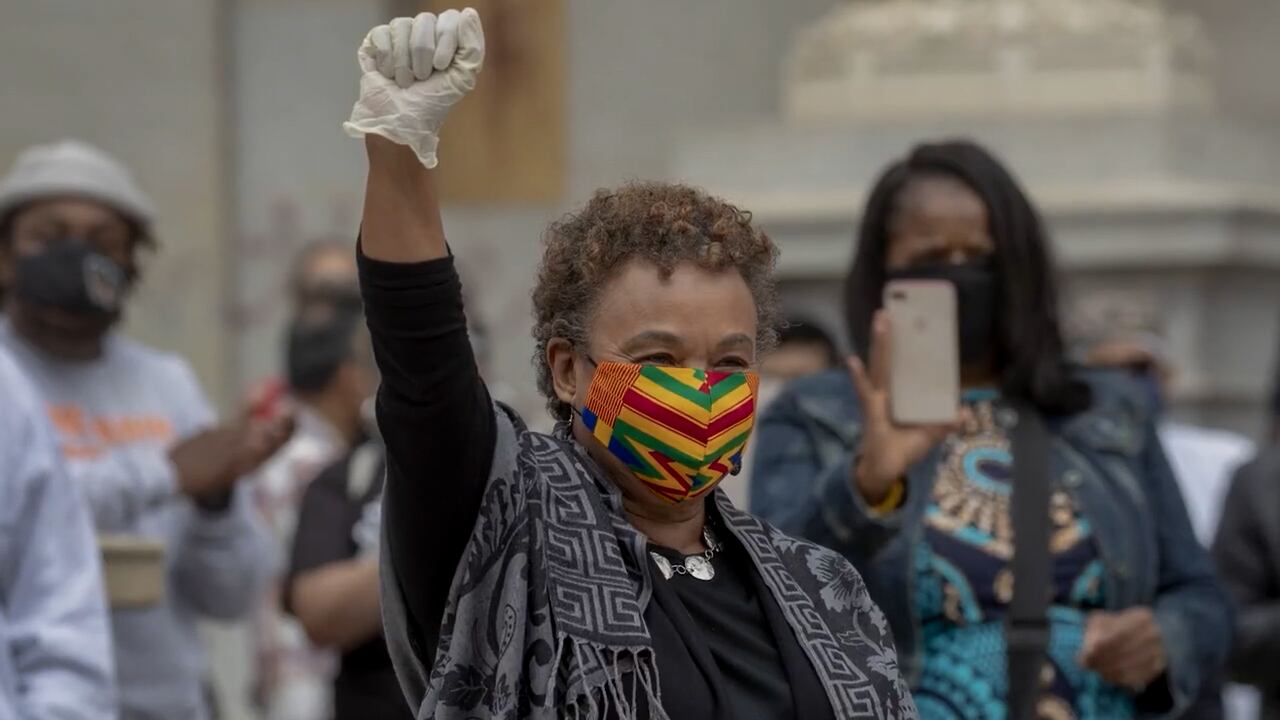
"Barbara Lee: Speaking Truth to Power" is the story of how the longtime House Democrat became, as she Is known to some, as "the Conscience of Congress." The film also
shows Representative Lee from her days working to fight community poverty to famously becoming the only member of Congress to vote "no" against the war in Afghanistan days after 9/11. The film is nominated for an NAACP Image Award, and Premieres on Starz on February 1. Film director Abby Ginzberg and Rep. Barbara Lee (D-Calif. 13th District), joined Cheddar to discuss more.
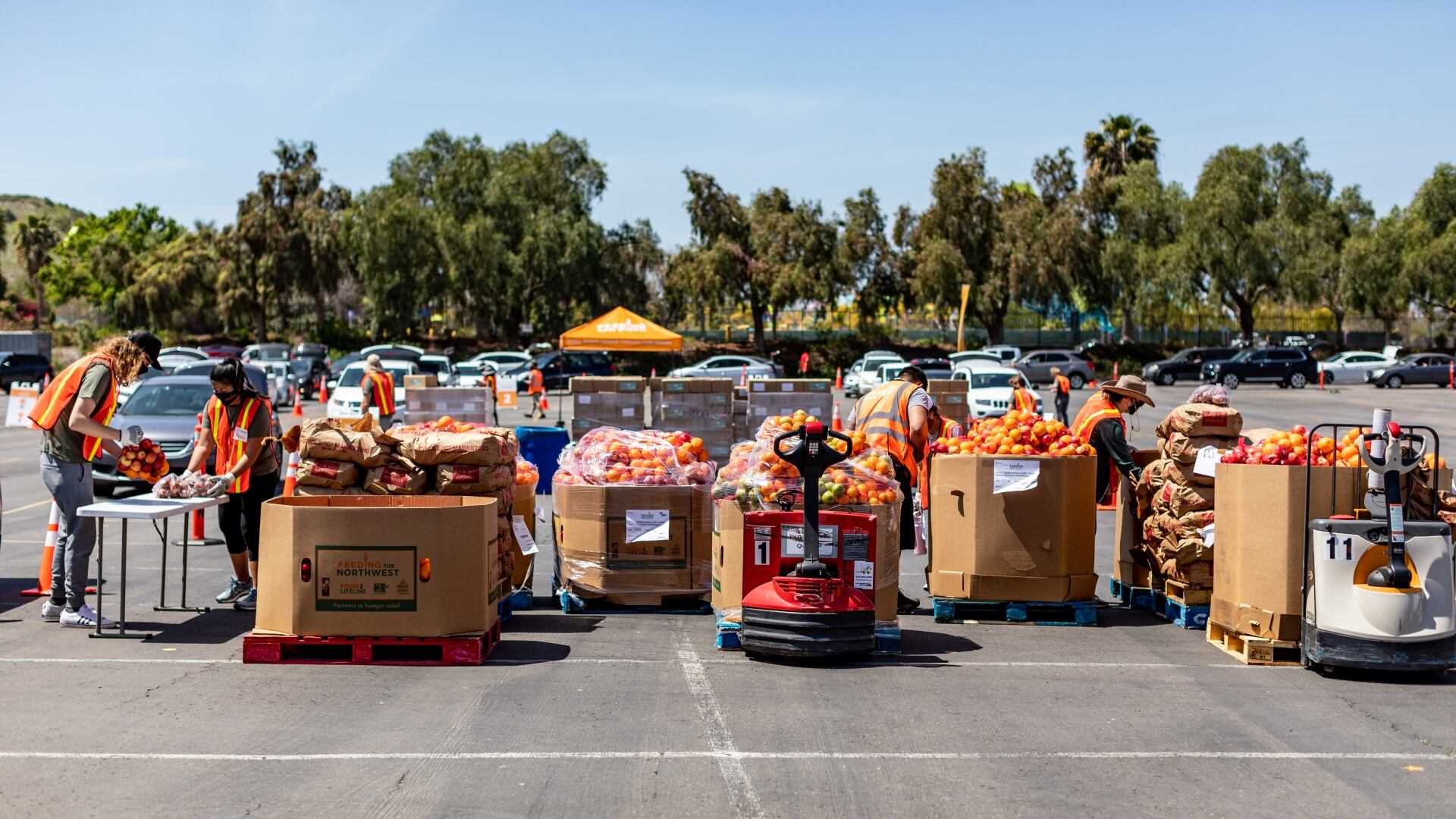
San Diego has just implemented a new law that could set the stage for how the country deals with food waste. This new law hopes to make a dent in that. Businesses and groceries stores out in San Diego will need to put a plan in place to *donate edible food rather than toss it straight to the trash. Food Rescue Manager at Feeding San Diego, Kate Garret
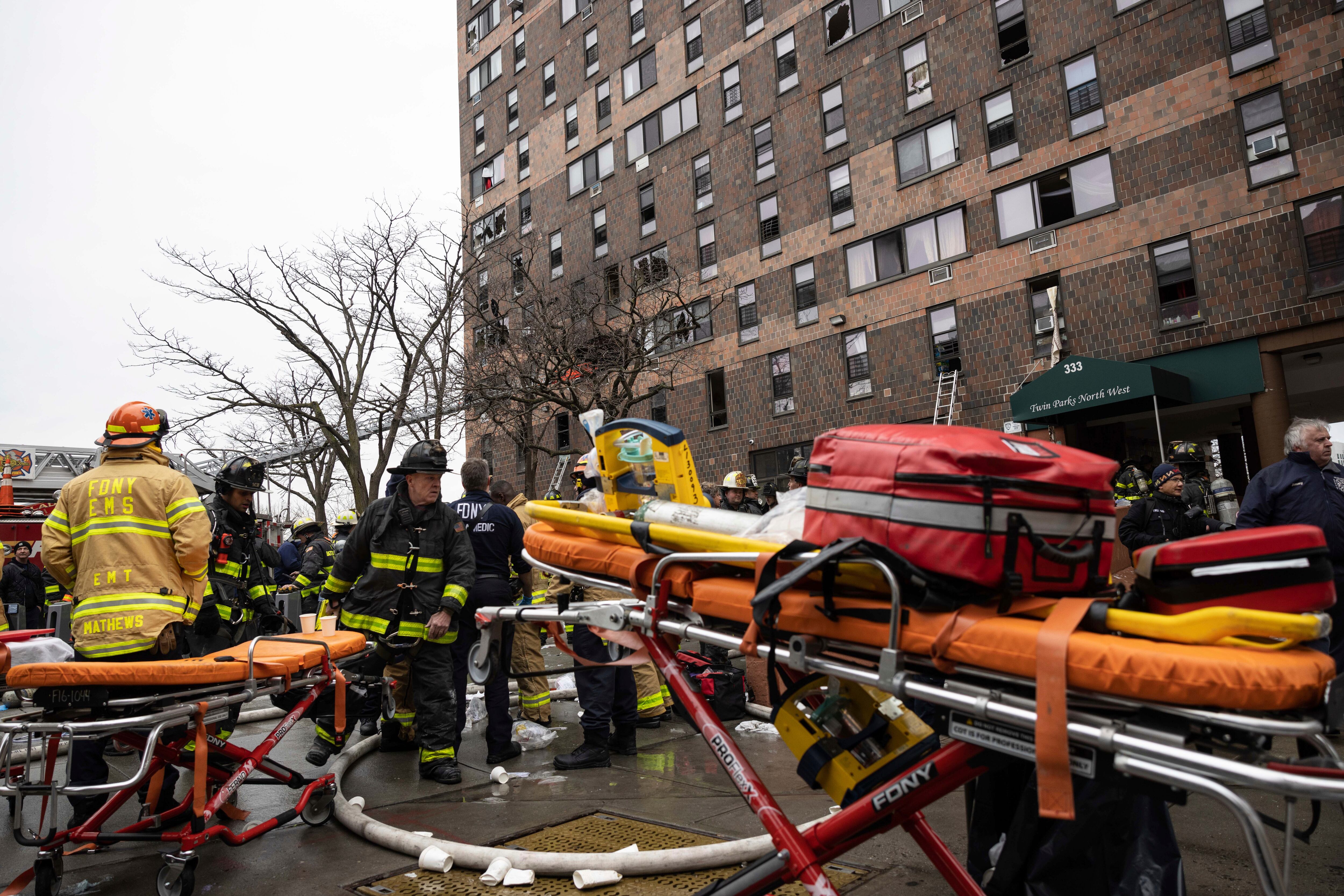
Earlier this month, New York City experienced one of the deadliest fires it has seen in decades. 17 people lost their lives in the Fordham section of the Bronx. This was due to a faulty space heater which reportedly began on the lower floor of the 120 unit building. Thanks to the F. D. N. Y. And heroic neighbors, many were able to get out in time. Unfortunately, the toxic smoke surged upwards through a safety door. Now, many advocates say negligence by policymakers and landlords has led to the deaths in black and brown communities from fires that honestly could have been preventable. Legislative Director of Citizen Action of New York, Rebecca Garrard, and the Chair of Journalism and New Media Studies at St. Joseph's College Theodore Hamm, joined Cheddar to discuss more.
The Supreme Court has declined to order the Texas Abortion case back to the original trial judge for further proceedings. Essentially if Texas abortion providers were able to get their case back to the lower court., It would have greatly helped the group move against the law. However, this decision is likely to prolong the case legal battle. Professor and Author of "The Turnaway Study: Ten Years, a Thousand Women, and the Consequences of Having — Or Being Denied — An Abortion", Diane Foster, joined Cheddar to discuss more.
The Supreme Court rejected yet another bid by abortion providers to block Texas's law - which bans most abortions after six weeks of pregnancy. This is the fourth time that advocates have tried and failed to block the most restrictive abortion ban in the country. Leah Litman, assistant professor of law at The University of Michigan and co-host of the "Strict Scrutiny" podcast, joins Cheddar News to discuss.