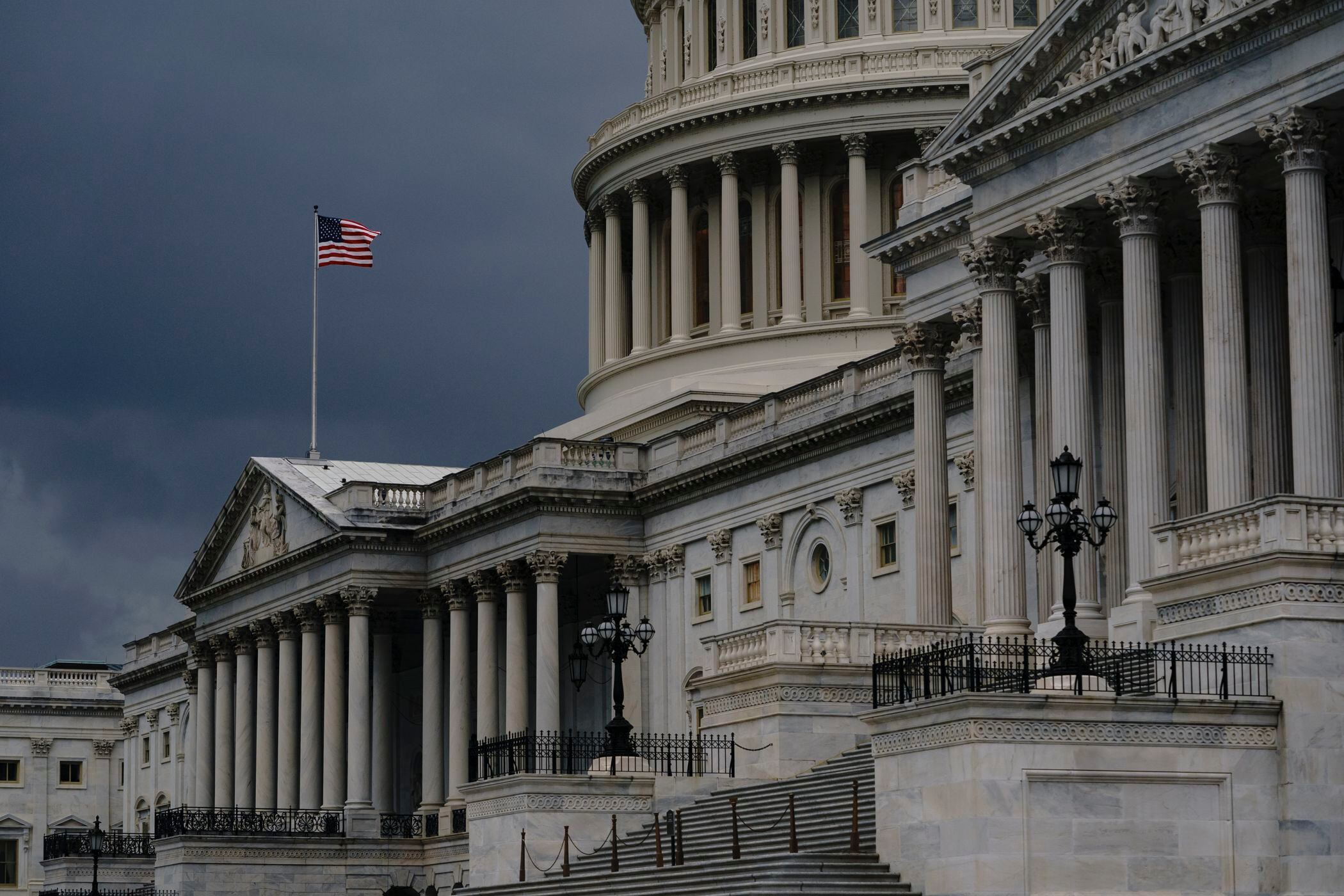
In this Aug. 3, 2020, file photo dark clouds and heavy rain sweep over the U.S. Capitol in Washington. The U.S. government's budget deficit surged to an all-time high of $1.7 trillion for the first six months of this budget year, nearly double the previous record, as another round of economic-support checks added billions of dollars to spending last month. (AP Photo/J. Scott Applewhite, File)
By Martin Crutsinger
The U.S. government's budget deficit surged to an all-time high of $1.7 trillion for the first six months of this budget year, nearly double the previous record, as another round of economic-support checks added billions of dollars to spending last month.
In its monthly budget report, the Treasury Department said Monday that the deficit for the first half of the budget year — from October through March — was up from a shortfall of $743.5 billion in the same period a year ago.
The deficit has been driven higher by trillions of dollars in support Congress has passed in successive economic rescue packages since the pandemic struck in early March 2020. The latest round came in a $1.9 trillion measure that President Joe Biden pushed through Congress last month.
Biden's package included individual support payments of up to $1,400 and the administration rushed to make those payments as soon as the president signed the measure into law. The Treasury Department statement showed that the payments in March totaled $339 billion.
The budget report showed that the deficit for just March totaled $659.6 billion, the third-highest monthly deficit. For the six-month period, the $1.7 trillion deficit total surpassed the previous record of an $829 billion deficit run-up for the six months ending in March 2011. That was a period when the government was spending to deal with the economic damage from the recession caused by the 2008 financial crisis.
Last year's deficit, for the budget year that ended Sept. 30, totaled a record $3.1 trillion. The Congressional Budget Office estimated in February that this fiscal year's deficit would total $2.3 trillion. But that estimate did not include the cost of Biden's $1.9 trillion rescue plan that Congress passed in March or the impact of the administration's “Build Back Better” infrastructure proposal that Congress is considering now.
Nancy Vanden Houten, senior economist at Oxford Economics, said she expects the deficit for this budget year will total $3.3 trillion, an all-time high but up just 6.5% from last year's record shortfall of $3.1 trillion.
Analysts said the deficit's surge in the first six months of the fiscal year reflected that the first half of the 2020 budget year was mostly unaffected by the pandemic. The loss of revenue from millions of jobs lost and the big-spending measures Congress passed to deal with the pandemic-triggered recession occurred in the second half of the 2020 budget year.
Vanden Houten said that, while she expects Congress will pass some version of Biden's $2 trillion infrastructure bill, the budget impact will not occur until the start of the next fiscal year.
For the first six months of the current budget year, Treasury said revenues totaled $1.7 trillion, a drop of 5.5% from the same period last year. Spending was $3.4 trillion, up 45.3%.
Biden's rescue program passed without Republican support, unlike the previous packages passed during the Trump administration, which were backed by both Republican and Democratic lawmakers.
Republicans contend that new spending is not needed in light of rising deficits and increased signs that the economy is starting to rebound.
The Treasury report Monday showed that through the first six months of the current budget year, interest payments on the debt total $229 billion, $41 billion below the same period a year ago. That reflects lower interest rates on the rising level of debt.
With contradictory reports about Russian troops pulling back or being added to the border with Ukraine and the expulsion of a U.S. diplomat from Russia, tensions in the region appear to be escalating. Jack Detsch, a Pentagon and national security reporter for Foreign Policy, joined Cheddar News to break down the situation. "Certainly a different tone out of Moscow today and a different tone out of the West. Even as the Kremlin has made the case that troops are moving back, the U.S. is saying that is certainly not the case with the satellite imagery that we have pouring in," he said.
New York City's famous subway system is currently facing scrutiny after several recent attacks on platforms. Now, local leaders in the Big Apple are calling on the MTA. To step in and take action.
Tensions in Ukraine continue to rise. According to NATO and U.S. officials, Russian troops are still being built up despite Moscow's claims of de-escalation. However, Ukraine does not believe the troops are enough to mount an invasion. The government in Kyiv has also reported several cyber attacks against its defense agencies and banks which is the largest attack in the country's history. Foreign Affairs Reporter based in Ukrain, Terrell Starr, joined Cheddar to discuss more
A Senate bill unveiled on Wednesday looks to tackleonline safety for children by regulating Big Tech and social media platforms to deter users from content that can harm their mental health. Irene Ly, a policy counsel for the age-based ratings and review organization Common Sense Media, joined Cheddar News to break down the potential of the Kids Online Safety Act. "We can't be imposing such a big burden on parents to be doing it all on theirselves," Ly said. "I think you also have to keep in mind that parents often didn't grow up with social media, so they don't understand what it's like to be addicted to social media or really understand how they work."
The Federal Reserve minutes from its January meeting are indicating it's sticking to an interest rate hike in March, but what does the report coupled with ongoing inflation mean for investors going forward? Scott Brown, a market strategist at LPL Financial, joined Cheddar News to break down the minutes and talk about how investors might navigate the rest of the year. "it seems like the market is kind of inclined to trade off these headlines, really, through the first half of the year," he said. "And then, oh, don't forget, we've got midterm elections, which always tend to add a little bit of volatility in the second half of the year." Brown noted that the path forward for stock investors in 2022 would be "rockier" than last year.
Senators Richard Blumenthal (D-Conn.) and Marsha Blackburn (R-Tenn.) have introduced a new bill to afford greater protection to minors on social media. The genesis of the Kids Online Safety Act came from a Facebook whistleblower case exposing the harm apps can have on the mental health of young girls.
The Chinese government brought the sitcom "Friends" back to its streaming services. However, it had instances of LGBTQ+ references left out, after the series had been banned on Chinese streaming platforms for years.
Prime Minister Justin Trudeau declared a national public order emergency as a 'last resort' to restore order after protests have significantly disrupted daily life and impacted the local economy since the protests began. It is the first time in 50 years a Canadian government has taken this type of action. Myah Ward, breaking news reporter at Politico, joins Cheddar News to discuss.
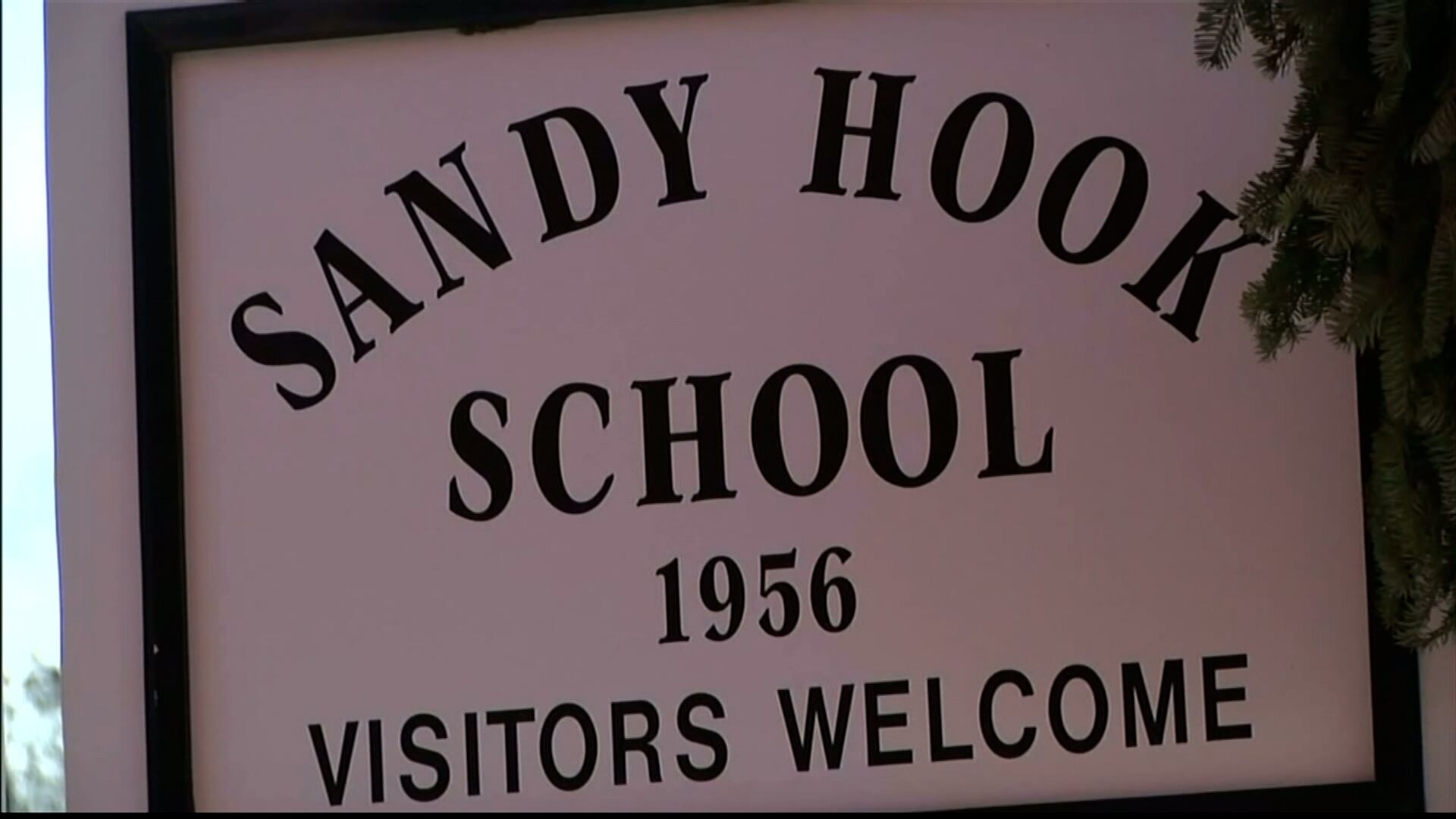
Almost a decade after facing a parent's worst nightmare, the families of the young students killed in the Sandy Hook School shooting reached a settlement with gun manufacturer Remington, makers of the Bushmaster AR-15 used in the crime. David Pucino, deputy chief counsel, Giffords Law Center to Prevent Gun Violence joined Cheddar News to discuss the families' case and how its strategy brought about the legal settlement. "They built a really great case showing the way that Bushmaster developed its advertising to drive sales using those toxic messages.