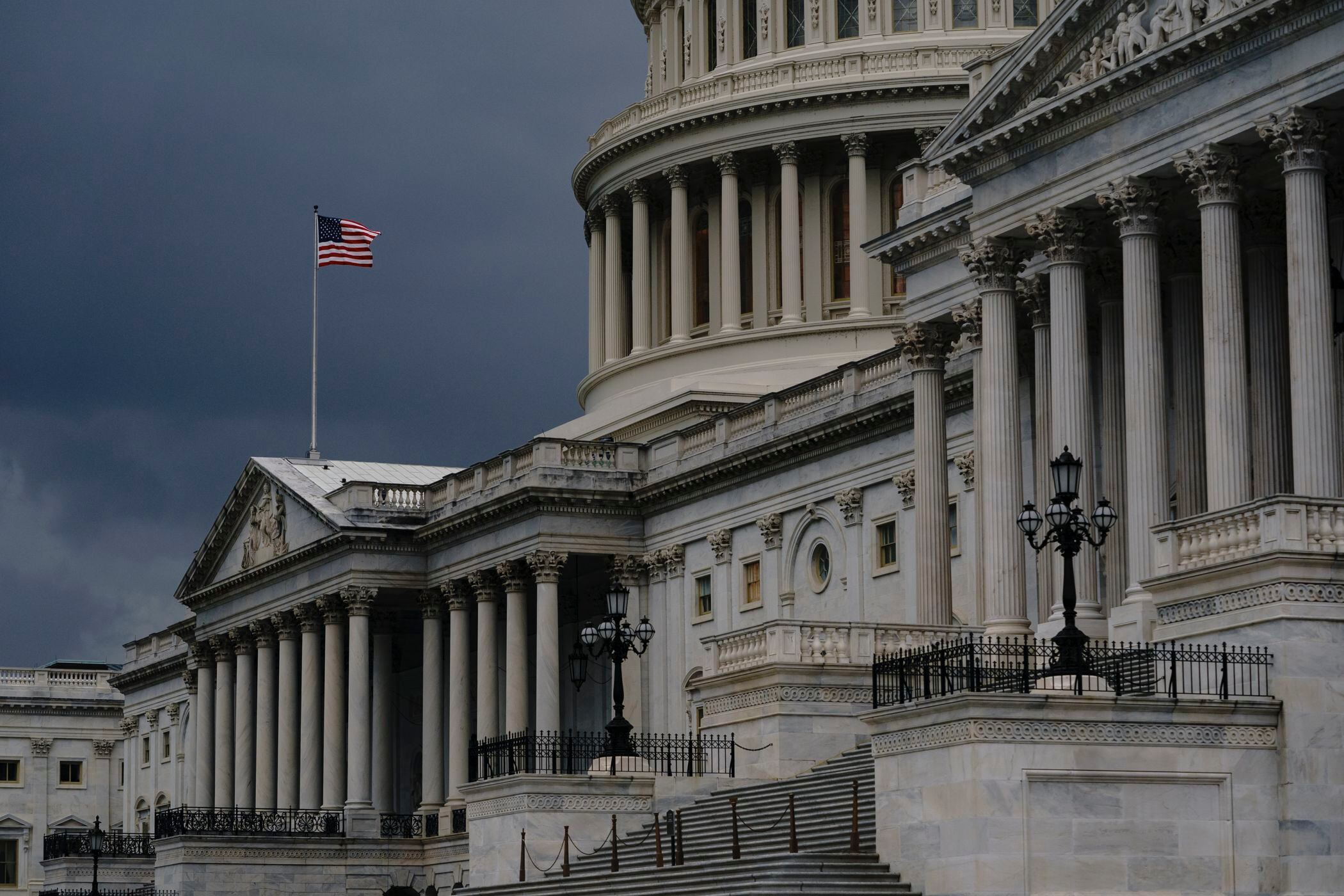
In this Aug. 3, 2020, file photo dark clouds and heavy rain sweep over the U.S. Capitol in Washington. The U.S. government's budget deficit surged to an all-time high of $1.7 trillion for the first six months of this budget year, nearly double the previous record, as another round of economic-support checks added billions of dollars to spending last month. (AP Photo/J. Scott Applewhite, File)
By Martin Crutsinger
The U.S. government's budget deficit surged to an all-time high of $1.7 trillion for the first six months of this budget year, nearly double the previous record, as another round of economic-support checks added billions of dollars to spending last month.
In its monthly budget report, the Treasury Department said Monday that the deficit for the first half of the budget year — from October through March — was up from a shortfall of $743.5 billion in the same period a year ago.
The deficit has been driven higher by trillions of dollars in support Congress has passed in successive economic rescue packages since the pandemic struck in early March 2020. The latest round came in a $1.9 trillion measure that President Joe Biden pushed through Congress last month.
Biden's package included individual support payments of up to $1,400 and the administration rushed to make those payments as soon as the president signed the measure into law. The Treasury Department statement showed that the payments in March totaled $339 billion.
The budget report showed that the deficit for just March totaled $659.6 billion, the third-highest monthly deficit. For the six-month period, the $1.7 trillion deficit total surpassed the previous record of an $829 billion deficit run-up for the six months ending in March 2011. That was a period when the government was spending to deal with the economic damage from the recession caused by the 2008 financial crisis.
Last year's deficit, for the budget year that ended Sept. 30, totaled a record $3.1 trillion. The Congressional Budget Office estimated in February that this fiscal year's deficit would total $2.3 trillion. But that estimate did not include the cost of Biden's $1.9 trillion rescue plan that Congress passed in March or the impact of the administration's “Build Back Better” infrastructure proposal that Congress is considering now.
Nancy Vanden Houten, senior economist at Oxford Economics, said she expects the deficit for this budget year will total $3.3 trillion, an all-time high but up just 6.5% from last year's record shortfall of $3.1 trillion.
Analysts said the deficit's surge in the first six months of the fiscal year reflected that the first half of the 2020 budget year was mostly unaffected by the pandemic. The loss of revenue from millions of jobs lost and the big-spending measures Congress passed to deal with the pandemic-triggered recession occurred in the second half of the 2020 budget year.
Vanden Houten said that, while she expects Congress will pass some version of Biden's $2 trillion infrastructure bill, the budget impact will not occur until the start of the next fiscal year.
For the first six months of the current budget year, Treasury said revenues totaled $1.7 trillion, a drop of 5.5% from the same period last year. Spending was $3.4 trillion, up 45.3%.
Biden's rescue program passed without Republican support, unlike the previous packages passed during the Trump administration, which were backed by both Republican and Democratic lawmakers.
Republicans contend that new spending is not needed in light of rising deficits and increased signs that the economy is starting to rebound.
The Treasury report Monday showed that through the first six months of the current budget year, interest payments on the debt total $229 billion, $41 billion below the same period a year ago. That reflects lower interest rates on the rising level of debt.
Tens of thousands of people have fled Ukraine in attempts to escape the Russian Invasion. According to the U.N. neighboring countries like Poland, Hungary, and even Romania have seen half a million refugees. While the hospitality is being welcomed by many, it also highlights the mistreatment of migrants and refugees from the Middle East and Africa. Professor of Philosophy and Director of Politics at Northeastern University Serena Parekh, joined Cheddar, to discuss more.
As Russia unleashed war in the country of Ukraine, global leaders have started inflicting punishment on Vladimir Putin's regime via commercial and financial penalties. According to President Joe Biden Putin's aggression is "a flagrant violation of international law and it demands a firm response from the international community".However, the main question is will these sanctions actually work. Partner at Jenner & Block LLP, Rachel Alpert, joined Cheddar to discuss more.
A Gallup poll finds that now 7.1% of American adults identify as LGBTQ, jumping from 3.5% in 2012. The increase is driven by Generation-Z – those born between 1997 and 2003 – of whom one out of five identify as LGBTQ. Cheddar News speaks with Washington Blade reporter Chris Johnson about the significant shift.
As the Biden administration continues to see the potential for an imminent invasion of Ukraine after contradictory reports of a Russian troop pullback or buildup, Rep. Ami Bera (D-Calif. 7th District), a member of the House Committee on Foreign Affairs, joined Cheddar News to give his insight into the tense situation. "When I was in Ukraine a couple of weeks ago and we were talking with the Ukrainian leadership with President Zelensky, they said we ought to approach Vladimir Putin as though he was a poker player," he said. "So this could be one of those head fakes where he's saying one thing and doing another thing."
The Biden Administration has now issued new guidelines when it comes to carbon capture. The new guidelines handed down this week encouraged the widespread use of climate attacks that traps and stores carbon emissions. The goal here is the process would help keep carbon out of the atmosphere without requiring a whole lot of change by big companies and manufacturing plants. Several scientists say that this method would be crucial to help us decrease the use of carbon emissions by the year 2050. Professor of Civil and Environmental Engineering at Stanford University, Mark Jacobson, joined Cheddar to discuss more.
Natalie Fertig, federal cannabis policy reporter for Politico Pro, joins Cheddar News to discuss the latest in marijuana legalization in the United States.
The Biden administration is launching a new task force to promote the use of 'cleaner' construction materials with lower life cycle emissions. This comes as the White House works to speed up government purchases of greener products. Sweta Chakraborty, climate change expert and U.S. president of "We Don't Have Time," joins Cheddar News to discuss.
Due to the staffing shortages of teachers in New Mexico, the state has been encouraging its National Guard members to fill in as licensed substitutes to keep schools open. Kurt Steinhaus, New Mexico secretary of education, joined Cheddar News to explain the state's stopgap measure amid its lack of teaching professionals. "The first thing they have to go through a fingerprint background check, just like any other substitute new Mexico. The second thing they have to do is go through some online training, and then we provided some in-person professional development about classroom management," Steinhaus explained about the qualifications process.