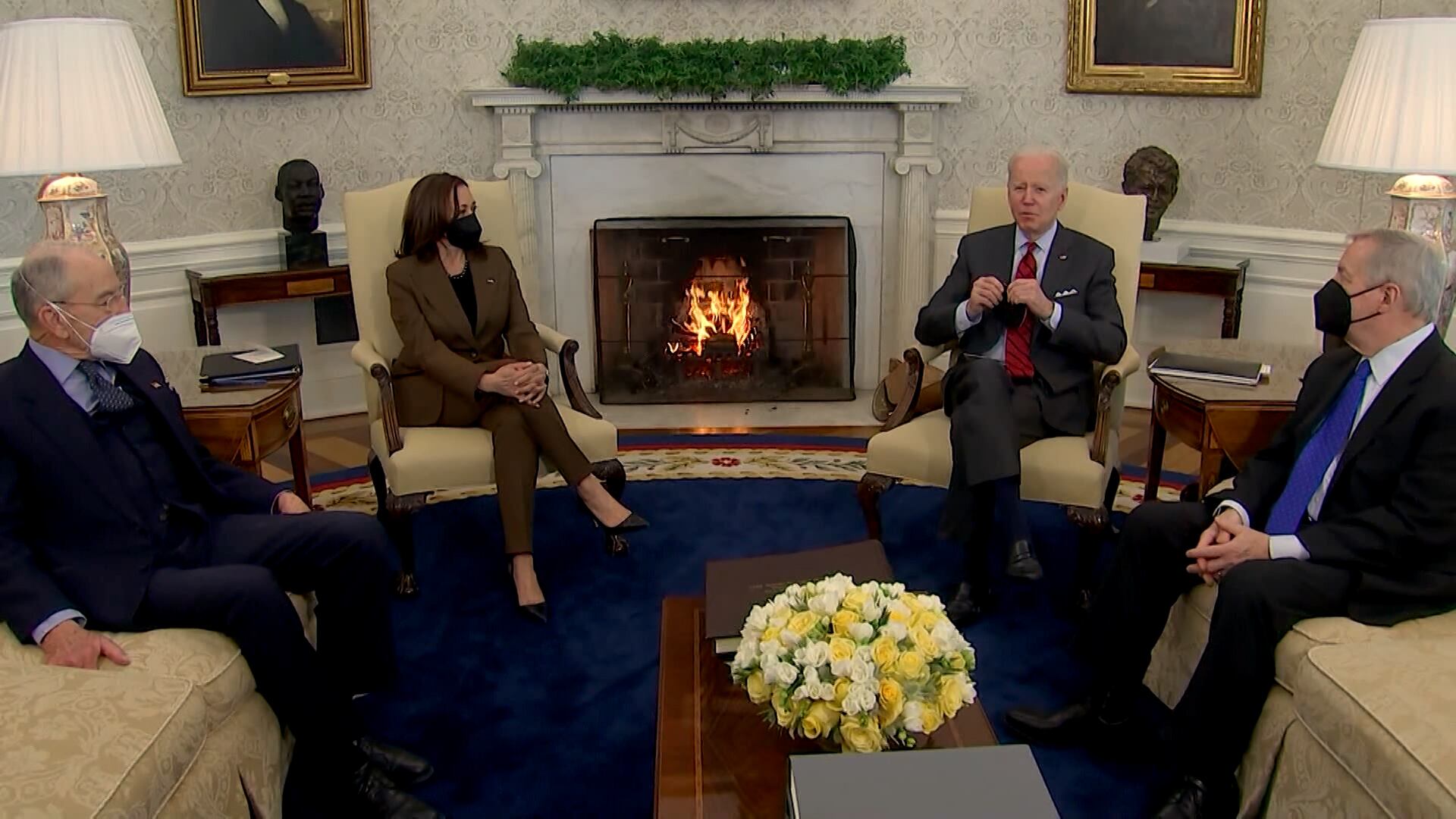
President Joe Biden said Monday that the U.S. will share an additional 20 million doses of COVID-19 vaccines with the world in the coming six weeks as domestic demand for shots drops and global disparities in distribution have grown more evident.
The doses will come from existing production of Pfizer, Moderna or Johnson & Johnson vaccine stocks, marking the first time that U.S.-controlled doses of vaccines authorized for use in the country will be shared overseas. It will boost the global vaccine sharing commitment from the U.S. to 80 million.
“We know America will never be fully safe until the pandemic that’s raging globally is under control," Biden said at the White House.
The announcement comes on top of the Biden's administration’s prior commitment to share about 60 million doses of the AstraZeneca vaccine, which is not yet authorized for use in the U.S., by the end of June. The AstraZeneca doses will be available to ship once they clear a safety review by the Food and Drug Administration.
Biden also tapped COVID-19 coordinator Jeff Zients to lead the administration's efforts to share doses with the world.
“Our nation’s going to be the arsenal of vaccines for the rest of the world," Biden said. He added that, compared to other countries like Russia and China that have sought to leverage their domestically produced doses, “we will not use our vaccines to secure favors from other countries.”
The Biden administration hasn't yet said how the new commitment of vaccines will be shared or which countries will receive them.
To date, the U.S. has shared about 4.5 million doses of AstraZeneca vaccine with Canada and Mexico. Additional doses of the Pfizer vaccine manufactured in the U.S. have begun to be exported as the company has met its initial contract commitments to the federal government.
The U.S. has faced growing pressure to share more of its vaccine stockpile with the world as interest in vaccines has waned domestically.
“While wealthy countries continue ramping up vaccinations, less than 1 percent of COVID-19 vaccine doses globally have been administered to people in low-income countries," said Tom Hart the acting CEO of the ONE Campaign. “The sooner the US and other wealthy countries develop a coordinated strategy for sharing vaccine doses with the world’s most vulnerable, the faster we will end the global pandemic for all.”
More than 157 million Americans have received at least one dose of a COVID-19 vaccine, and 123 million are full vaccinated against the virus. Biden hopes the U.S. will have 160 million people fully vaccinated by July Fourth.
Globally, more than 3.3 million people are confirmed to have died from the coronavirus. The U.S. has seen the largest confirmed loss of life from COVID-19, at more than 586,000 people.
The Labor Department's January jobs report showed 467,000 jobs were added, compared to the 150,000 that were projected, a sign that employment is continuign to return to pre-pandemic levels. Lindsey Piegza, chief economist at investment bank Stifel, joined Cheddar to break down the report, noting the big gains but adding a note of caution. "Remember, even with this morning's stellar report, we're still millions below that level that we had reached prior to the onset of COVID-19," she said." Yes, we are recapturing jobs. We still have further ground that needs to be made before we can talk about reaching that previous peak." Piegza also discussed the role of the Federal Reserve going forward as the employment figures turn more positive.
As President Biden's poll numbers fall with Black voters, Rep. Ayanna Pressley (D-Mass. 7th District) joined Cheddar to discuss what she feels could help the embattled administration: deliver on policies. Pressley pointed to stalled legislation such as new voting rights laws and Build Back Betters and canceling student loan debt, which would go a long way to improving his standing with Black constituents. "President Biden has the authority and the power to alleviate this burden, which would also help in closing the racial wealth gap, and he can do it by executive action with the stroke of a pen," she said. "And it doesn't require one vote from Congress. So, the Biden administration just needs to deliver to Black America in a tangible and impactful way."
Mayor Ras Baraka of Newark, NJ and Ayana Morris, co-director of the documentary 'Why Is We Americans?,' join Cheddar News to discuss the new documentary highlighting the impact of the Baraka family.
Former New York City mayor and lawyer to Donald Trump Rudy Giuliani made his singing debut on a taping of Fox’s The Masked Singer. However, Ken Jeong and Robin Thicke, two judges on the competition show, reportedly left in protest when Giuliani was unmasked upon being eliminated.
All Hands celebrates Black History Month by highlighting achievements in inclusivity and paying homage to those who have fought for equal rights. Rep. Maxine Waters (D-CA) joins Cheddar News to discuss voter suppression; Damali Peterman, CEO of Breakthrough ADR, elaborates on the biggest barriers for Black professionals; Andre Perry, senior fellow of Brookings Institution, dives into student loans and the racial wealth divide; and lastly, BET CEO Scott Mills discusses the company's initiatives for 2022.
All month long Cheddar News is celebrating Black History Month.
In our nation’s capital, Black history is being made right now.
cheddar's own Arielle Hixon puts the spotlight on three lawmakers making that happen, Rep. Lauren Underwood (D-IL), Rep. Cori Bush (D-MO), and Sen. Tim Scott (R-SC).
Representative Maxine Waters (D-Calif. 43rd District) joined Cheddar News to talk about the current political climate in America, including efforts to roll back voting rights in multiple states in light of Black History Month. "Why do we have to deal with those who still believe that somehow this country only belongs to the whites of the country and that somehow they have to do everything that they can to undermine our voting and do voters suppression to keep us from being influential and at the table by which to solve problems?" she asked. Waters chided "two Democrats" who she said were stymying attempts to rectify the issue and also spoke on President Biden’s promise to nominate a Black woman to the Supreme Court.