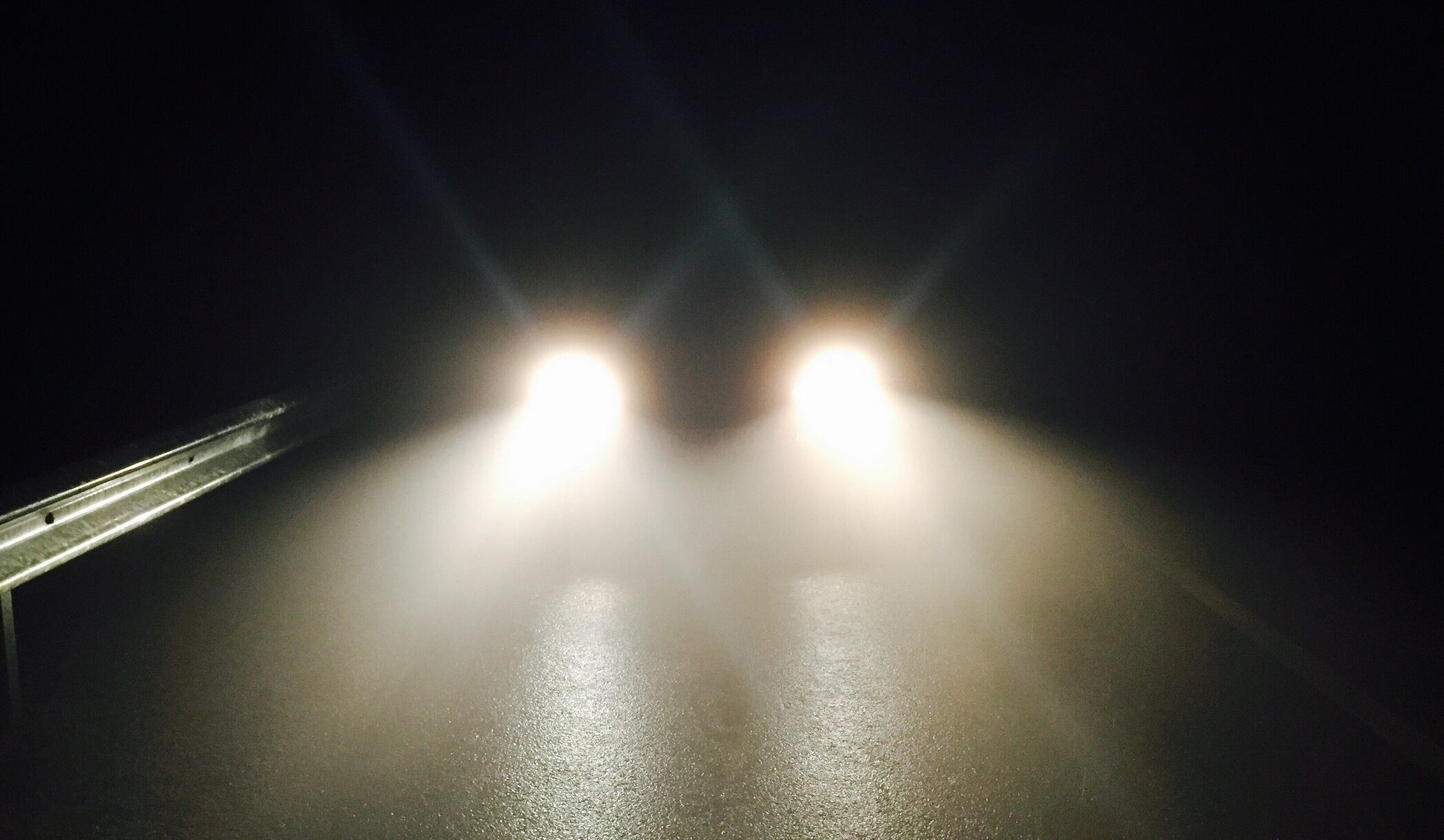
Anyone who has ever been temporarily blinded by high-beam headlights from an oncoming car will be happy to hear this.
U.S. highway safety regulators are about to allow new high-tech headlights that can automatically tailor beams so they focus on dark areas of the road and don't create glare for oncoming drivers.
The National Highway Traffic Safety Administration says it issued a final rule allowing what's called “adaptive driving beam headlights” on new vehicles. It will go into effect when published in the Federal Register in the next few days.
The headlights, commonly used in Europe, have LED lamps that can focus beams on darkness such as the driver's lane and areas along the roadside. They also lower the intensity of the light beams if there's oncoming traffic. Camera sensors and computers help determine where the light should go.
“This final rule will improve safety for pedestrians and bicyclists by making them more visible at night, and will help prevent crashes by better illuminating animals and objects in and along the road,” the agency said in a news release on Tuesday.
The new rule, which was supported by the auto industry, comes as the safety agency grapples with a dramatic rise in traffic deaths nationwide.
The estimated figure of people dying in motor vehicle crashes from January to September 2021 was 12% higher than the same period in 2020. That represents the highest percentage increase over a nine-month period since the Transportation Department began recording fatal crash data in 1975.
The tally of 31,720 deaths was the highest nine-month figure since 2006.
Sam Abuelsamid, principal mobility analyst for Guidehouse Research, said the new lights will show up in higher-cost luxury vehicles at first, but will spread to more mainstram vehicles as the price of the technology falls.
Currently Audi charges $3,000 for the top version of the lights in the U.S. on its e-tron Sportback electric vehicle. The adaptive beam lights are offered on most Audi models in the U.S., but until now, could not be used. An Audi spokesman says the company is evaluating whether the lights meet NHTSA standards and whether they can be activated in the future.
The technology uses an array of light emitting diodes that can change where light beams are sent, rather than the current technology of high beams hitting everywhere. “You have the ability to basically create a light pattern on the fly that is optimized for real-time conditions,” Abuelsamid said. “You can cast the light where it's most useful.”
The new lights also will help partially automated driver assist systems keep cars in their lanes and avoid objects in front of the vehicles at night, Abuelsamid said.
The new lighting regulation also comes more than 1 1/2 years ahead of a requirement in the bipartisan infrastructure law passed by Congress last year, NHTSA said.
In the past the agency has moved slowly on safety measures mandated by Congress. An Associated Press review last year of NHTSA’s rule-making activities under the last three presidents found at least 13 auto safety rules that are years overdue based on deadlines set in laws passed by Congress.
The agency has been without a Senate-confirmed administrator since early 2017. President Joe Biden has nominated former California air quality regulator Steven Cliff for the post. Cliff is awaiting confirmation by the full Senate.
____
Hope Yen contributed to this report from Washington.
President Biden announced a ban on Russian oil and natural gas imports to the U.S. in response to its invasion of Ukraine, a move he warned could lead to an even greater surge in gas prices. The ban is prompting a conversation about the current oil production levels in the U.S. and whether or not the industry can ramp up production to soften the blow to American families at the gas pump. Clark Williams-Derry, Energy Finance Analyst with the Institute for Energy Economics and Financial Analysis, breaks down the state of the U.S. oil industry and how the ban might impact production levels here at home.
PepsiCo, Coca-Cola, McDonald’s, and Starbucks are the latest American food brands to have halted business operations in Russia after having faced scrutiny and criticism for originally failing to do so amid the country's invasion of Ukraine.
As Russia intensifies its war on Ukraine, President Biden announced a ban on oil imported from the aggressor nation. Critics of Russia have said this would be the best way to force Putin to pull back, but curbs on Russian oil exports are expected to send already skyrocketing oil and gas prices even higher, further impacting consumers, businesses, financial markets, and the global economy. Leslie Beyer, CEO of the Energy Workforce and Technology Council, joined Cheddar News' Closing Bell to discuss. "It's certainly going to increase pricing, but it is the right thing to do," she said. "The industry itself has already pulled out of the significant portion of its operations in Russia."
Sports Betting in the U.S. is booming. According to industry experts, we could see another boom this year as more states move towards statewide legalization of sports wagering. While this comes as huge news for fans, there are some very real concerns as to whether or not sports betting potentially poses a threat to public health. Senior Clinician at the Caron Treatment Centers, Eric Webber, joined Cheddar to discuss more.
The Biden administration has made gender policy a core part of how it governs. The president established the first Gender Policy Council. It's on the same level as the National Security Council, Domestic Policy Council and National Economic Council, putting the interests of women and other underserved groups at the table for the most important policy discussions.
Cheddar News sat down with Jennifer Klein, executive director and co-chair of the White House Gender Policy Council, to discuss the council's work and its significance during Women's History Month.
State Representative Jessica González, Vice Chair of the Texas House LGBTQ Caucus, joins Cheddar News to discuss the latest Texas anti-transgender directive.
The United States Secretary of Agriculture, Tom Vilsack joins None of the Above to discuss the newly emerging conflict in Europe, what it means for agriculture in the states, dairy and meat consumption, and how the department is planning to promote climate-smart agriculture.
Tens of thousands of people have fled Ukraine in attempts to escape the Russian Invasion. According to the U.N. neighboring countries like Poland, Hungary, and even Romania have seen half a million refugees. While the hospitality is being welcomed by many, it also highlights the mistreatment of migrants and refugees from the Middle East and Africa. Professor of Philosophy and Director of Politics at Northeastern University Serena Parekh, joined Cheddar, to discuss more.
As Russia unleashed war in the country of Ukraine, global leaders have started inflicting punishment on Vladimir Putin's regime via commercial and financial penalties. According to President Joe Biden Putin's aggression is "a flagrant violation of international law and it demands a firm response from the international community".However, the main question is will these sanctions actually work. Partner at Jenner & Block LLP, Rachel Alpert, joined Cheddar to discuss more.