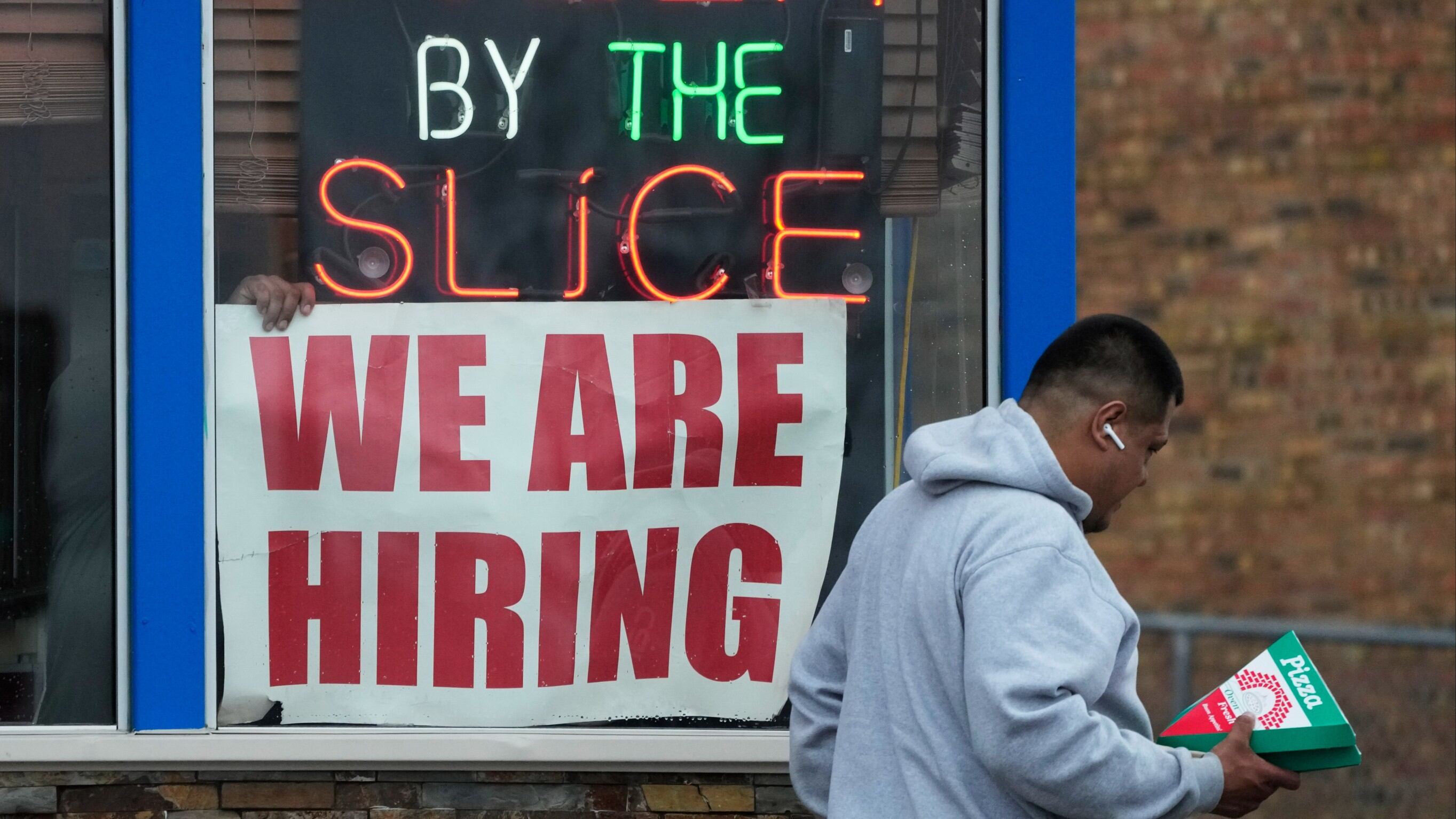
A hiring sign is displayed at a restaurant in Prospect Heights, Ill., on April 4, 2023. The hot jobs market has been defying a weakening economy and confounding the Federal Reserve for months, but now shows signs of cooling. The latest set of employment data from the government shows that job openings fell in March to their lowest level since April 2021. Layoffs rose to 1.8 million, their highest level since December 2020. (AP Photo/Nam Y. Huh, File)
By Matt Ott
The number of Americans applying for unemployment benefits last week rose to its highest level since October 2021, but the labor market remains one of the healthiest parts of the U.S. economy.
The Labor Department reported Thursday that U.S. applications for jobless claims were 261,000 for the week ending June 3, an increase of 28,000 from the previous week's 233,000. Weekly jobless claims are considered representative of U.S. layoffs.
The four-week moving average of claims, which evens out some of the weekly variations, rose by 7,500 to 237,250.
Despite last week’s sharp increase in filings for unemployment aid, some analysts cautioned against concluding that layoffs are picking up across the economy. They noted that the weekly figures are prone to revision and that last week’s numbers might have been distorted by the three-day Memorial Day weekend.
“The latest reading reflects a holiday-shortened week (Memorial Day), which ought to raise suspicions that the big move was more noise than signal,” said Stephen Stanley, chief U.S. economist for Santander. “I am eager to see next week’s reading before I draw any conclusions.”
The U.S. economy has added jobs at a furious rate since the pandemic purge of more than 20 million jobs in the spring of 2020. Americans have enjoyed unusual job security, despite the Federal Reserve's aggressive campaign to cool the economy and labor market in its bid to stifle persistent, decades-high inflation.
In early May, the Fed raised its benchmark lending rate for the 10th time in a row. There have been scattered signs that the Fed’s actions are working, but broadly, the job market continues to favor workers.
U.S. employers added a robust 339,000 jobs last month, well above expectations. Last week’s report painted a mostly encouraging picture of the job market but there were some mixed messages. Notably, the unemployment rate rose to 3.7%, from a five-decade low of 3.4% in April, the highest unemployment rate since October.
In April, employers posted 10.1 million job openings, up from 9.7 million in March and the most since January. Economists had expected vacancies to slip below 9.5 million.
Those reports, along with the jobless claims numbers, could help sway Fed officials one way or the other with regard to its next rate hike move. Most economists are predicting that the Fed will pause its rate hikes at its meeting next week, though the strong labor market could convince the central bank to stay the course with another small quarter-point increase.
The U.S. economy grew at a lackluster 1.3% annual rate from January through March as businesses wary of an economic slowdown trimmed their inventories. That’s a slight upgrade from its initial growth estimate of 1.1%.
Though the labor market remains strong, there have been notable high-profile layoffs recently, mostly in the technology sector, where many companies now acknowledge overhiring during the pandemic. IBM, Microsoft, Salesforce, Twitter, Lyft, LinkedIn, Spotify and DoorDash have all announced layoffs in recent months. Amazon and Facebook parent Meta have each announced two sets of job cuts since November.
Outside the tech sector, McDonald’s, Morgan Stanley and 3M also recently announced layoffs.
Overall, 1.76 million people were collecting unemployment benefits the week that ended May 27, about 37,000 fewer than the previous week.
Eight months after the National Football League announced $1 million in research into cannabinoids, the NFL-NFLPA Joint Pain Management Committee has awarded the funding to two teams of medical researchers at the University of California San Diego and the University of Regina. The NFL says the studies will investigate the effects of cannabinoids on pain management and neuroprotection from concussion in elite football players, respectively. Cheddar correspondent Chloe Ailello spoke with Jeff Miller, the executive vice president of communications, public affairs, and policy for the NFL, about the studies, as well as the recent lawsuit filed against the NFL by former Miami Dolphins head coach Brian Flores. "Maybe we can learn things from other alternative pain approaches that are going to benefit our player population and then sports medicine as a whole," Miller said.
All Hands celebrates Black History Month by highlighting achievements in inclusivity and paying homage to those who have fought for equal rights. Rep. Maxine Waters (D-CA) joins Cheddar News to discuss voter suppression; Damali Peterman, CEO of Breakthrough ADR, elaborates on the biggest barriers for Black professionals; Andre Perry, senior fellow of Brookings Institution, dives into student loans and the racial wealth divide; and lastly, BET CEO Scott Mills discusses the company's initiatives for 2022.
Hinge users who have children can opt-in to a $100 stipend up to $25,000 for childcare. Logan Ury, the director of relationship science for the online dating platform, noted the issue as an obstacle for single parents who want to go out on dates. "We have heard that singles with children have a hard time going on dates for one of the reasons being that it's just hard to find childcare and it's hard to be able to afford it," she said. Ury also said that the hot topic among Hinge's users is mental health and the prioritizing of mental health.
According to the Federal Reserve, the investment gap between Black and white Americans has remained substantial, with only 34 percent of Black households joining in on the historic rise in the markets. Stacey Tisdale, the first Black woman to have reported from the NYSE and the CEO and president of Mind Money Media Inc., said that the data might not be as disheartening as it seems. "I think that number is very deceiving. That Federal Reserve study is actually from 2019, and it's very important that we all look beneath that number and look beneath the surface because there is nothing short of an investing revolution going on in the Black community," Tisdale said.
Facebook parent Meta’s miss on Q4 earnings raised alarm bells amongst investors. The tech giant lost users for the first time as it invests a lot into the metaverse, its virtual realm, in the hopes that consumers will move their social media consumption there. The stock dropped around 25 percent on the report, and CEO Mark Zuckerberg chalked it up to people flocking toward apps like TikTok, even as his own platform attempts to make a big pivot to the metaverse future. "It's gonna take a long time to develop and it's gonna take a long time to bring to fruition," Rebecca Walser, president of Walser Wealth Management told Cheddar. "In the meantime, the world is moving on. We have a very short attention span, especially on social media, and we want the short little videos. And Tiktok has just taken off."
Wall Street saw another volatile day after the Federal Reserve left rates unchanged for now, with plans to raise rates in March at its next meeting in order to ease inflation. Fed Chair Jerome Powell said the Fed has not made decisions on the size of rate increases, adding that the Fed is not trying to get inflation below two-percent. Ken Johnson, CFA and Investment Strategy Analyst explains why Powell thinks that high inflation is a significant threat to the labor market.