By Lauran Neergaard and Matthew Perrone

The U.S. stood on the verge of adding a second COVID-19 vaccine to its arsenal Friday as the outbreak descended deeper into its most lethal phase yet, with the nation regularly recording over 3,000 deaths per day.

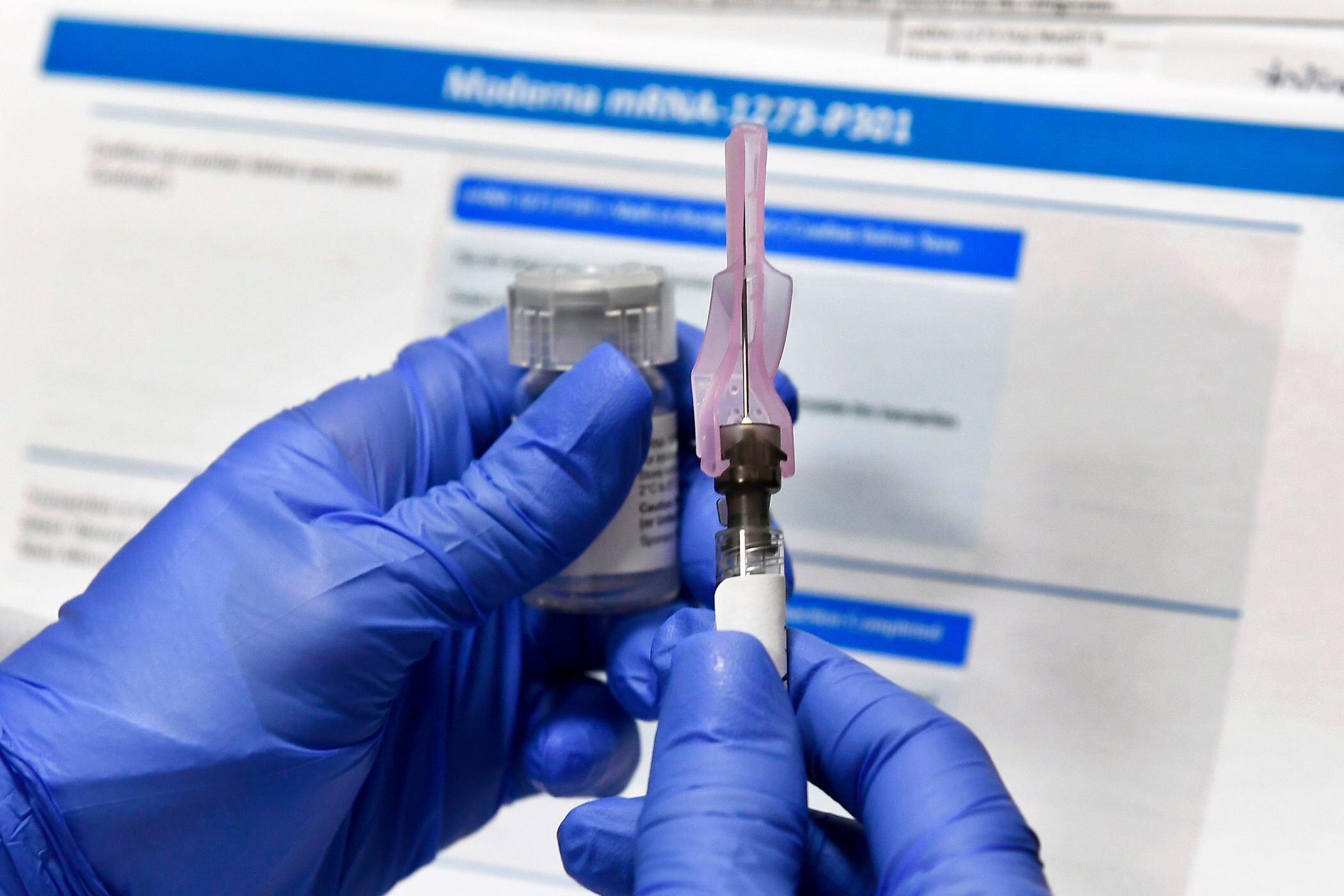
The Food and Drug Administration was evaluating a shot developed by Moderna Inc. and the National Institutes of Health and was expected to give it the green light soon, clearing the way for its use to begin as early as Monday.

That would give the U.S. a critical new weapon against the coronavirus in addition to the Pfizer-BioNTech vaccine now being dispensed to millions of health care workers and nursing home patients as part of the biggest vaccination drive in American history.

The go-ahead from the FDA would mark the world’s first authorization of Moderna’s shots. Large but unfinished studies show that both vaccines appear safe and strongly protective, though Moderna's is easier to handle, since it does not need to be kept at ultra-frozen temperatures like the Pfizer-BioNTech shot. Both require two doses for full protection.

A second vaccine represents a ray of hope amid despair as the virus continues to spread unabated even before holiday gatherings certain to fuel the outbreak.

The scourge has claimed more than 310,000 U.S. lives and killed 1.6 million people worldwide. New cases in the U.S. are running at over 216,000 per day on average. Deaths per day have hit all-time highs, eclipsing 3,600 on Wednesday.

California has emerged as one of the most lethal hot spots, with hospitals running out of intensive care beds and ambulances lining up outside emergency rooms in scenes reminiscent of the calamity around New York City last spring.

“I am fearful it will be worse than what we saw in New York,” said Dr. Marc Futernick, an emergency room physician in Los Angeles. When New York’s hospitals were in crisis, health care workers from across the country came to help out.

“None of that is happening right now, and there’s no way for it to happen because every place is busy. There’s no cavalry coming,” Futernick said.

California on Thursday reported 52,000 new cases in a single day — equal to what the entire U.S. was averaging in mid-October — along with a one-day record of 379 deaths and more than 16,000 people in the hospital with COVID-19.

The goal is to get 80% or so of the U.S. population vaccinated by mid-2021 to finally conquer the outbreak.

Even with Moderna’s doses added to the U.S. supply, however, there won’t be enough vaccine for the general population until spring, and shots will be rationed in the meantime. And while health workers are enthusiastically embracing vaccination, authorities worry the public may need more reassurance to ensure more people get in line when it’s their turn.

To help instill confidence in the shot, Vice President Mike Pence received the Pfizer-BioNTech vaccination on live TV Friday, along with Surgeon General Jerome Adams.

FDA clearance could help pave the way for other countries that are considering the Moderna vaccine. European regulators could authorize its use as soon as Jan. 6. Britain, Canada and a few other countries already have cleared the Pfizer-BioNTech shot, with a European Union decision due Monday.

“What we want to always remember is one size does not fit all. We want to have options,” said Dr. Paul Duprex of the University of Pittsburgh.

Moderna has about 5.9 million doses ready for shipment set to begin over the weekend. Injections of health workers and nursing home residents continue next week, before other essential workers and vulnerable groups are allowed to get in line.

Both Moderna’s and Pfizer-BioNTech’s shots are so-called mRNA vaccines, made with a groundbreaking new technology. They use a piece of genetic code that trains the immune system to recognize the spike protein on the surface of the virus, ready to attack if the real thing comes along.

Experts are hoping the two together will “break the back of the pandemic” when combined with masks and other precautions, said Dr. Arnold Monto of the University of Michigan, who chaired an advisory committee that debated the data on the shots ahead of the FDA’s decisions.

Emergency authorization from the FDA means a vaccine is still experimental, with studies required to continue to track long-term safety and answer lingering questions.

Data provided to the FDA's advisers show that the Moderna vaccine was more than 94% effective at preventing COVID-19 in people 18 and older and that it strongly protected older adults, who are most vulnerable.

A study of more than 30,000 volunteers uncovered no major safety problems so far. Side effects typically seen with other vaccinations were common, such as sore arms, fever, fatigue, and muscle aches, which are signs the immune system is revving up.

___

Associated Press reporter Amy Taxin contributed to this report from Orange County, California.

___

The Associated Press Health and Science Department receives support from the Howard Hughes Medical Institute’s Department of Science Education. The AP is solely responsible for all content.

Updated on December 18, 2020, at 3:00 p.m. ET.

Share:
More In Science
Climate Experts Attend House Committee Meeting in Place of Big Oil Board Members
After months of investigation, board members from U.S. big oil companies were slated to appear before a House oversight committee this week to discuss their respective roles in pushing for climate initiatives internally. However, all four board members from Exxon, Shell, Chevron, and BP said they couldn't attend due to scheduling conflicts. Climate experts are testifying in their place about how effective big oil's climate promises have been so far. Meanwhile, President Joe Biden's lead science adviser Eric Lander has resigned after an investigation found he violated workplace policy. What will this mean for Biden's climate agenda? Amy Harder, executive editor of Cipher, a publication by Breakthrough Energy, joins Cheddar Climate to discuss.
Will The Texas Grid Fail Again? ERCOT Says They Are 'Ready For This Storm'
Although this week's weather is predicted to be less severe than the 2021 storm, Texans are preparing for the worst - stocking up on supplies and emptying shelves in grocery stores, once again. Some Texans still have not recovered from last year's tragedy, and are heading into the next few weeks with anxiety for what's to come. Leslie Beyer, CEO of the Houston-based energy workforce & technology council, joins Cheddar News to discuss if the Texas grid will fail again.
American Red Cross Calls for Donors Amid Worst Blood Shortage in Over a Decade
The American Red Cross has declared its first-ever "national blood crisis" in the United States. Since COVID hit the U.S. in March 2020, blood donations have declined by 10 percent. American Red Cross Medical Director, Dr. Baia Lasky joined Cheddar News to discuss the country facing the worst blood shortage in over a decade. Dr. Lasky noted that as much as 40 percent of Americans are eligible to donate blood but only about 4 percent do so. "This is going to be ongoing," she said. "This is not an acute shortage. We really do need the commitment of people to come out and donate and donate again." Appointments to donate can be made by using the Red Cross Donor App, at RedCrossBlood.org, or calling 1-800-RED CROSS (1-800-733-2767).
NFL Awards $1 Million to Study Impact of Cannabis and CBD on Pain Management
Eight months after the National Football League announced $1 million in research into cannabinoids, the NFL-NFLPA Joint Pain Management Committee has awarded the funding to two teams of medical researchers at the University of California San Diego and the University of Regina. The NFL says the studies will investigate the effects of cannabinoids on pain management and neuroprotection from concussion in elite football players, respectively. Cheddar correspondent Chloe Ailello spoke with Jeff Miller, the executive vice president of communications, public affairs, and policy for the NFL, about the studies, as well as the recent lawsuit filed against the NFL by former Miami Dolphins head coach Brian Flores. "Maybe we can learn things from other alternative pain approaches that are going to benefit our player population and then sports medicine as a whole," Miller said.
How A.I. is Reinventing Remembrance; Biodiversity of the Humboldt Current
On this episode of Cheddar Innovates: CEO of HereAfter AI discusses how artificial intelligence can be used to preserve family history and stories, and allow you to 'talk' to loved ones that have passed; Creator of the board game 'Travel Explore Discover' explains how she came up with the idea for this informative and educational board game, and how she's using the proceeds to give back to her community; Cheddar gets a look at Curiosity Stream's 'The Humboldt Current.'
Long COVID: Millions Dealing with Residual Symptoms
Immunologist Dr. Purvi Parikh of the Allergy & Asthma Network joined Cheddar News to break down long Covid, in which Covid symptoms remain up to two years after infection; a phenomenon that has so far mystified health experts.
Factorial Energy Raises $200 Million to Accelerate Commercialization of Its Solid-State Batteries for Electric Vehicles
Solid-state battery maker Factorial Energy recently raised $200 million in a Series D round led by Mercedes-Benz and Stellantis. Factorial says the funding will be used to accelerate commercial production and deployment of its solid-state battery technology, which the company says is safer, and offers up to 50% more driving range than current lithium-ion technology. Factorial also has joint development agreements (announced in late 2021) with Mercedes-Benz, Stellantis, and Hyundai, three of the top 10 global automotive manufacturers, to commercialize its batteries. Factorial CEO Siyu Huang joined Cheddar News' Closing Bell to discuss.
Energy Storage Solutions Company Leclanché Powers EV Fleets to Reduce Emissisions
A 2021 report from UK Research and Innovation found that the shipping industry makes up at least 2.5 percent of the world's total CO2 emissions. It's a problem that energy solutions company, Leclanché, is trying to solve. Founded in 1909, the company has been developing and producing batteries for more than 100 years. Today, Leclanché's lithium-ion battery is used to electrify not just ships, but also railroad locomotives, trucks, and specialty vehicles. Cheddar News spoke with Pierre Blanc, chief technology and industrial officer of Leclanché, to discuss.
Load More