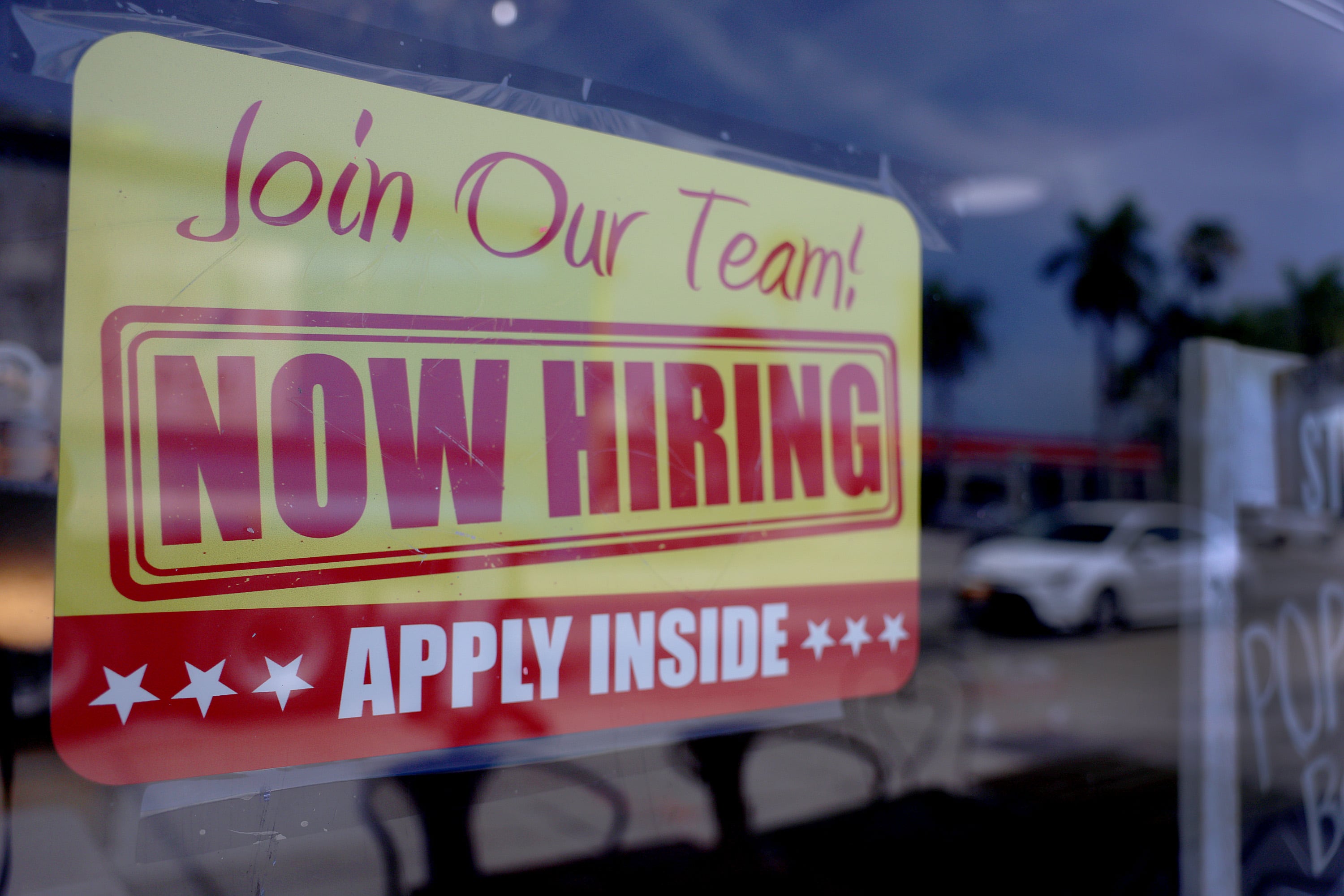
Nailea Rosales works behind a protective shield wearing a protective mask and gloves at the Morada Bay Beach Cafe in Islamorada, in the Florida Keys, during the new coronavirus pandemic, Monday, June 1, 2020. The Florida Keys reopened for visitors Monday after the tourist-dependent island chain was closed for more than two months to prevent the spread of the coronavirus. (AP Photo/Lynne Sladky)
By Christopher Rugaber
The U.S. unemployment rate fell to 13.3 percent in May from 14.7 percent, and 2.5 million jobs were added — a surprisingly positive reading in the midst of a recession that has paralyzed the economy in the wake of the viral pandemic.
The May job gain suggests that businesses have quickly been recalling workers as states have reopened their economies.
Other evidence has also shown that the job market meltdown triggered by the coronavirus has bottomed out. The number of people applying for unemployment benefits has declined for nine straight weeks. And the total number of people receiving such aid has essentially leveled off.
The overall job cuts have widened economic disparities that have disproportionately hurt minorities and lower-educated workers. Though the unemployment rate for white Americans was 12.4 percent May, it was 17.6 percent for Hispanics and 16.8 percent for African-Americans.
Even with the surprising gain in May, it may take months for all those who lost work in April and March to find jobs. Some economists forecast the rate could remain in double-digits through the November elections and into next year.
Meridith McGraw, White House Reporter at The Wall Street Journal, breaks down Trump’s $200M ballroom plan, D.C. police tensions, and the future of MAGA.
Dr. Richard Besser, President & CEO of the Robert Wood Johnson Foundation and former CDC acting director, unpacks the impact of RFK's mRNA funding cuts.
Jessica Inskip, Director of Investor Research at StockBrokers.com and host of MarketMakeHer, unpacks earnings, market outlook, and what history says is next.
Laura Desmond, CEO of Smartly, explores how Big Tech giants are competing for ad dollars in a shifting digital landscape and how Smartly is here to help.
George Sakellaris, President & CEO at Ameresco, outlines how smart energy upgrades and performance contracts are cutting costs, CO₂, and boosting efficiency.
Seth Schachner, Managing Director at Strat Americas, breaks down Disney’s Q3 results: streaming profits, parks growth and ESPN rights deal with the NFL.