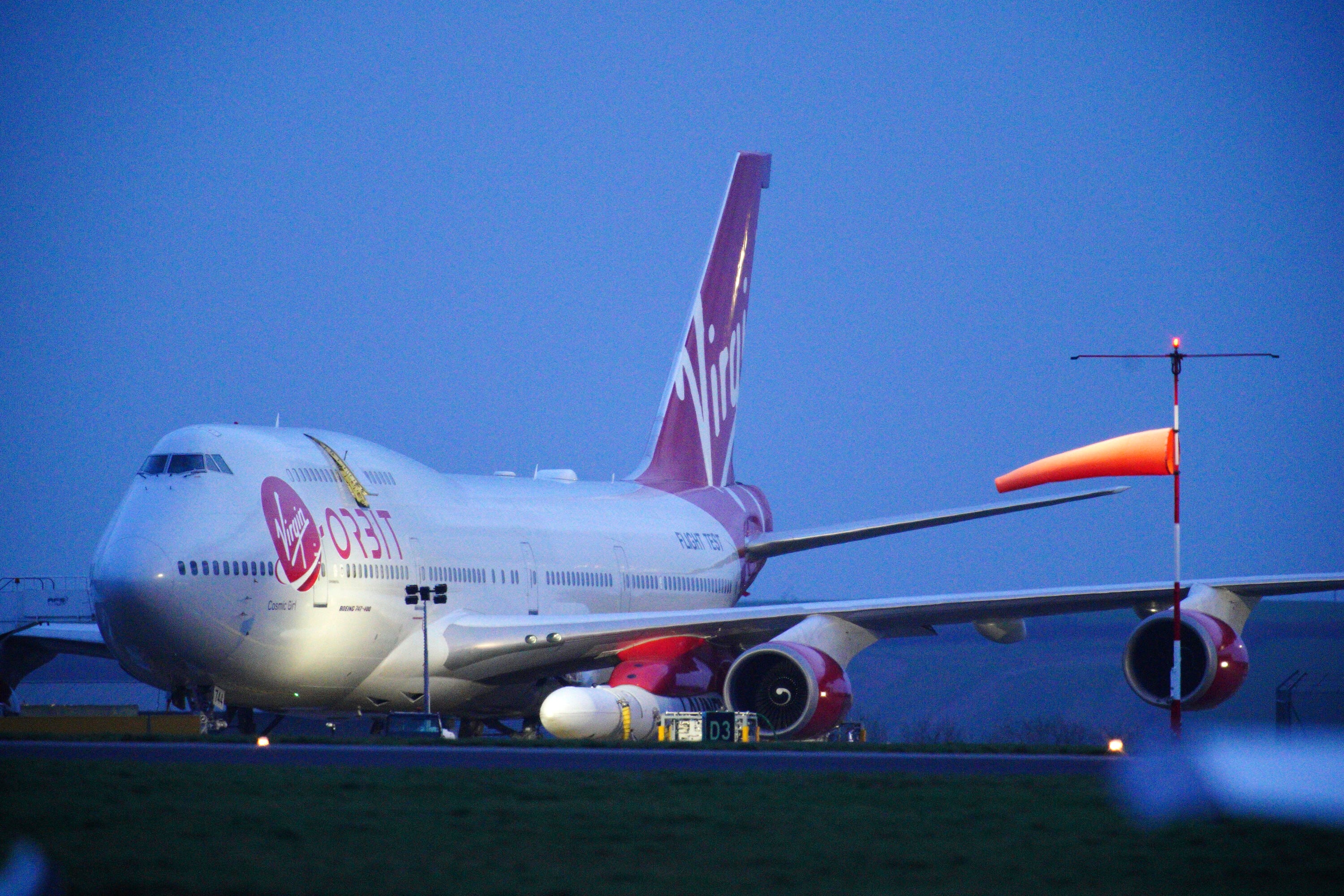
Virgin Atlantic Cosmic Girl, a repurposed Virgin Atlantic Boeing 747 aircraft carrying a rocket, is parked at Spaceport Cornwall, at Cornwall Airport in Newquay, England, Monday, Jan. 9, 2023. (Ben Birchall/PA via AP)
LONDON (AP) — British officials and space scientists said Tuesday they were disappointed but not deterred after the first attempt to launch satellites into orbit from the U.K. ended in failure.
U.S.-based Virgin Orbit attempted its first international launch late Monday, using a modified jumbo jet to carry one if its rockets from Cornwall in southwestern England over the Atlantic Ocean.
The plane released the rocket, carrying nine small satellites for a mix of civilian and domestic uses. But about two hours after the plane took off, the company reported “an anomaly that has prevented us from reaching orbit.”
The plane, piloted by a Royal Air Force pilot, returned to Cornwall. The rocket and satellites were destroyed.
“We’re feeling awful, to be honest – I’m not going to lie,” Melissa Thorpe, head of Spaceport Cornwall. said.
“This isn’t the first time we’ve been knocked, this is the biggest definitely, but I feel OK and we’ll get up and we’ll go again,” she said.
Virgin Orbit, which was founded by British transport and telecommunications tycoon Richard Branson, previously completed four similar launches from California.
Hundreds of people gathered for the Cornwall launch had cheered when a repurposed Virgin Atlantic Boeing 747 aircraft, named Cosmic Girl, took off late Monday. Around an hour into the flight, the plane released the rocket at around 35,000 feet (around 10,000 meters) over the Atlantic Ocean to the south of Ireland.
Virgin Orbit chief executive Dan Hart said “a technical failure appears to have prevented us from delivering the final orbit.”
“While we are very proud of the many things that we have successfully achieved as part of this mission, we are mindful that we failed to provide our customers with the launch service they deserve,” he said.
The mission was a collaboration between the U.K. Space Agency, the Royal Air Force, Virgin Orbit and Cornwall Council.
Britain hopes to become a major player in making and launching satellites, and is building a spaceport in the Shetland Islands north of Scotland as well as the one in Cornwall.
U.K. Business Secretary Grant Shapps said Monday’s launch was “a big moment” despite its failure.
“Space is difficult,” Shapps told Sky News.
“It didn’t work. I’ve no doubt that they’ll pick themselves up, dust themselves off and they’ll go again once they find out what exactly went wrong with it,” he said.
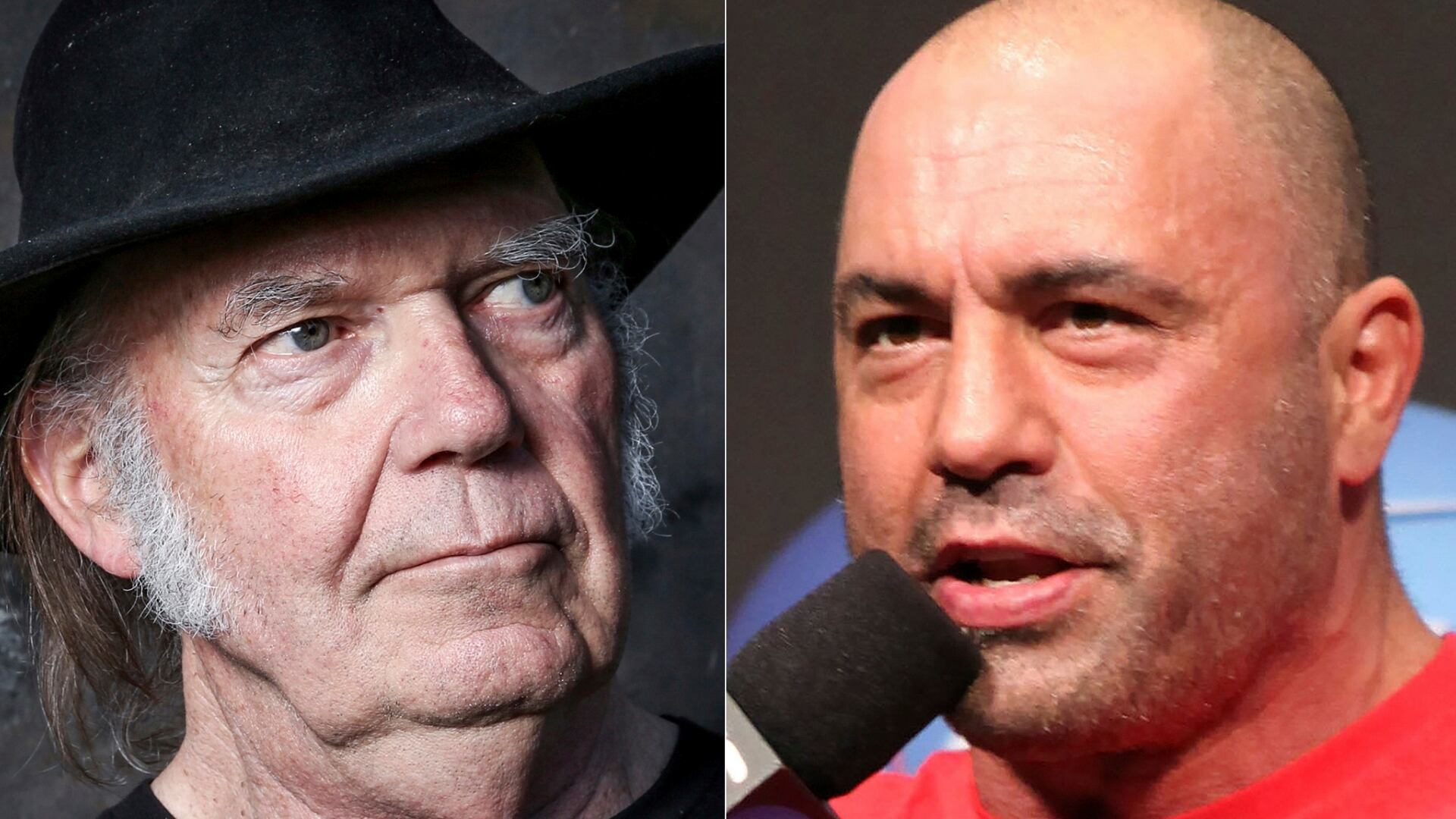
Neil Young has come up with an ultimatum for Spotify: his music or Joe Rogan’s podcast. This comes over concerns that the podcast is spreading COVID-19 vaccine misinformation to its listeners. "The Joe Rogan Experience," which is exclusive to Spotify, is currently the number one streamed podcast on the platform.
Commercial and residential buildings account for 13% of carbon emissions in the U.S., according to the EPA, and one company says it has a solution. Runwise says it has updated the boiler and heating systems of thousands of buildings, and that its technology not only lowers carbon output but also saves landlords money. Lee Hoffman, Co-Founder and COO of Runwise, joined Cheddar Climate to discuss.
Jo Ruxton, Founder of Ocean Generation, joins Cheddar Climate, where she explains the threat that plastic pollution poses to marine life, but elaborates on why we shouldn't be looking to ban plastic entirely. Ruxton also discusses her biggest takeaways while producing the film ‘A Plastic Ocean.'
President Joe Biden's Build Back Better deal seems all but finished after months of Democratic infighting and the Senate's deadlock over certain provisions. But Biden mentioned during a press conference marking his first year in office that 'chunks' of the bill could be passed. Is that enough motivation to force Democrats to rally around certain parts of the bill - especially those that focus on climate and green energy? Andrew Freedman, Energy and Climate Reporter at Axios, joins Cheddar Climate to discuss whether Senate Democrats will be able to rally around climate provisions, if the idea of passing Build Back Better in 'chunks' is doable, and more.
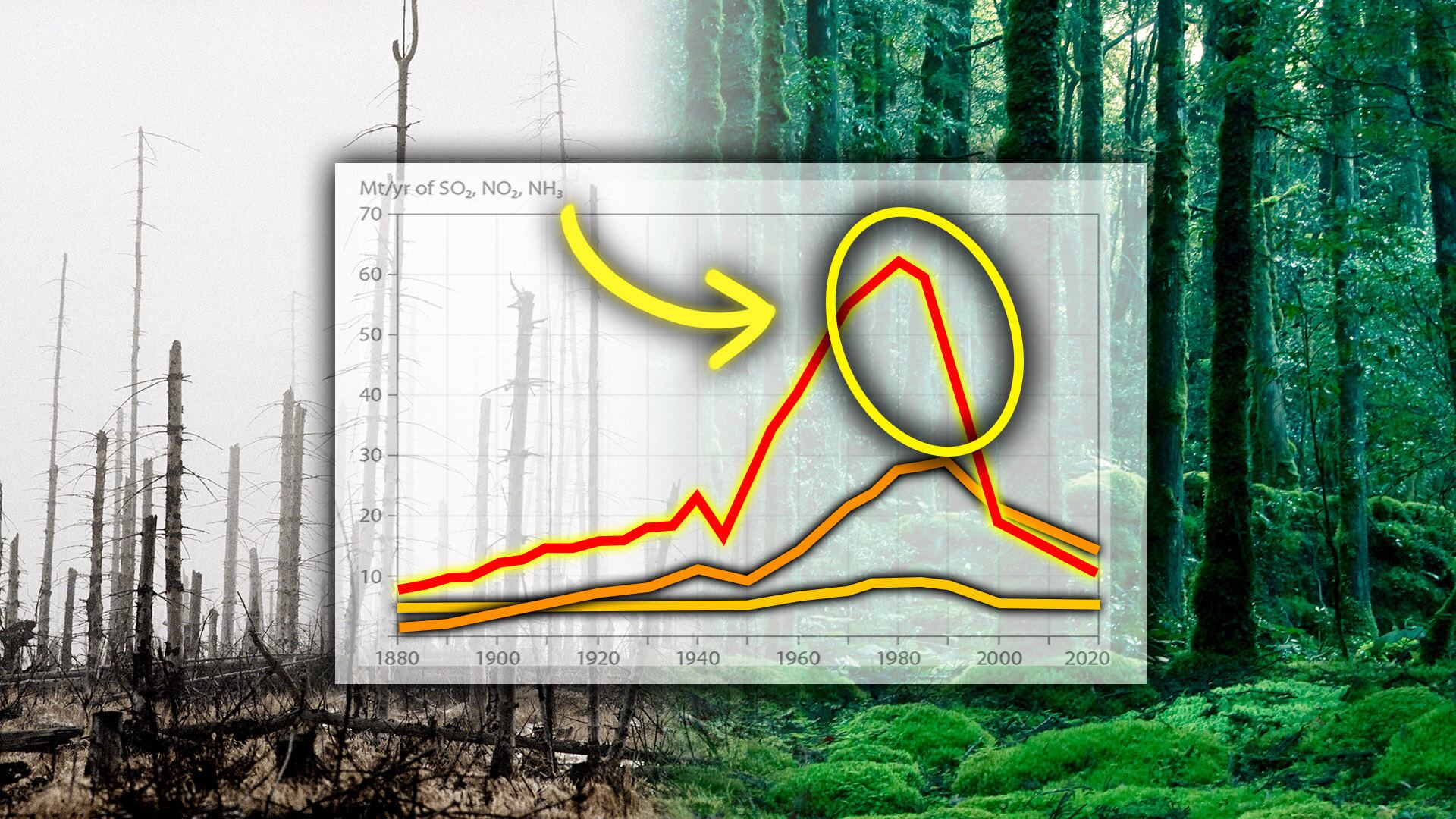
Anyone who remembers the 70s and 80s will probably remember acid rain. Industrial emissions acidified precipitation around the globe, which killed forests and crops, rendered lakes inhospitable, corroded buildings, and exacerbated human health problems.
But anyone who follows environmental news will be surprised to learn this: we solved it! Countries came together to limit acid rain-causing emissions, eliminating the problem altogether.
…kind of. Acidic precipitation may not be a thing of the past after all.
Natalie Ginsberg, Global Impact Officer, MAPS, joins Cheddar Reveals to discuss MAPS organization and its current initiatives and their work to get FDA approval for MDMA to treat PTSD.
Kelsey Ramsden, Co-Founder, President & CEO, Mind Cure Health, joins Cheddar Reveals to break down what 'psychedelic therapy' could look like once it's legalized and how Mind Cure Health is using AI to help treat everything from addiction to depression.
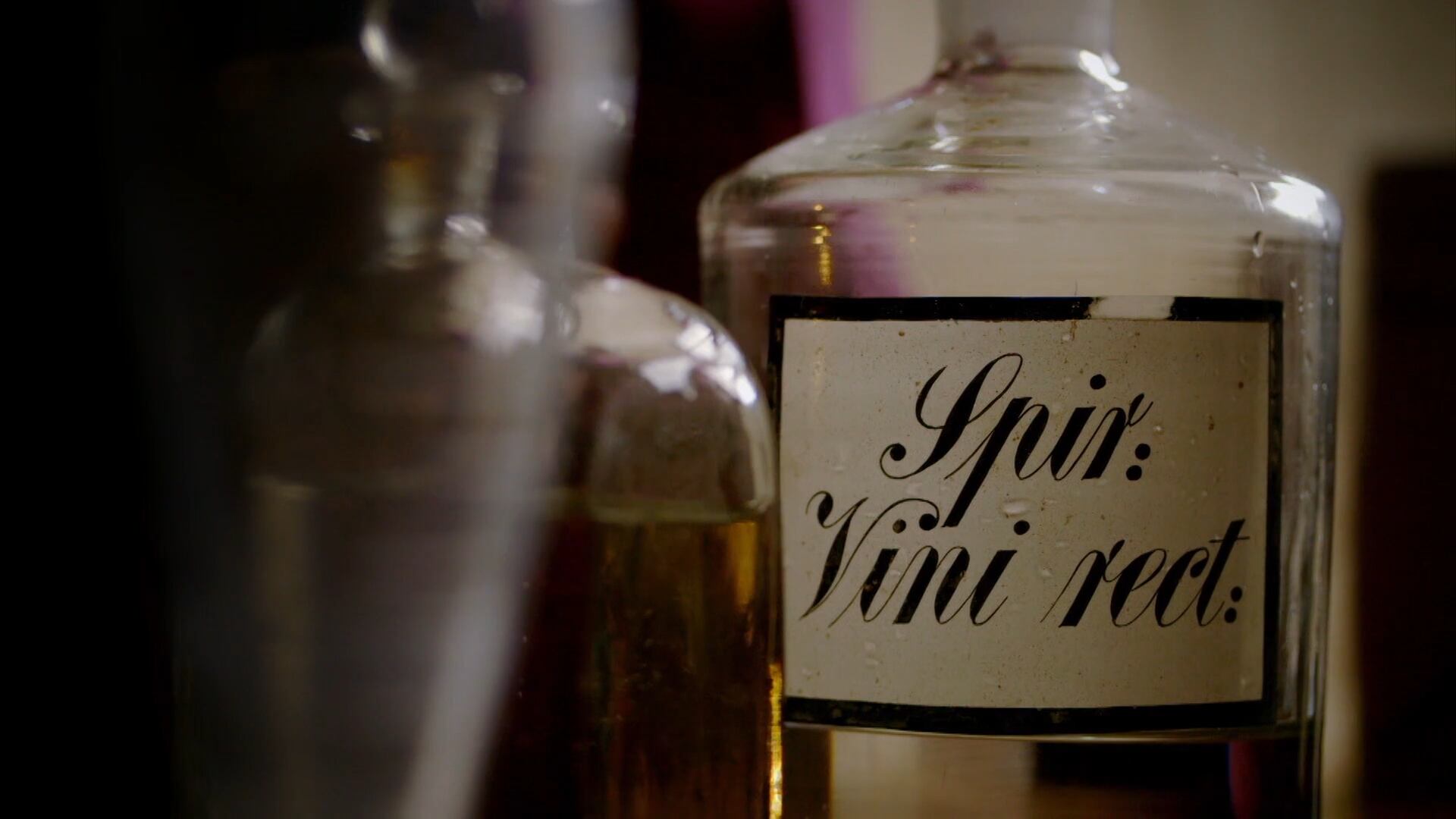
On this episode of Cheddar Reveals, Natalie Ginsberg, Global Impact Officer, MAPS, discusses the MAPS organization and its current initiatives and their work to get FDA approval for MDMA to treat PTSD; Kelsey Ramsden, Co-Founder, President & CEO, Mind Cure Health, breaks down what 'psychedelic therapy' could look like once it's legalized and how Mind Cure Health is using AI to help treat everything from addiction to depression; Cheddar gets a look at Curiosity Stream's 'Pain, Pus and Poison.'