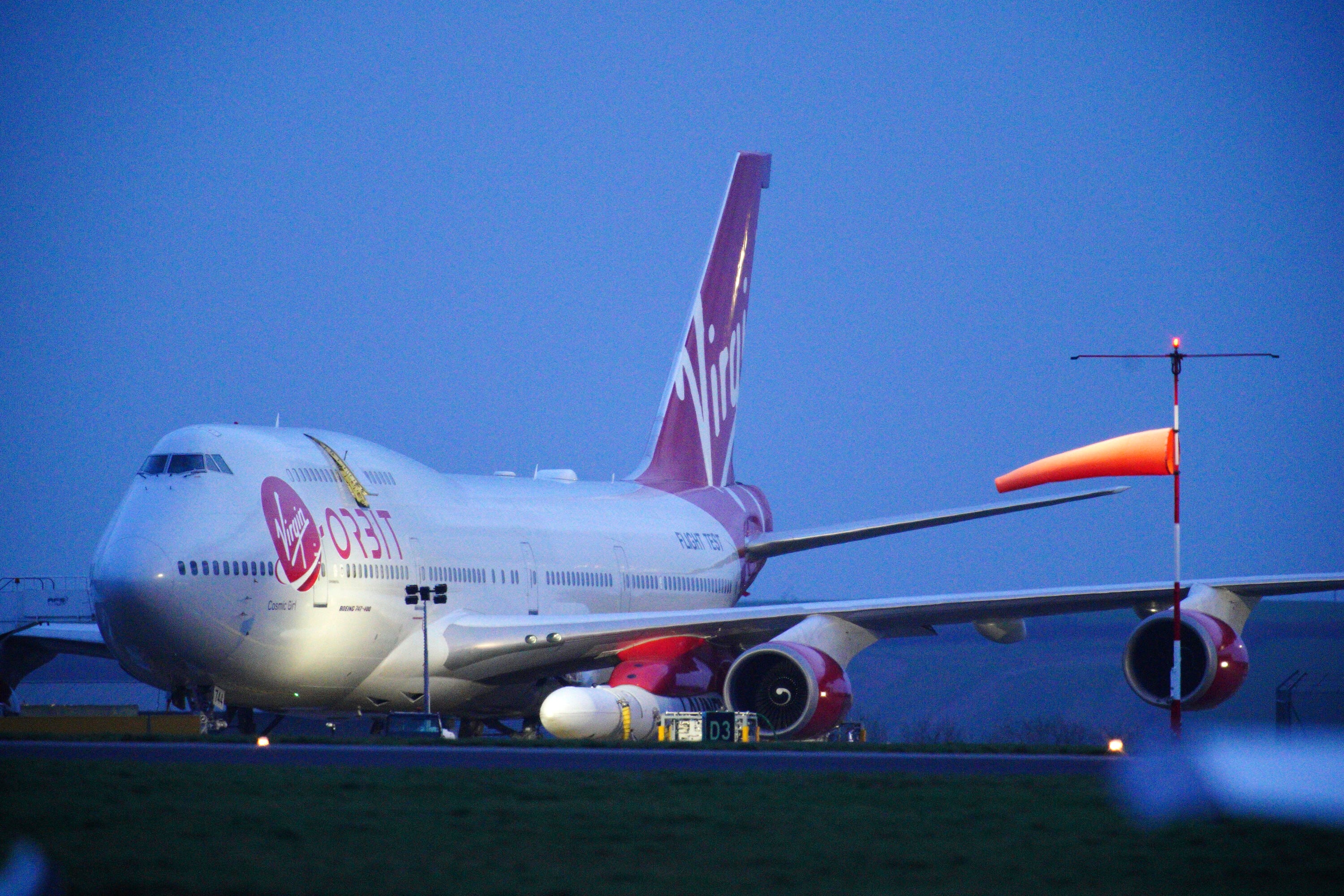
Virgin Atlantic Cosmic Girl, a repurposed Virgin Atlantic Boeing 747 aircraft carrying a rocket, is parked at Spaceport Cornwall, at Cornwall Airport in Newquay, England, Monday, Jan. 9, 2023. (Ben Birchall/PA via AP)
LONDON (AP) — British officials and space scientists said Tuesday they were disappointed but not deterred after the first attempt to launch satellites into orbit from the U.K. ended in failure.
U.S.-based Virgin Orbit attempted its first international launch late Monday, using a modified jumbo jet to carry one if its rockets from Cornwall in southwestern England over the Atlantic Ocean.
The plane released the rocket, carrying nine small satellites for a mix of civilian and domestic uses. But about two hours after the plane took off, the company reported “an anomaly that has prevented us from reaching orbit.”
The plane, piloted by a Royal Air Force pilot, returned to Cornwall. The rocket and satellites were destroyed.
“We’re feeling awful, to be honest – I’m not going to lie,” Melissa Thorpe, head of Spaceport Cornwall. said.
“This isn’t the first time we’ve been knocked, this is the biggest definitely, but I feel OK and we’ll get up and we’ll go again,” she said.
Virgin Orbit, which was founded by British transport and telecommunications tycoon Richard Branson, previously completed four similar launches from California.
Hundreds of people gathered for the Cornwall launch had cheered when a repurposed Virgin Atlantic Boeing 747 aircraft, named Cosmic Girl, took off late Monday. Around an hour into the flight, the plane released the rocket at around 35,000 feet (around 10,000 meters) over the Atlantic Ocean to the south of Ireland.
Virgin Orbit chief executive Dan Hart said “a technical failure appears to have prevented us from delivering the final orbit.”
“While we are very proud of the many things that we have successfully achieved as part of this mission, we are mindful that we failed to provide our customers with the launch service they deserve,” he said.
The mission was a collaboration between the U.K. Space Agency, the Royal Air Force, Virgin Orbit and Cornwall Council.
Britain hopes to become a major player in making and launching satellites, and is building a spaceport in the Shetland Islands north of Scotland as well as the one in Cornwall.
U.K. Business Secretary Grant Shapps said Monday’s launch was “a big moment” despite its failure.
“Space is difficult,” Shapps told Sky News.
“It didn’t work. I’ve no doubt that they’ll pick themselves up, dust themselves off and they’ll go again once they find out what exactly went wrong with it,” he said.
On this episode of Cheddar Innovates: President of The Pillow Bar breaks down how everyone can benefit from a pillow customized to their unique way of sleeping; CEO of H2Pro explains how to bring environmentally friendly hydrogen to scale; Cheddar gets a look at Curiosity Stream's 'Suppressed Science.'
On this episode of Cheddar Innovates: Gardenuity CEO breaks down how gardening can improve your wellbeing; Augmedix CEO discusses how this technology is helping doctors fight burnout; Cheddar gets a look at Curiosity Stream's 'Suppressed Science.'
On this episode of Cheddar Innovates: Atom Limbs CEO breaks down how the Atom Touch prosthetic is different from other prosthetics on the market; CEO & Chief Scientific Officer of MyMD explains how the MYMD-1 is on track to be the first FDA-approved drug to treat aging and age-related diseases; A look at Curiosity Stream's 'The Future of Warfare.'
On this episode of Cheddar Innovates: SkilsVR CEO explains how virtual reality is being used to train frontline workers to handle difficult customers; Rubicon CEO breaks down how technology and sustainability will go hand in hand in the future; Cheddar gets a look at 'Our Infinite Universe.'
A UN report is warning that relying on seawalls and other engineering fixes will not be enough to keep communities safe from rising sea levels and climate change consequences. Dr. Steve Rose, a senior research economist at the Electric Power Research Institute, joins Cheddar News to discuss.
As gas prices surge amid the Russian invasion of Ukraine, other nations could potentially transition faster to using clean energy than previously expected. Philip K. Verleger, a senior fellow at the Niskanen Center, joined Cheddar News to explain how this could be a possibility in the near future. "Part of the reason I think we have this invasion and the tantrum that's being thrown by Russia, terrible tantrum, is because the Russians were trying to slow down the transition," he said. "Ironically they speeded it up."
As Russia intensifies its war on Ukraine, President Biden announced a ban on oil imported from the aggressor nation. Critics of Russia have said this would be the best way to force Putin to pull back, but curbs on Russian oil exports are expected to send already skyrocketing oil and gas prices even higher, further impacting consumers, businesses, financial markets, and the global economy. Leslie Beyer, CEO of the Energy Workforce and Technology Council, joined Cheddar News' Closing Bell to discuss. "It's certainly going to increase pricing, but it is the right thing to do," she said. "The industry itself has already pulled out of the significant portion of its operations in Russia."
On this episode of Cheddar Innovates: Vision Marine Technologies CEO discusses how e-boats will play a role in the fight against the climate crisis; Lasso CEO breaks down how the design behind these compression socks can prevent injuries and improve performance; Cheddar gets a look at Curiosity Stream's 'The Tombs Of Egypt.'
Vaccine maker Pfizer delayed its COVID shot for kids allegedly due to a lack of data on how it would perform against the omnicron variant, according to the Wall Street Journa. Peter Pitts, professor and founder of the Center for Medicine in the Public Interest and a former FDA associate commissioner, joined Cheddar News Wrap to break down why the authorization can't be rushed. "Going forward, the FDA wants to look at data specifically against omicron, and it looks like that's going to be a three-shot regimen versus two, which was efficient against delta but not omicron because obviously omicron is more infectious," said Pitts.
Walker Ross, Assistant Professor of Sports Business Management at Florida Southern College, joins Business of Sports: The Beijing Winter Olympics 2022, where he says that actions Beijing and other Olympic host sites have been implementing to combat climate change has simply not been enough to offset their carbon footprint.