By Rodney Muhumuza
Uganda's president has signed into law anti-gay legislation supported by many in this East African country but widely condemned by rights activists and others abroad.
The version of the bill signed by President Yoweri Museveni doesn't criminalize those who identify as LGBTQ, a key concern for some rights campaigners who condemned an earlier draft of the legislation as an egregious attack on human rights.
But the new law still prescribes the death penalty for “aggravated homosexuality,” which is defined as cases of sexual relations involving people infected with HIV, as well as with minors and other categories of vulnerable people.
A suspect convicted of “attempted aggravated homosexuality” can be imprisoned for up to 14 years, according to the legislation.
Parliamentary Speaker Anita Among said in a statement that the president had “answered the cries of our people” in signing the bill.
“With a lot of humility, I thank my colleagues the Members of Parliament for withstanding all the pressure from bullies and doomsday conspiracy theorists in the interest of our country,” the statement said.
Museveni had returned the bill to the national assembly in April, asking for changes that would differentiate between identifying as LGBTQ and actually engaging in homosexual acts. That angered some lawmakers, including some who feared the president would proceed to veto the bill amid international pressure. Lawmakers passed an amended version of the bill earlier in May.
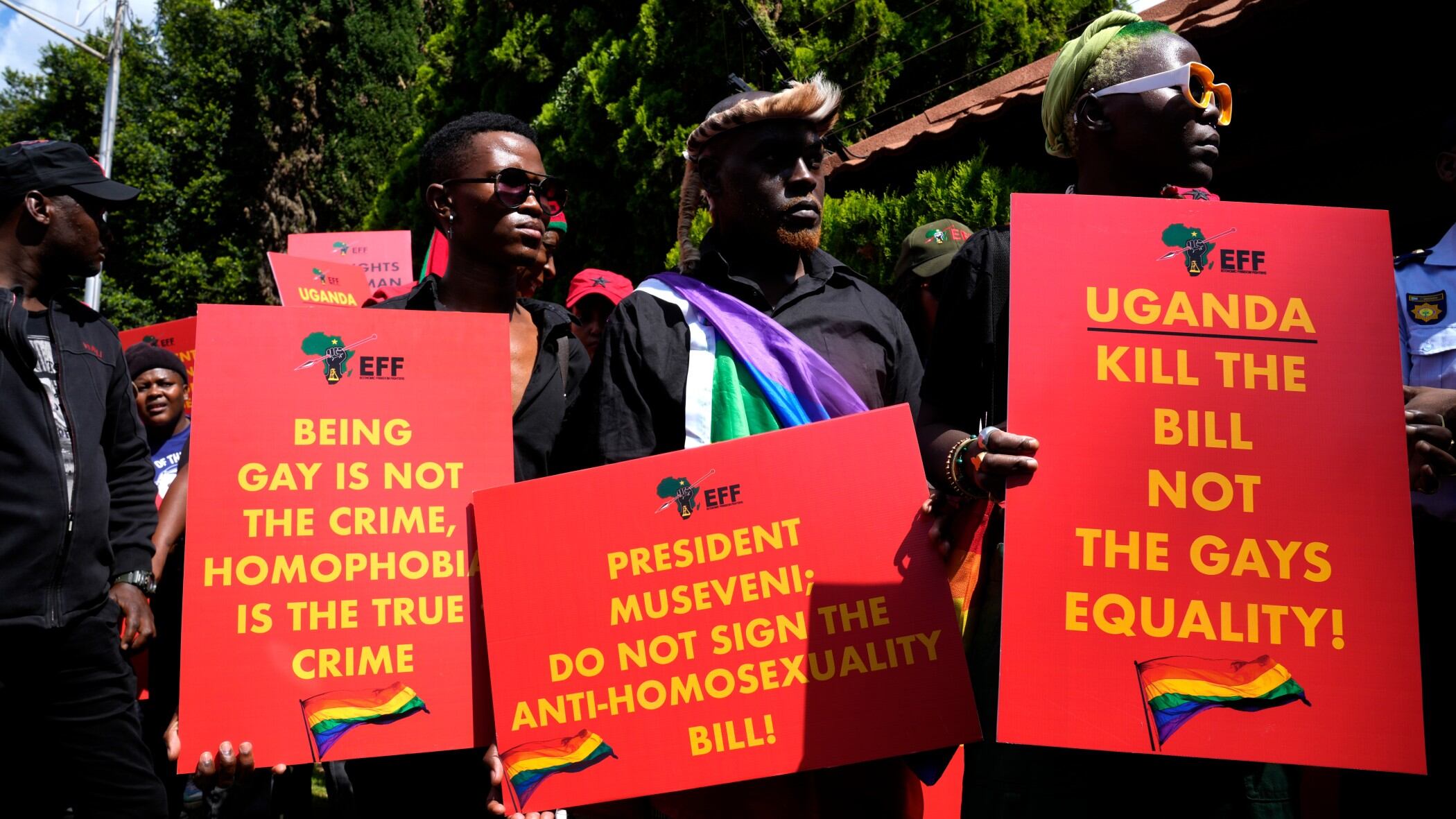
LGBTQ rights campaigners say the new legislation is unnecessary in a country where homosexuality has long been illegal under a colonial-era law criminalizing sexual activity “against the order of nature.” The punishment for that offense is life imprisonment.
The U.S. had warned of economic consequences over legislation described by Amnesty International as “draconian and overly broad.” In a statement from the White House later on Monday, U.S. President Joe Biden called the new law “a tragic violation of universal human rights — one that is not worthy of the Ugandan people, and one that jeopardizes the prospects of critical economic growth for the entire country.”
"I join with people around the world — including many in Uganda — in calling for its immediate repeal. No one should have to live in constant fear for their life or being subjected to violence and discrimination. It is wrong," Biden said.
The U.N. Human Rights Office said it was “appalled that the draconian and discriminatory anti-gay bill is now law," describing the legislation as ”a recipe for systematic violations of the rights" of LGBTQ people and others.
In a joint statement the leaders of the U.N. AIDS program, the U.S. President's Emergency Plan for AIDS Relief and the Global Fund said they were “deeply concerned about the harmful impact” of the legislation on public health and the HIV response.
“Uganda’s progress on its HIV response is now in grave jeopardy,” the statement said. “The Anti-Homosexuality Act 2023 will obstruct health education and the outreach that can help end AIDS as a public health threat.”
That statement noted that “stigma and discrimination associated with the passage of the Act has already led to reduced access to prevention as well as treatment services" for LGBTQ people.
Rights activists have the option of appealing the legislation before the courts. One group of activists and academics later on Monday petitioned the constitutional court seeking an injunction against enforcement of the law.
An anti-gay bill enacted in 2014 was later nullified by a panel of judges who cited a lack of quorum in the plenary session that had passed that particular bill. Any legal challenge this time is likely to be heard on the merits, rather than on technical questions.
Anti-gay sentiment in Uganda has grown in recent weeks amid news coverage alleging sodomy in boarding schools, including a prestigious school for boys where a parent accused a teacher of abusing her son.
The February decision of the Church of England ’s national assembly to continue banning church weddings for same-sex couples while allowing priests to bless same-sex marriages and civil partnerships outraged many in Uganda and elsewhere in Africa.
Homosexuality is criminalized in more than 30 of Africa’s 54 countries. Some Africans see it as behavior imported from abroad and not a sexual orientation.