ALEX VEIGA and DAMIAN J. TROISE AP Business Writers
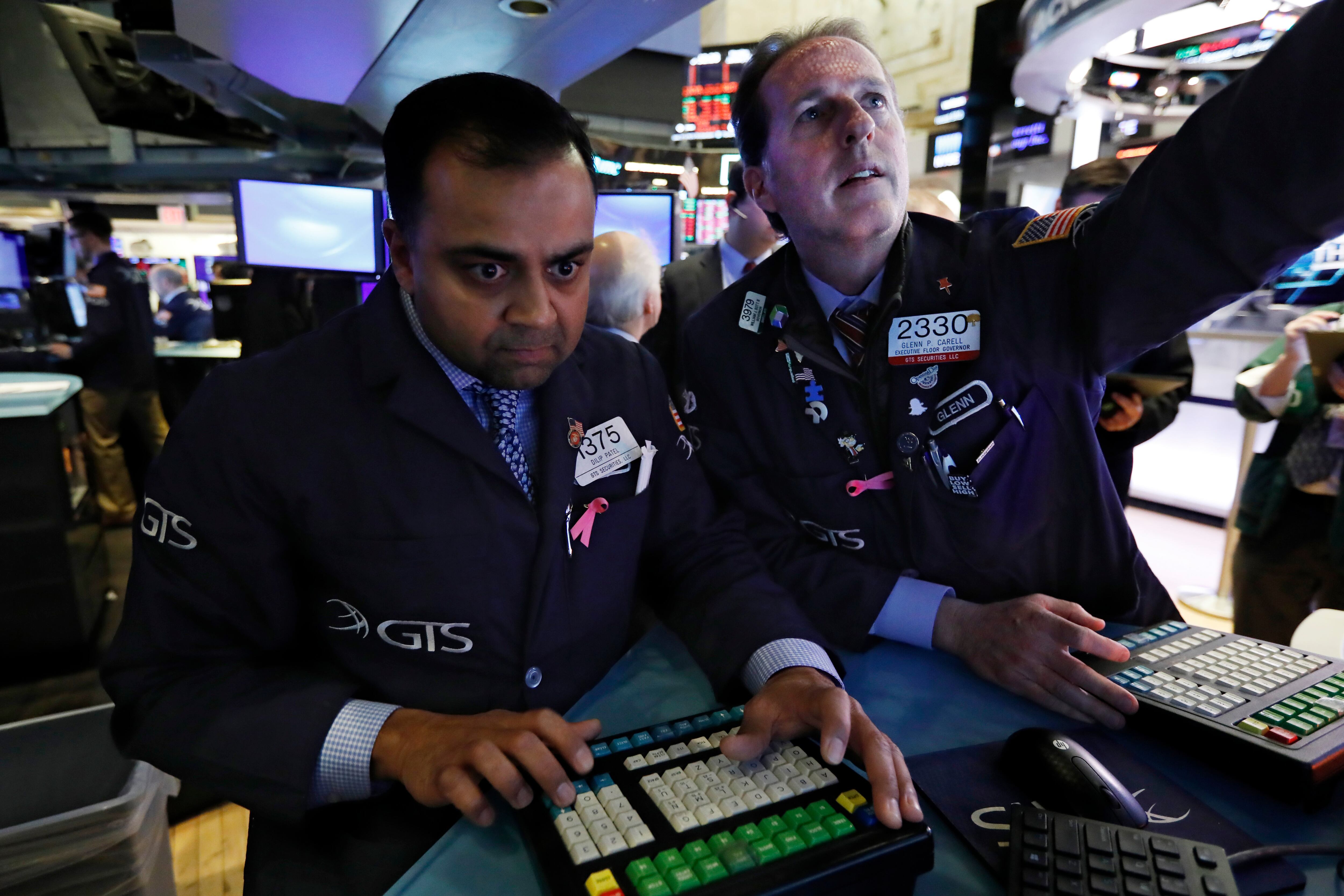
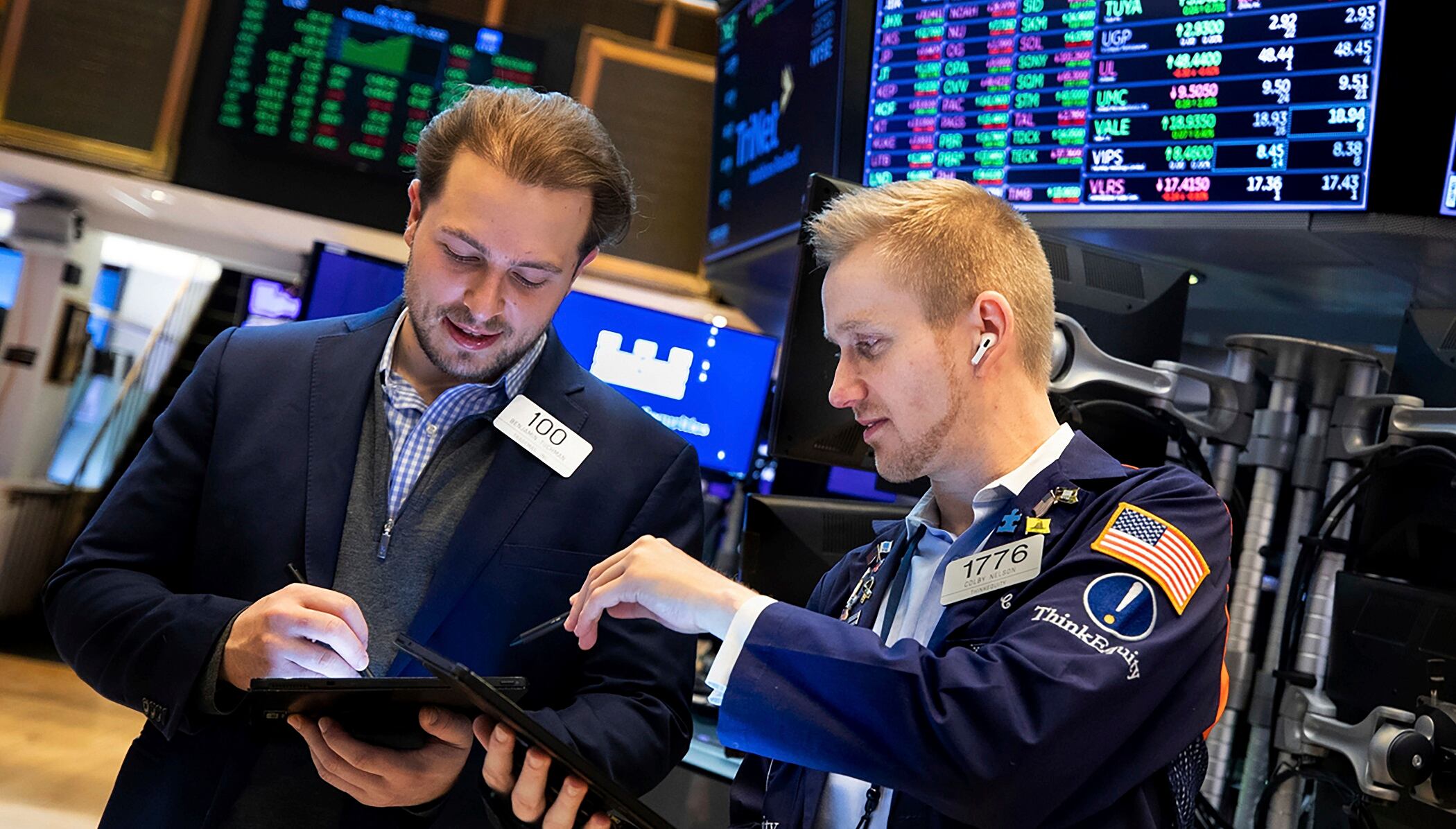
U.S. stocks fell sharply Monday, sending the Dow Jones Industrial Average down by more than 450 points, as investors grappled with fresh worries about the spread of a new virus in China that threatens global economic growth.
The sell-off gave the Dow its first 5-day losing streak since early August and handed the S&P 500 its worst day since early October. Both indexes were off about 1.5%, giving up a significant portion of their gains this month.
The latest bout of selling on Wall Street came after China announced a sharp rise in cases of the virus.
Airlines, resorts and other companies that rely on travel and tourism suffered steep losses. Gold prices rose as did bonds as traders sought refuge in safer holdings. The yield on the 10-year Treasury fell to 1.60%, its lowest level since October. The market's broad slide followed a sell-off in markets in Europe and Japan.
“Over the weekend you saw more cases,” said Quincy Krosby, chief market strategist at Prudential Financial. “That got investors and traders worried that this may be a longer event. The next question is, 'What happens to global growth if this does continue and magnify?'"
The Dow Jones Industrial Average fell 453.93 points, or 1.6%, to 28,535.80. The Dow had been down nearly 550 points. The S&P 500 index dropped 51.84 points, or 1.6%, to 3,243.63. The Nasdaq lost 175.60 points, or 1.9%, to 9,139.31. The Russell 2000 index of smaller company stocks gave up 18.09 points, or 1.1%, to 1,644.14.
Most markets in Asia were closed for the Lunar New Year holiday, but Japan’s Nikkei fell 2.03%, its biggest decline in five months. European markets also slumped. Germany’s DAX and France’s CAC 40 dove 2.7%.
Chinese health authorities have confirmed 2,750 cases of the virus along with 81 related deaths as authorities extended a week-long public holiday by an extra three days as a precaution against having the virus spread still further. The virus has spread to a dozen countries, including the U.S. Besides the threat to people's lives and health, investors are worried about how much damage the virus will do to profits for companies around the world.
Even if they're thousands of miles away from Wuhan, the interconnected global economy means U.S. companies have plenty of customers and suppliers in China. It's the world's second-largest economy, and it accounts for 6% of all revenue for S&P 500 companies over the last 12 months. That's nearly double any other country besides the United States, according to FactSet.
“Markets hate uncertainty, and the coronavirus is the ultimate uncertainty in that no one knows how badly it will impact the global economy,” said Alec Young, managing director of global markets research at FTSE Russell.
Resort operators were among the biggest losers in the S&P 500. Wynn Resorts led all company’s in the index lower with an 8.1% tumble, while Las Vegas Sands dropped 6.7%. The companies get most of their revenue from the Chinese gambling haven of Macao. MGM Resorts fell 3.9%.
American Airlines lost 5.5% and Delta dropped 3.4% as part of a broad slide for airlines because of concerns international travel will decline amid the virus’ spread.
Booking companies and cruise-line operators also got hurt. Expedia Group fell 2.7% and Carnival slid 4.7%.
Chinese companies that trade shares in the U.S. also declined. Search engine operator Baidu fell 2.9% and e-commerce company JD.com dropped 4.8%.
The technology sector, the biggest in the S&P 500, also saw heavy selling. Apple, which relies on China for supplies and sales, fell 2.9%.
Financial stocks also took steep losses. Citigroup dropped 2.2%.
Energy stocks fell broadly as U.S. oil prices fell 1.9% on worries about reduced demand from China. Schlumberger skidded 5.1%.
Utilities, real estate stocks and household goods makers held up better than the rest of the market, though they still finished in the red. The sectors are viewed as less-risky and are not as affected by international issues and developments.
A few companies managed to climb against the sliding markets. Bleach and cleaning products maker Clorox rose 1.1%.
Small biotechnology companies and drug developers made some of the biggest gains. Cleveland BioLabs more than doubled, while NanoViricides and BioCryst also climbed sharply.
"If you look at this right now, investors and traders are looking at pockets of opportunity,” Krosby said. “It's not a question of if, but when they start buying.”
Investors are also dealing with a heavy week of corporate earnings. Apple will report financial results on Tuesday. Pharmaceutical giant Pfizer and Starbucks will also report.
Boeing, McDonald’s, Coca-Cola and Amazon are also among some of the biggest names reporting earnings throughout the week that includes 147 S&P 500 companies.
Benchmark crude oil fell $1.05 to settle at $53.14 a barrel. Brent crude oil, the international standard, dropped $1.37 to close at $59.32 a barrel.
Wholesale gasoline slid 3 cents to $1.48 per gallon. Heating oil declined 5 cents to $1.70 per gallon. Natural gas inched 1 cent higher to $1.90 per 1,000 cubic feet.
Gold rose $5.50 to $1,577.40 per ounce, silver fell 6 cents to $18.06 per ounce and copper slid 9 cents to $2.60 per pound.
The dollar fell to 108.92 Japanese yen from 109.24 yen on Friday. The euro weakened to $1.1020 from $1.1029.
Christian Ledoux, Director of Investment Research at CAPTRUST, talks about the ripple effect Russia's invasion of Ukraine is having on U.S. markets and outlines ways investors are navigating volatility.
Craig Fehr, Principal & Investment Strategist at Edward Jones, talks about the major risks to the markets and which industries are poised for growth in the near term.
Rob Haworth, Senior Investment Strategist at U.S. Bank Wealth Management, discusses how Markets can navigate geopolitical conflict and whether the Fed will take an aggressive stance on inflation.
Ukrainian President Volodymyr Zelenskyy has signed an application for Ukraine's membership in the European Union, pleading with the bloc to accept this request. It comes as Russian forces push further into Ukraine, forcing at least half a million refugees to flee. Benjamin Schmitt, Postdoctoral Research Fellow at Harvard University and Senior Fellow at the Center for European Policy Analysis, breaks down the latest in Ukraine.
A growing wave of major U.S. companies have taken steps to cut ties with Russia or offer support to Ukraine, as tensions escalate in the region. Exxon, Apple and Boeing are just the latest companies to make the move, following the likes of Google, Meta and BP who have all announced plans to exit the region in response to the conflict. Courtney Vinopal, Breaking News Reporter, Quartz joined Cheddar's Opening Bell for more.
Uber is rolling out a new feature on its app called Explore that will allow users to discover things to do in their area such as dining. The new service is now available in 14 U.S. cities.
Traci Gusher, EY Americas data and analytics leader, joins Cheddar News to discuss how companies have made strides within data and analytics throughout the pandemic and what the chief information officers of today need to focus on and dedicate resources to.
Wall Street took another sharp swing Wednesday, this time back to rally mode, as stocks and Treasury yields rose even as U.S. crude oil prices climbed to the highest level in more than a decade.
The S&P 500 rose 1.9%, recouping its losses from earlier in the week, after Federal Reserve Chair Jerome Powell said he supports a more modest rise in interest rates this month than some investors had feared. He also said he still expects inflation, which is at its highest level in 40 years, to moderate through the year.
“Although we’ve had some Fed governors lately saying ‘Oh my God, this is such a huge crisis,’ the conventional wisdom is slow and steady wins the race right now,” said J.J. Kinahan, chief strategist with TD Ameritrade.
The comments helped drive the market higher, adding to modest gains from earlier in the morning. Other areas of the market also gained ground a day after worries about Russia’s invasion of Ukraine sent the S&P 500 tumbling 1.5% and prices soaring for all kinds of commodities.
Treasury yields jumped to recover some of their steep losses from the past week. Gold receded, and a measure of nervousness among stock investors on Wall Street eased after swinging sharply in recent days.
“We’ve seen wild swings, but not major changes in the indexes,” said Jeff Kleintop, chief global investment strategist at Charles Schwab. “Geopolitical conflicts can be very unsettling, but you don’t tend to get bear markets from these, just periods of volatility.”
Markets have been spinning wildly as investors try, sometimes blindly, to gauge how high Russia's attack on Ukraine will push prices for oil, wheat and other commodities where the region is a major producer. On top of that are worries about what upcoming hikes in interest rates by the Federal Reserve and other central banks around the world will do to the economy and inflation.
Powell said in testimony to Congress that the Fed is set to raise its key interest rate for the first time since 2018. But he also said the attack on Ukraine may have muddied conditions, with its impact on the U.S. economy “highly uncertain,” adding that “we're never on autopilot.”
The Fed is balancing a tightrope where it needs to raise interest rates enough to rein in the highest inflation in generations but not so much that it pushes the economy into a recession. All the while, higher interest rates tend to put downward pressure on stocks and most other investments.
The yield on the 10-year Treasury leaped to 1.89% from 1.72% late Tuesday, while the two-year Treasury surged to 1.53% from 1.31%. Yields, though, remain well below where they were before Russia’s invasion. The 10-year yield was above 2% last month, before it plunged as investors plowed into investments seen as safer amid worries about war.
The price of U.S. oil jumped another 7% to $110.60 per barrel, the highest level in just over a decade. Brent crude, the international standard, climbed 7.6% to $112.93 per barrel.
Leaders of OPEC and other major oil-producing countries decided Wednesday to stick with their plan to gradually increase oil production. The OPEC+ coalition of oil producers, made up of OPEC members led by Saudi Arabia and non-cartel members led by Russia, chose to increase oil production by 400,000 barrels per day in April.
The move follows a perhaps less impactful decision by the United States and other major governments in the International Energy Agency to release 60 million barrels from strategic reserves to boost supplies.
“Markets dismissed the notion that 60 million barrels of strategic reserves released will be consequential to the risks of Russian supply jeopardized,” Tan Boon Heng of Mizuho Bank said in a report. “Russia pumps more than that in just six days.”
In the stock market, all the uncertainty about oil prices and inflation has led to big swings not only by the day but also by the hour. The S&P 500 swung between gains of 0.4% and 2.2% Wednesday. It closed 80.28 points higher to 4,386.54.
The Dow Jones Industrial Average rose 596.40 points, or 1.8%, to 33,891.35, while the Nasdaq composite gained 219.56 points, or 1.6%, to 13,752.02.
More than 90% of stocks in the S&P 500 rose, with technology, financial and health care companies accounting for a big share of the rally. Bank stocks led the gainers, climbing 2.6%, as higher longer-term interest rates can mean bigger profits for them making loans. Energy stocks also helped lift the index as they rode higher energy prices.
Ross Stores climbed 6.1% after the retail chain reported stronger profit for its last quarter than analysts expected.
Ford jumped 8.4% after it said it was accelerating its transformation into an electric-vehicle company and split its EV and internal combustion operations into two individual businesses.
Stock markets around the world were mixed. France’s CAC 40 rose 1.6%, Germany’s DAX returned 0.7% and Japan’s Nikkei 225 fell 1.7%.
Russia’s central bank said stock trading on the Moscow exchange would remain closed Wednesday for a third day, though trading of currencies and precious metals would resume for the first time this week.
Late Tuesday, President Joe Biden announced he was joining U.S. allies in closing the country’s air space to Russian aircraft, the latest in a set of sanctions and other measures meant to isolate Russia.
But Biden also said in his annual State of the Union speech that he would try to cushion Americans against the impact of higher oil prices. “I will use every tool at our disposal to protect American businesses and consumers,” Biden said.
To kick off Women's History Month, Luminary will be hosting its first annual #InThisTogether Summit. Cate Luzio, founder and CEO of Luminary, joins Cheddar News to discuss the event.