ALEX VEIGA and DAMIAN J. TROISE AP Business Writers
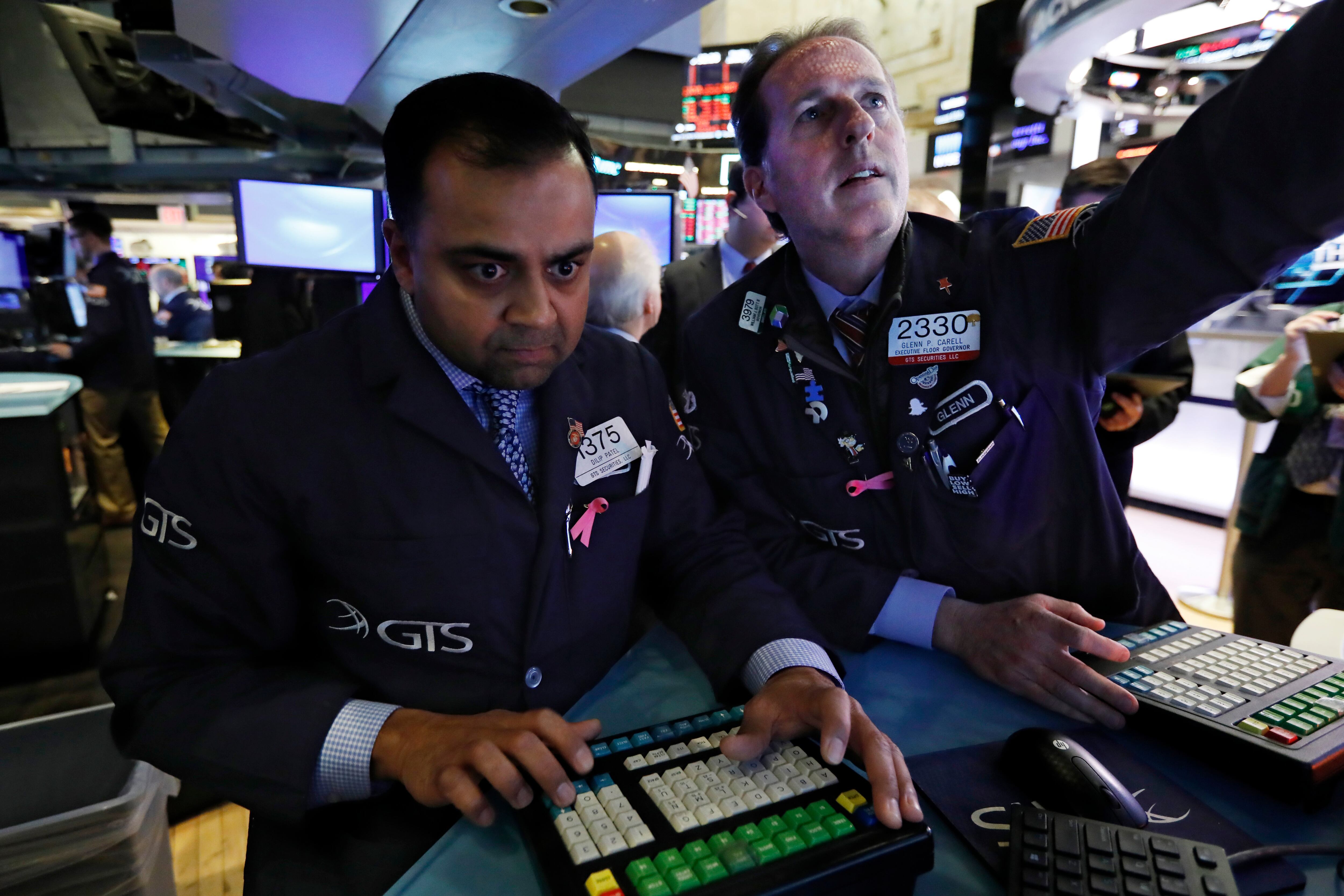
U.S. stocks fell sharply Monday, sending the Dow Jones Industrial Average down by more than 450 points, as investors grappled with fresh worries about the spread of a new virus in China that threatens global economic growth.
The sell-off gave the Dow its first 5-day losing streak since early August and handed the S&P 500 its worst day since early October. Both indexes were off about 1.5%, giving up a significant portion of their gains this month.
The latest bout of selling on Wall Street came after China announced a sharp rise in cases of the virus.
Airlines, resorts and other companies that rely on travel and tourism suffered steep losses. Gold prices rose as did bonds as traders sought refuge in safer holdings. The yield on the 10-year Treasury fell to 1.60%, its lowest level since October. The market's broad slide followed a sell-off in markets in Europe and Japan.
“Over the weekend you saw more cases,” said Quincy Krosby, chief market strategist at Prudential Financial. “That got investors and traders worried that this may be a longer event. The next question is, 'What happens to global growth if this does continue and magnify?'"
The Dow Jones Industrial Average fell 453.93 points, or 1.6%, to 28,535.80. The Dow had been down nearly 550 points. The S&P 500 index dropped 51.84 points, or 1.6%, to 3,243.63. The Nasdaq lost 175.60 points, or 1.9%, to 9,139.31. The Russell 2000 index of smaller company stocks gave up 18.09 points, or 1.1%, to 1,644.14.
Most markets in Asia were closed for the Lunar New Year holiday, but Japan’s Nikkei fell 2.03%, its biggest decline in five months. European markets also slumped. Germany’s DAX and France’s CAC 40 dove 2.7%.
Chinese health authorities have confirmed 2,750 cases of the virus along with 81 related deaths as authorities extended a week-long public holiday by an extra three days as a precaution against having the virus spread still further. The virus has spread to a dozen countries, including the U.S. Besides the threat to people's lives and health, investors are worried about how much damage the virus will do to profits for companies around the world.
Even if they're thousands of miles away from Wuhan, the interconnected global economy means U.S. companies have plenty of customers and suppliers in China. It's the world's second-largest economy, and it accounts for 6% of all revenue for S&P 500 companies over the last 12 months. That's nearly double any other country besides the United States, according to FactSet.
“Markets hate uncertainty, and the coronavirus is the ultimate uncertainty in that no one knows how badly it will impact the global economy,” said Alec Young, managing director of global markets research at FTSE Russell.
Resort operators were among the biggest losers in the S&P 500. Wynn Resorts led all company’s in the index lower with an 8.1% tumble, while Las Vegas Sands dropped 6.7%. The companies get most of their revenue from the Chinese gambling haven of Macao. MGM Resorts fell 3.9%.
American Airlines lost 5.5% and Delta dropped 3.4% as part of a broad slide for airlines because of concerns international travel will decline amid the virus’ spread.
Booking companies and cruise-line operators also got hurt. Expedia Group fell 2.7% and Carnival slid 4.7%.
Chinese companies that trade shares in the U.S. also declined. Search engine operator Baidu fell 2.9% and e-commerce company JD.com dropped 4.8%.
The technology sector, the biggest in the S&P 500, also saw heavy selling. Apple, which relies on China for supplies and sales, fell 2.9%.
Financial stocks also took steep losses. Citigroup dropped 2.2%.
Energy stocks fell broadly as U.S. oil prices fell 1.9% on worries about reduced demand from China. Schlumberger skidded 5.1%.
Utilities, real estate stocks and household goods makers held up better than the rest of the market, though they still finished in the red. The sectors are viewed as less-risky and are not as affected by international issues and developments.
A few companies managed to climb against the sliding markets. Bleach and cleaning products maker Clorox rose 1.1%.
Small biotechnology companies and drug developers made some of the biggest gains. Cleveland BioLabs more than doubled, while NanoViricides and BioCryst also climbed sharply.
"If you look at this right now, investors and traders are looking at pockets of opportunity,” Krosby said. “It's not a question of if, but when they start buying.”
Investors are also dealing with a heavy week of corporate earnings. Apple will report financial results on Tuesday. Pharmaceutical giant Pfizer and Starbucks will also report.
Boeing, McDonald’s, Coca-Cola and Amazon are also among some of the biggest names reporting earnings throughout the week that includes 147 S&P 500 companies.
Benchmark crude oil fell $1.05 to settle at $53.14 a barrel. Brent crude oil, the international standard, dropped $1.37 to close at $59.32 a barrel.
Wholesale gasoline slid 3 cents to $1.48 per gallon. Heating oil declined 5 cents to $1.70 per gallon. Natural gas inched 1 cent higher to $1.90 per 1,000 cubic feet.
Gold rose $5.50 to $1,577.40 per ounce, silver fell 6 cents to $18.06 per ounce and copper slid 9 cents to $2.60 per pound.
The dollar fell to 108.92 Japanese yen from 109.24 yen on Friday. The euro weakened to $1.1020 from $1.1029.