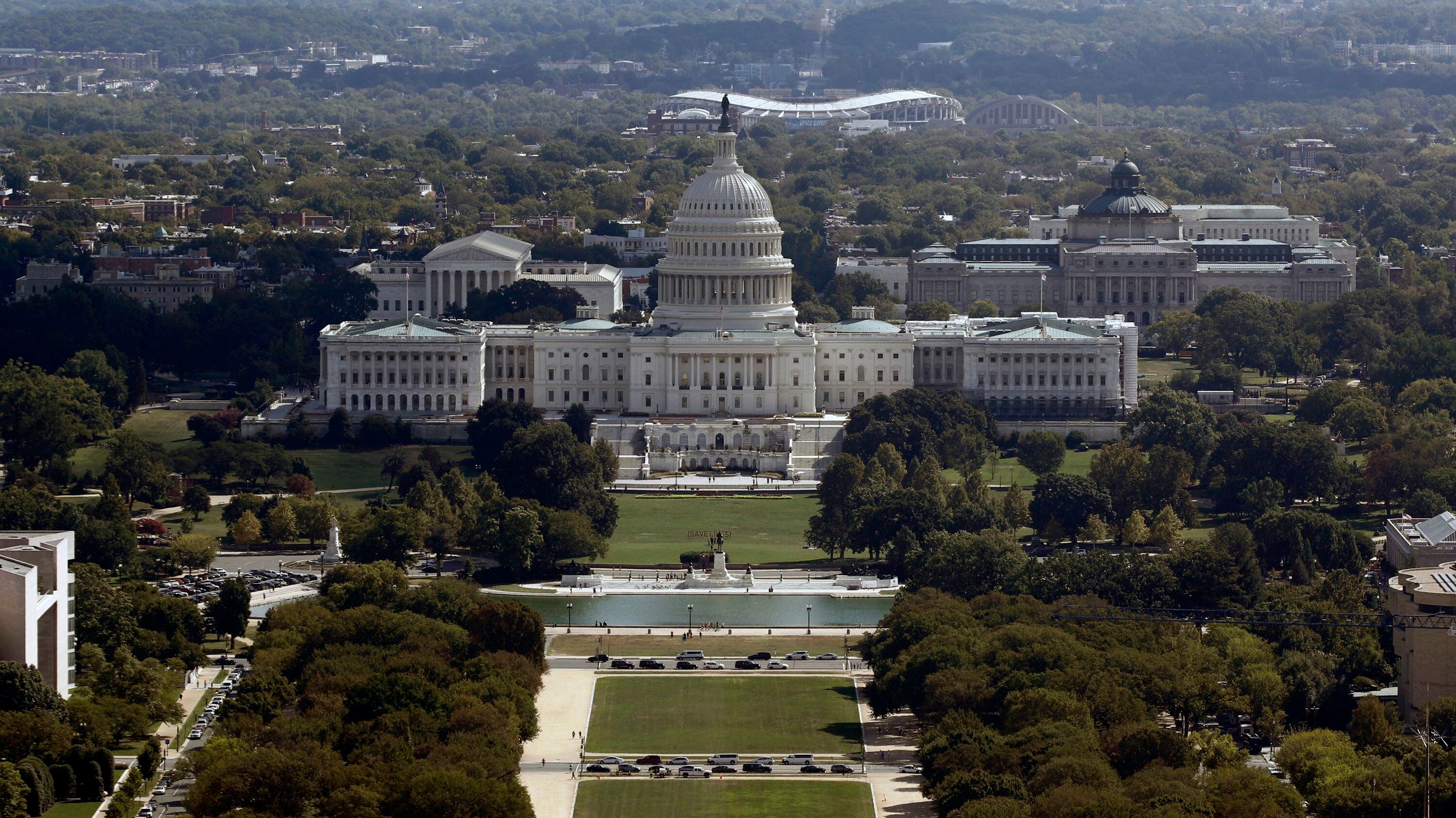
This Sept. 18, 2019, file photo shows the view of the U.S. Capitol building from the Washington Monument in Washington. The federal government incurred the biggest monthly budget deficit in history in June 2020 as spending on programs to combat the coronavirus recession exploded while millions of job losses cut into tax revenues. The Treasury Department reported Monday, July 13, 2020 that the deficit hit $864 billion last month, an amount of red ink that surpasses most annual deficits in the nation’s history and is above the previous monthly deficit record of $738 billion in April.(AP Photo/Patrick Semansky, File)
By Martin Crutsinger
The federal government incurred the biggest monthly budget deficit in history in June as spending on programs to combat the coronavirus recession exploded while millions of job losses cut into tax revenues.
The Treasury Department reported Monday that the deficit hit $864 billion last month, an amount of red ink that surpasses most annual deficits in the nation's history and is above the previous monthly deficit record of $738 billion in April. That amount was also tied to the trillions of dollars Congress has provided to cushion the impact of the widespread shutdowns that occurred in an effort to limit the spread of the viral pandemic.
For the first nine months of this budget year, which began Oct. 1, the deficit totals $2.74 trillion, also a record for that period. That puts the country well on the way to hitting the $3.7 trillion deficit for the whole year that has been forecast by the Congressional Budget Office.
That total would surpass the previous annual record of $1.4 trillion set in 2009 when the government was spending heavily to lift the country out of the recession caused by the 2008 financial crisis.
The June deficit was driven higher by spending on various government relief programs such as an extra $600 per week in expanded unemployment benefits and a Paycheck Protection Program that provided support to businesses to keep workers on their payrolls.
The report showed that the cost of the Paycheck Protection Program in June was $511 billion. That reflected a charge to the government for all the bank loans made under the program even though the government will not actually have to pay out funds until the banks determine whether the businesses met the criteria for having the loans forgiven. Those requirements include spending at least 60% of the loan amount on worker pay with the other 40% going to overhead costs such as rent and utilities.
Another reason for the surge in the June deficit was the government's decision to delay tax payments this year until July 15. That decision means that quarterly payments made by individual taxpayers and corporations will not be due until July 15 this year rather than June.
So far this budget year, revenues total $2.26 trillion, down 13.4% from the same period last year, while spending totals $5 trillion, up 49.1% from a year ago.
The CBO estimate of a $3.7 trillion deficit for this year could go higher depending on the course of the economy. The country fell into a deep recession in February, ending a record long expansion of nearly 11 years. The Trump administration is predicting that the economy will come roaring back in the second half of this year but many private forecasters are concerned that a resurgence of virus cases could make consumers too fearful to resume spending, which drives 70% of the economy.
Congress which has already approved more than $3 trillion in a series of rescue packages, is scheduled to debate another support effort when it returns from recess on June 20. Democrats are pushing for an extension of the expanded unemployment benefits which will soon run out.
Ukrainian President Volodymyr Zelenskyy has signed an application for Ukraine's membership in the European Union, pleading with the bloc to accept this request. It comes as Russian forces push further into Ukraine, forcing at least half a million refugees to flee. Benjamin Schmitt, Postdoctoral Research Fellow at Harvard University and Senior Fellow at the Center for European Policy Analysis, breaks down the latest in Ukraine.
A growing wave of major U.S. companies have taken steps to cut ties with Russia or offer support to Ukraine, as tensions escalate in the region. Exxon, Apple and Boeing are just the latest companies to make the move, following the likes of Google, Meta and BP who have all announced plans to exit the region in response to the conflict. Courtney Vinopal, Breaking News Reporter, Quartz joined Cheddar's Opening Bell for more.
A hospital basement in Ukraine’s coastal city of Mariupol has transformed into a bomb shelter and maternity ward amid shelling during Russia’s invasion.
World leaders are currently dealing with a handful of pressing issues, including Russia's invasion of Ukraine, inflation, and not to mention the COVID-19 pandemic; but it could be argued that the most pressing issue is one that has experienced its fair share of neglect in the past -- climate change. As tensions escalate between Russia and Ukraine, there is fear the focus on climate will once again be pushed aside. However, the White House appears to be making some effort to prevent that from happening. The White House Office of Science and Technology held a first-of-its-kind roundtable discussion with some of the nation's leading climate scientists on Thursday. Michael Mann, Director of the Earth System Science Center at Pennsylvania State University, and author of the book 'The New Climate War' joins Cheddar News' Closing Bell to discuss his experience as one of the climate scientists at the White House event.
Scott Clemons, Partner and Chief Investment Strategist at Brown Brothers Harriman, joins Cheddar News' Closing Bell, where he discusses the factors leading to the sell-off on Wall Street today and explains why uncertainty is worse than bad news for the investors.
U.S. stocks rebounded to end higher on Thursday after President Biden announced new sanctions against Russia following the country's attack on Ukraine. The Dow was down 859 points at its lowest point of the session, before ultimately finishing the day in the green. Melissa Armo, founder and owner of the Stock Swoosh, joins Cheddar News' Closing Bell to discuss.
People of African and Middle Eastern descent fleeing from Russia’s invasion of Ukraine are facing the double trauma of racism at the borders. Professor of law and migration studies at the University of San Francisco, Bill Hing, joined Cheddar News Wrap to discuss what some are describing as a double standard for other refugees escaping the war. "Those that are from the Middle East and from Africa who just happen to be in Ukraine, for example on a student visa, they are not going to be able to get into Poland or another area of the Schengen area because they are not natural Ukrainian," he said.
Add FIFA to the list of organizations announcing a break with Russia. The world soccer authority has suspended the nation from competing in the 2022 World Cup tournament, while the NHL also announced suspending business relations with Russia. Executive editor and senior writer at Sports Illustrated, Jon Wertheim, joined Cheddar News to discuss the rebukes. "I think a big element of this is, this is a way to really hit at Putin because we know how much this appearance of strength and the victory… often portrayed through sports, how much that means to him," he said. "This will bother him in a way that it might not bother other world leaders."