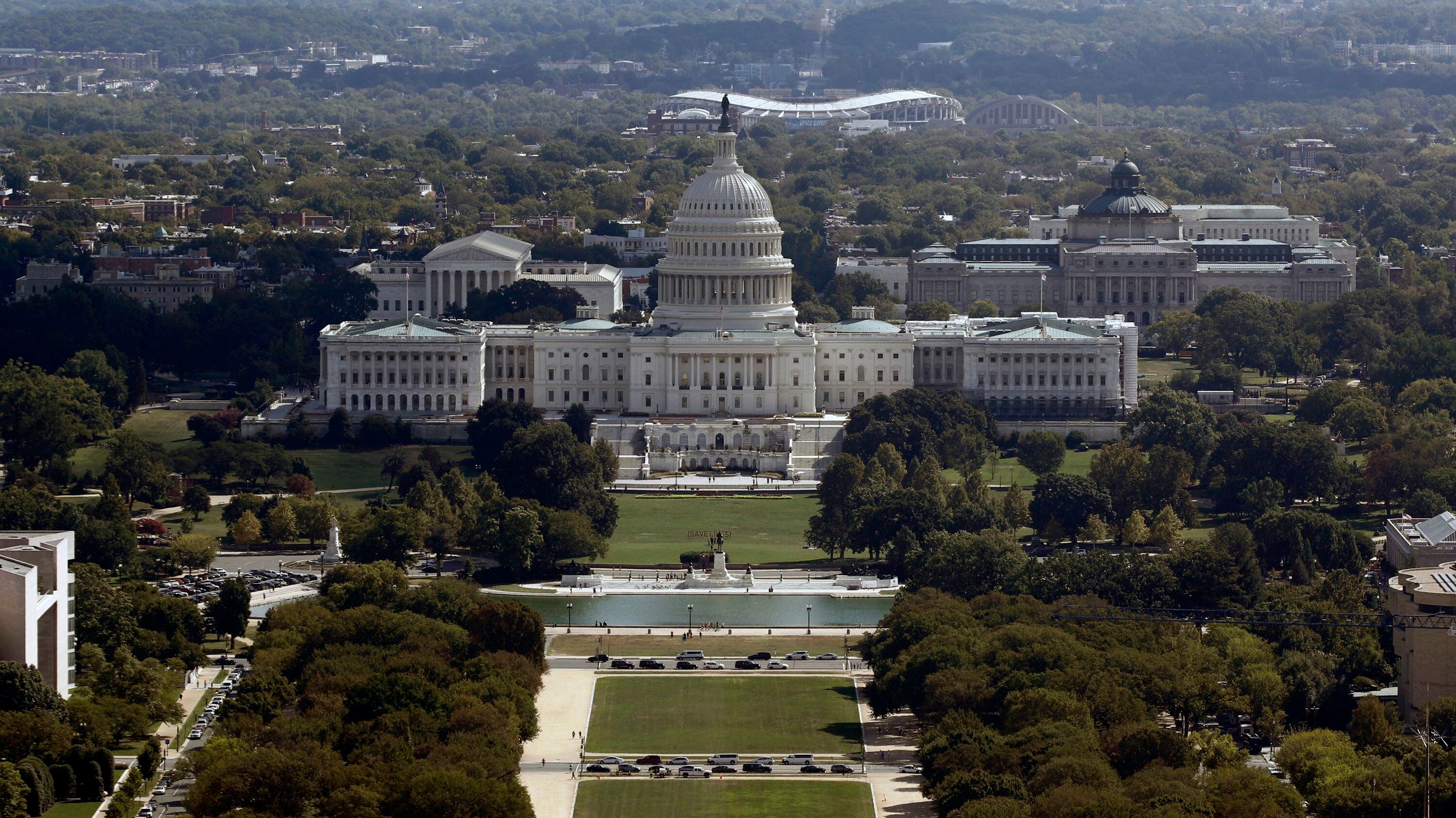
This Sept. 18, 2019, file photo shows the view of the U.S. Capitol building from the Washington Monument in Washington. The federal government incurred the biggest monthly budget deficit in history in June 2020 as spending on programs to combat the coronavirus recession exploded while millions of job losses cut into tax revenues. The Treasury Department reported Monday, July 13, 2020 that the deficit hit $864 billion last month, an amount of red ink that surpasses most annual deficits in the nation’s history and is above the previous monthly deficit record of $738 billion in April.(AP Photo/Patrick Semansky, File)
By Martin Crutsinger
The federal government incurred the biggest monthly budget deficit in history in June as spending on programs to combat the coronavirus recession exploded while millions of job losses cut into tax revenues.
The Treasury Department reported Monday that the deficit hit $864 billion last month, an amount of red ink that surpasses most annual deficits in the nation's history and is above the previous monthly deficit record of $738 billion in April. That amount was also tied to the trillions of dollars Congress has provided to cushion the impact of the widespread shutdowns that occurred in an effort to limit the spread of the viral pandemic.
For the first nine months of this budget year, which began Oct. 1, the deficit totals $2.74 trillion, also a record for that period. That puts the country well on the way to hitting the $3.7 trillion deficit for the whole year that has been forecast by the Congressional Budget Office.
That total would surpass the previous annual record of $1.4 trillion set in 2009 when the government was spending heavily to lift the country out of the recession caused by the 2008 financial crisis.
The June deficit was driven higher by spending on various government relief programs such as an extra $600 per week in expanded unemployment benefits and a Paycheck Protection Program that provided support to businesses to keep workers on their payrolls.
The report showed that the cost of the Paycheck Protection Program in June was $511 billion. That reflected a charge to the government for all the bank loans made under the program even though the government will not actually have to pay out funds until the banks determine whether the businesses met the criteria for having the loans forgiven. Those requirements include spending at least 60% of the loan amount on worker pay with the other 40% going to overhead costs such as rent and utilities.
Another reason for the surge in the June deficit was the government's decision to delay tax payments this year until July 15. That decision means that quarterly payments made by individual taxpayers and corporations will not be due until July 15 this year rather than June.
So far this budget year, revenues total $2.26 trillion, down 13.4% from the same period last year, while spending totals $5 trillion, up 49.1% from a year ago.
The CBO estimate of a $3.7 trillion deficit for this year could go higher depending on the course of the economy. The country fell into a deep recession in February, ending a record long expansion of nearly 11 years. The Trump administration is predicting that the economy will come roaring back in the second half of this year but many private forecasters are concerned that a resurgence of virus cases could make consumers too fearful to resume spending, which drives 70% of the economy.
Congress which has already approved more than $3 trillion in a series of rescue packages, is scheduled to debate another support effort when it returns from recess on June 20. Democrats are pushing for an extension of the expanded unemployment benefits which will soon run out.
Tim Davis, Partner and Executive Managing Director at Steward Partners, joins Cheddar News' Closing Bell, where he discusses what activity we could expect to see from the crypto market this week as the Fed decision approaches, the prices of Bitcoin and Ether struggle to find a spark, and the industry continues to digest President Biden's executive order on crypto.
Russia may be asking China for help with its war in Ukraine, according to several reports citing unnamed U.S. officials. Russia is reportedly calling on its ally for military and economic assistance, in an attempt to avoid punishment from sanctions imposed by the U.S., Europe, and Asia, which have hammered Russia's economy. Chinese and Russian officials denied the reports. Meanwhile, top U.S. and Chinese officials are meeting today, with both countries confirming the conflict in Ukraine will be the meeting's main topic. Edward Wong, diplomatic correspondent for the New York Times, joins Cheddar News' Closing Bell to discuss.
A Ukrainian drone company is using its technology to help defend its home nation during the ongoing war with Russia. Valerii Iakovenko, co-founder and CEO of DroneUA, joined Cheddar News to discuss its efforts to help against the invasion. "These drones can be used to do strikes more precise and even cheap drones, even simple technologies can help to make a defensive possibilities more precise," he said.
Following the Texas Supreme Court's decision to end further challenges against the latest abortion restrictions, Texas saw a 60 percent decrease in abortions performed in the state — with an exodus of patients seeking care in other parts of the country. President, and CEO of Planned Parenthood Federation of America, Alexis McGill Johnson, joined Cheddar News at South by Southwest 2022 to discuss the impact of the court's ruling on reproductive health care in the Lone Star State and beyond.
Damian Mason, farm owner, agricultural economist and author of "Food Fear" joined Cheddar News to talk about how the Russian invasion of Ukraine is putting pressure on commodities, which could lead to a 20 percent price hike according to the United Nations. “Russia and Ukraine are responsible for about 35 percent of exports, 35 percent of grain exports, specifically wheat,” said Mason. He also added, "You've got Russia saying, 'we're going to hoard and hold back our wheat,' which of course crimps global supply, and you've got Ukraine that maybe won't even get harvested."
In order to qualify for one of the coveted first retail licenses in New York's adult-use cannabis program, you'll have to have a conviction on cannabis-related charges or have an immediate family member who does. It's part of the latest effort by New York lawmakers to create a diverse and inclusive industry — but some advocates still have reservations. Amber Littlejohn, the executive director of the Minority Cannabis Business Association, joined Cheddar News' Closing Bell to discuss. "We definitely applaud the state of new york, but ultimately the devil will be in the details as to whether or not this actually works out to create equity in the cannabis industry," she said.
David Daley, senior fellow for FairVote, joins Cheddar News to discuss the Supreme Court denying the GOP's challenge to congressional maps in North Carolina and Pennsylvania.