Secretary of State Mike Pompeo and Treasury Secretary Steve Mnuchin announced new sanctions against Iran and its economy, including on eight individuals the officials said were involved in missile strikes on Iraqi bases housing U.S. personnel on Tuesday night.
"We will continue to apply economic sanctions until Iran stops its terrorist activities and commit[s] that it will never have nuclear weapons," Mnuchin said.
Adding details to President Donald Trump's announcement Wednesday that he intended to further sanction Iran, whose goods are already heavily sanctioned, Mnuchin said the president will sign an executive order authorizing new sanctions including 17 against the nation's economy and sanctions against individuals he asserted, "advance Iran's destabilizing activities and were involved in Tuesday's ballistic missile strike." Mnuchin, who last announced sanctions against the Middle Eastern nation in September 2019 after suspected attacks on Saudi Arabian oil facilities, said the administration has "100 percent confidence" that "the economic sanctions are working."
"We want Iran to behave simply like a normal nation," Pompeo told reporters in a White House briefing, saying he believed sanctions will help accomplish that goal. He added, "We're striking at the heart of the Islamic Republic's inner security apparatus."
Pompeo was pressed by reporters on the timing of attacks the president initially said were "imminent." The administration has been inconsistent in justification for the drone strike on Jan. 3 that killed Iranian top military commander Gen. Qassem Soleimani. In the past 24 hours, Trump said "they were looking to blow up our embassy," which the administration later explained he was referencing the storming of the Baghdad embassy on New Year's Eve. Though the Department of Defense had stated that the general had been "actively developing plans" to attack Americans in the region, Pompeo told Fox last night "we don't know precisely when and we don't know precisely where."
On Friday morning, Pompeo attempted to clarify the differing accounts, saying "we had specific information on an imminent threat and those included attacks on U.S. embassies. Period. Full stop."
Justification for the drone strike has had lawmakers up in arms for days, exacerbated by the five days it took the White House to brief Congressional leaders, a meeting two Republican Senators had excoriated as unacceptable and had them saying they would vote with Democrats in a war powers resolution.
Pompeo repeated this morning that Soleimani had been planning "a broad, large-scale attack against American interests," including U.S. embassies and bases in the region, and reiterated reports from the U.S. and its allies that the Ukrainian passenger jet that crashed after its takeoff in Iran, just hours after Iran had sent a retaliatory missile barrage at Americans housed in Iraqi bases, was "likely" shot down by an Iranian missile.
"When we get the results of that investigation, I am confident we and the rest of the world will take appropriate action," Pompeo said.
After 40 years of tension came to a head last month with the death of an American contractor, storming of the American embassy in Baghdad, and the killing of Soleimani, lawmakers worried the president had taken the U.S. to the brink of war with the Iran. On Jan. 8, Trump said Iran appeared to "be standing down" after its missile attack response.
The House narrowly passed President Biden's $1.7 trillion Build Back Better bill, the largest expansion of the social safety net in decades. The final vote was 220 to 213, with only one Democrat joining all Republicans in opposing the bill. It now heads to the Senate, where it faces an uncertain fate. Jennifer Haberkorn, congressional reporter for the Los Angeles Times, joins Cheddar News' Closing Bell, where she breaks down the current version of the bill, where it goes next, and what it could mean for the country if it eventually reaches the president's desk.
Two murder trials in focus in America — Wisconsin V. Kyle Rittenhouse and Georgia V. Travis Mcmichael, Gregory Mcmichael, and William Bryan, the Men who killed Ahmaud Arbery. Civil rights and criminal defense lawyer Anthony Tall and the Founder and CEO of Kim Crowder consulting Kim Crowder, joined Cheddar to discuss more.
Rep. Ruben Gallego (D - Arizona) joined Cheddar to discuss the passing of President Biden's Infrastructure Bill and his new book, 'They Called us 'Lucky,' about his time serving in the Iraq War.
Markets were pointing mostly lower to end the week as investors reacted to the threat of a Covid resurgence in Europe. Jeff Schulze, Investment Strategist at ClearBridge Investments joined Cheddar's Opening Bell to discuss Friday's pre-market activity.
A federal judge tossed out a lawsuit against financial services platform Robinhood following the meme stock saga that swept the investment world. The judge said it found no wrongdoing on Robinhood's part after the platform halted trading on popular meme stocks Gamestop and AMC.
Jill and Carlo are back to cover the latest in the Rittenhouse trial, new information on the origins of Covid, return-to-office and more.
JOIN US FOR THE YOUTUBE WATCH PARTY @ 9aET: http://www.youtube.com/cheddarnow
The U.S. Justice Department has filed a lawsuit against Uber after it was discovered that disabled people were being disproportionately affected by extra “wait time” fees. Attorney Jonathan Bell joined Cheddar to discuss.
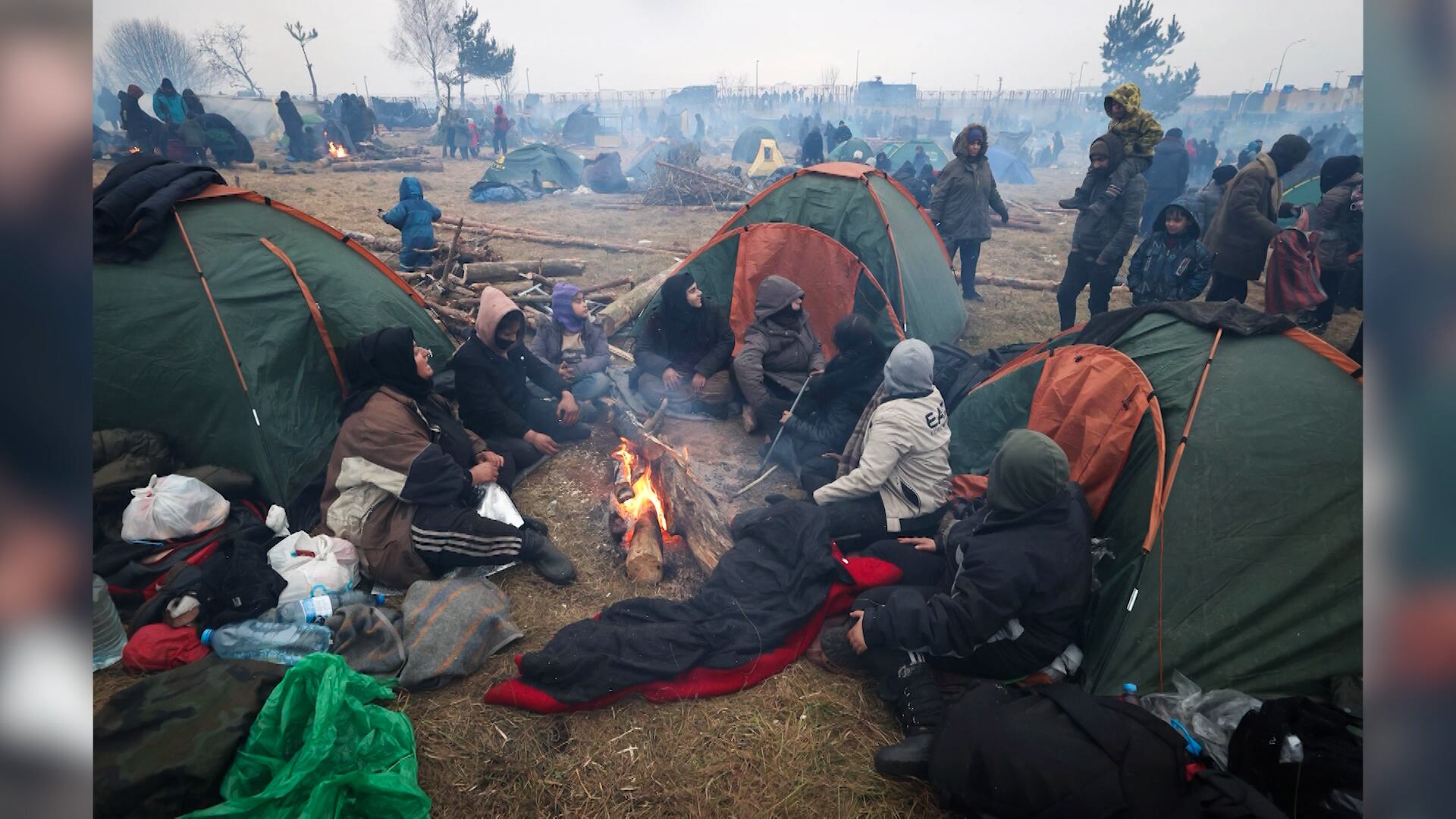
Belarus President Alexander Lukashenko has been accused by the EU of manufacturing a migration crisis along his border with Poland. But, even as tensions appear to be stabilizing at the moment, Ali Noorani, the president and CEO of National Immigration Forum and the host of the "Only in America" podcast spoke to Cheddar about the ongoing danger to the migrants who hail from countries like Iraq and Afghanistan. "What is going to happen to folks who are in Belarus who came from these countries? Is Lukashenko going to provide them asylum and protection in Belarus, or are they going to continue to be political pawns in a geopolitical battle," he said. "Real people's lives are being put at great risk."
A group of crypto investors has come together to raise millions of dollars in the hopes of owning a rare piece of the U.S. Constitution. According to the crypto group, "Constitution DAO" It is time to put the constitution in the hands of the people. CEO and Founder of Metaversal Yossi Hasson, joined Cheddar to discuss more.
Polarization is among the defining traits of American politics in the 21st century. Sometimes it seems like the only thing we can all agree on is the fact that we don't really agree on anything. But those divisions don't just stop at whether you vote red or blue.
A new survey from the Pew Research Center finds that rather than just two political buckets, we have nine. The "2021 political typology" as it's called distinguishes between different ideological subsets in the Democratic and Republican party. It encompasses everyone from the loudest revolutionary lefties, to the loudest insurrection apologists on the right.
Andrew Daniller, research associate at the Pew Research Center, joins None of the Above to discuss.