Secretary of State Mike Pompeo and Treasury Secretary Steve Mnuchin announced new sanctions against Iran and its economy, including on eight individuals the officials said were involved in missile strikes on Iraqi bases housing U.S. personnel on Tuesday night.
"We will continue to apply economic sanctions until Iran stops its terrorist activities and commit[s] that it will never have nuclear weapons," Mnuchin said.
Adding details to President Donald Trump's announcement Wednesday that he intended to further sanction Iran, whose goods are already heavily sanctioned, Mnuchin said the president will sign an executive order authorizing new sanctions including 17 against the nation's economy and sanctions against individuals he asserted, "advance Iran's destabilizing activities and were involved in Tuesday's ballistic missile strike." Mnuchin, who last announced sanctions against the Middle Eastern nation in September 2019 after suspected attacks on Saudi Arabian oil facilities, said the administration has "100 percent confidence" that "the economic sanctions are working."
"We want Iran to behave simply like a normal nation," Pompeo told reporters in a White House briefing, saying he believed sanctions will help accomplish that goal. He added, "We're striking at the heart of the Islamic Republic's inner security apparatus."
Pompeo was pressed by reporters on the timing of attacks the president initially said were "imminent." The administration has been inconsistent in justification for the drone strike on Jan. 3 that killed Iranian top military commander Gen. Qassem Soleimani. In the past 24 hours, Trump said "they were looking to blow up our embassy," which the administration later explained he was referencing the storming of the Baghdad embassy on New Year's Eve. Though the Department of Defense had stated that the general had been "actively developing plans" to attack Americans in the region, Pompeo told Fox last night "we don't know precisely when and we don't know precisely where."
On Friday morning, Pompeo attempted to clarify the differing accounts, saying "we had specific information on an imminent threat and those included attacks on U.S. embassies. Period. Full stop."
Justification for the drone strike has had lawmakers up in arms for days, exacerbated by the five days it took the White House to brief Congressional leaders, a meeting two Republican Senators had excoriated as unacceptable and had them saying they would vote with Democrats in a war powers resolution.
Pompeo repeated this morning that Soleimani had been planning "a broad, large-scale attack against American interests," including U.S. embassies and bases in the region, and reiterated reports from the U.S. and its allies that the Ukrainian passenger jet that crashed after its takeoff in Iran, just hours after Iran had sent a retaliatory missile barrage at Americans housed in Iraqi bases, was "likely" shot down by an Iranian missile.
"When we get the results of that investigation, I am confident we and the rest of the world will take appropriate action," Pompeo said.
After 40 years of tension came to a head last month with the death of an American contractor, storming of the American embassy in Baghdad, and the killing of Soleimani, lawmakers worried the president had taken the U.S. to the brink of war with the Iran. On Jan. 8, Trump said Iran appeared to "be standing down" after its missile attack response.
The memoir, "COMPROMISED: Counterintelligence and the Threat of Donald J. Trump", tells a familiar story from a bit of a different source: Peter Strzok himself, former FBI Counterintelligence Agents and Agency Veteran who spent most of his very long career investigating some of the most controversial inquiries, most notably in recent American history. Those inquiries were Hillary Clinton's email to even Trump Russia investigations. Former FBI Agent and Author of "Compromised" Peter Strzok, joined Cheddar to discuss more.
President Biden's first year did not come to the close that he had hoped after last night's Senate vote blocked the voting rights bill, a priority that Biden has promoted since his inauguration. Joining us to discuss the voting rights bill, and many others passing through congress is congresswoman Lori Trahan, representing Massachusett's 3rd district.
Members of Congress have voted to advance a bill meant to address antitrust concerns related to tech giants including Amazon, Apple, Google, and Meta. The 'American Innovation and Choice Online Act' is largely seen as one of the best chances for the government to reign in Big Tech's dominance
Seth Schachner, Managing Director StratAmericas; Digital Business Executive joined Cheddar's Opening Bell to discuss.
American semiconductor company, Intel officially announcing plans to build a new $20 billion chip manufacturing complex outside Columbus, Ohio. This comes as the global chip shortage continues to hamper production of everything from smart phones, to cars. Jennifer Smith - Logistics and Supply Chain Reporter, WSJ joined Cheddar's Opening Bell to discuss.
The U.S. has put more than 8,000 American troops on high alert for possible deployment to Eastern Europe as the West prepares for a potential Russian invasion of Ukraine. With Russia building up more than 100,000 troops near the Ukrainian border, concerns over the country's behavior are mounting. Joel Rubin, Former Deputy Assistant Secretary of State and President of the Washington Strategy Group, joined Cheddar to discuss what this means for U.S.-Russia relations, and where the conflict might be heading next.
As the midterm election looms, things aren't looking too promising for President Joe Biden. One year into his term as president, Biden is facing one of the lowest approval ratings of any modern-day president, threatening his party's control of the House in 2022. Brian Bennett, Senior White House Correspondent for TIME, joined Cheddar's Opening Bell to discuss.
A full one year into his term as President of The United States, President Biden addressed the nation on Wednesday, facing questions on everything from inflation to chip shortages and covid-19. As Biden enters his second year in office, he is facing one of the lowest approval ratings of any modern-day president. Kate Davidson, Reporter, POLITICO joined Cheddar's Opening Bell to discuss.
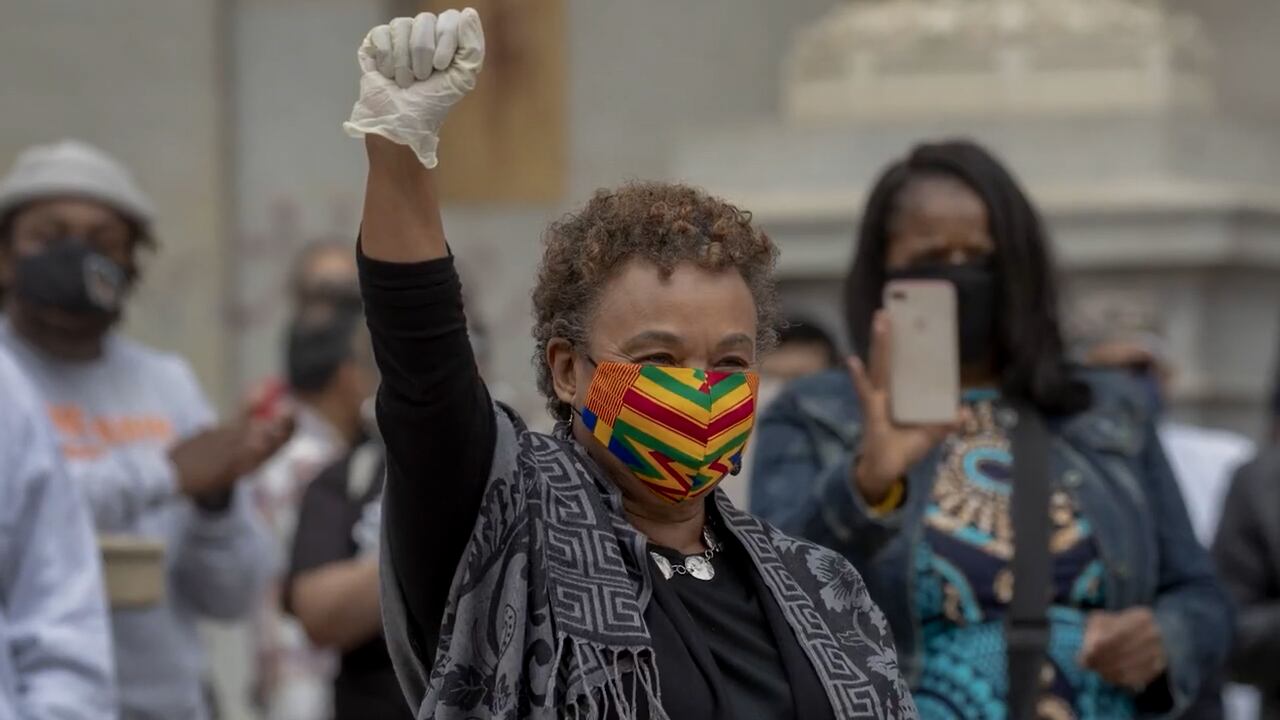
"Barbara Lee: Speaking Truth to Power" is the story of how the longtime House Democrat became, as she Is known to some, as "the Conscience of Congress." The film also
shows Representative Lee from her days working to fight community poverty to famously becoming the only member of Congress to vote "no" against the war in Afghanistan days after 9/11. The film is nominated for an NAACP Image Award, and Premieres on Starz on February 1. Film director Abby Ginzberg and Rep. Barbara Lee (D-Calif. 13th District), joined Cheddar to discuss more.
San Diego has just implemented a new law that could set the stage for how the country deals with food waste. This new law hopes to make a dent in that. Businesses and groceries stores out in San Diego will need to put a plan in place to *donate edible food rather than toss it straight to the trash. Food Rescue Manager at Feeding San Diego, Kate Garret