Turkey’s president promised Saturday to rescue the Marmara Sea from an outbreak of “sea snot” that is alarming marine biologists and environmentalists.
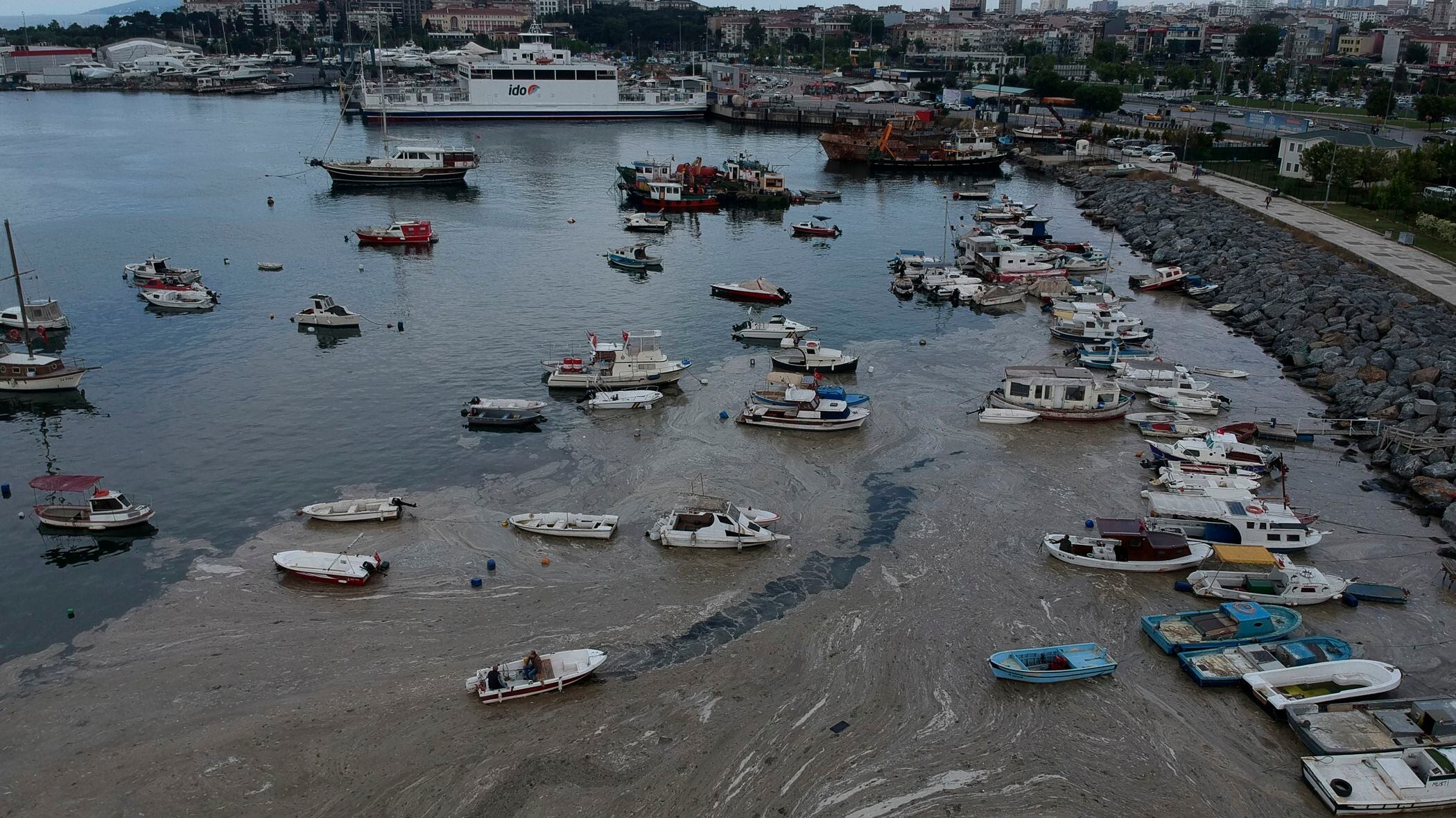
A huge mass of marine mucilage, a thick, slimy substance made up of compounds released by marine organisms, has bloomed in Turkey's Marmara, as well as in the adjoining Black and Aegean Seas.
Turkish President Recep Tayyip Erdogan said untreated waste dumped into the Marmara Sea and climate change had caused the sea snot bloom. Istanbul, Turkey’s largest city with some 16 million residents, and five other provinces, factories and industrial hubs border the sea.
Marine mucilage has reached unprecedented levels this year in Turkey. It is visible above the water as a slimy gray sheet along the shores of Istanbul and neighboring provinces. Underwater videos showed suffocated coral covered with sea snot.
Erdogan said he instructed the Ministry of Environment and Urbanization to coordinate with relevant institutions, municipalities and universities. Teams are inspecting waste water and solid waste facilities, along with other potential sources of pollution, he said.
“We will save our seas from this mucilage calamity, leading with the Marmara Sea,” Erdogan said. “We must take this step without delay.”
Marine experts say that human waste and industrial pollution is choking Turkey’s seas. They say the rise in water temperatures from climate change is contributing to the problem.
This week's episode of Cheddar's Crypto Craze tackles the latest news and trends in this emerging market. Dropbox files to go public. The dow closes the week up more than 300 points. TV personality Kelly Killoren Bensimon is out with a fur slipper line.
Hanneke Weitering, staff writer at Space.com, discusses SpaceX's launch of the Falcon 9 rocket that carried a Spanish imaging satellite and two demo Starlink broadband test satellites. With this technology, SpaceX hopes to provide high speed, low cost energy across the globe.
Weight Watchers is getting slammed after offering a free membership promotion for teenagers. Project Heal's Kristina Saffran joins Cheddar to discuss the effects early dieting can have on young people's health and wellness.
Cody Gough, podcast host at Curiosity.com, discusses new studies that reveal why we may not want to be around people when we're sick. He also describes the physical characteristics that tell people when we're feeling under the weather.
I-han Chou, senior editor at Nature, discusses a new study about adolescence and how that period of your life influences adulthood.
Concerns over electronics' batteries overheating and potentially exploding have been circling for some time, reaching a head with Samsung's massive recall of its Note Seven phones. That is why KULR Technologies has created technology that protects batteries and material for everything from electric cars to NASA spaceships.
Facebook is back under the microscope for failing to stop the spread of fake news. Sara Fischer, media reporter for AXIOS, joins to explain how the big tech companies are, or are not, addressing the problem.
Extreme weather across the nation this week. New York City, Philadelphia, and Washington, D.C. experiencing record high temperatures. Meanwhile, parts of Washington state and Denver are seeing record lows. Mashable's Andrew Freedman explains how the polar vortex split is causing wild weather coast to coast.
Temperatures in Washington, D.C., hit 82 degrees on Wednesday, while the West Coast braced for record lows. Andrew Freedman, senior science editor at Mashable, says a "polar vortex split" is partly to blame.
On Between Bells: Talking to kids about gun violence, Dallas Mavericks under fire, restaurant servers fight tip-pooling laws, and more. With Eater, Parents Magazine, and Popular Science.