Senate Majority Leader Mitch McConnell shut the door Wednesday on President Donald Trump's push for $2,000 COVID-19 relief checks, declaring Congress has provided enough pandemic aid as he blocked another attempt by Democrats to force a vote.
The GOP leader made clear he is unwilling to budge, despite political pressure from Trump and even some fellow Republican senators who demanded a vote. Trump wants the recently approved $600 in aid increased threefold. But McConnell dismissed the idea of bigger “survival checks,” saying the money would go to plenty of American households that don't need it.
McConnell's refusal to act means the additional relief Trump wanted is all but dead.
"We just approved almost a trillion dollars in aid a few days ago," McConnell said, referring to the year-end package Trump signed into law.
McConnell added, "if specific, struggling households still need more help,” the Senate will consider “smart targeted aid. Not another firehose of borrowed money.”
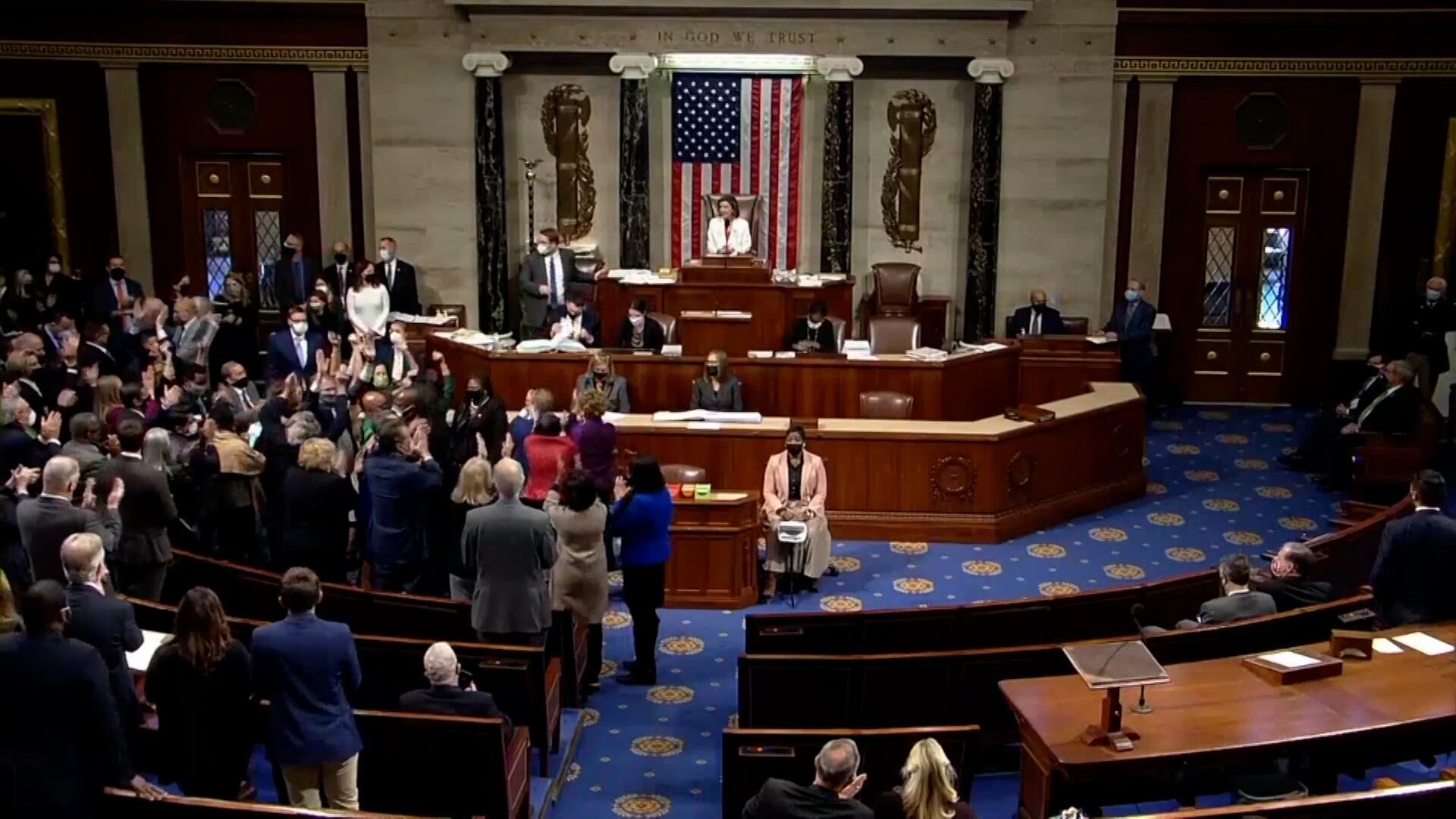
The showdown between the outgoing president and his own Republican Party over the $2,000 checks has thrown Congress into a chaotic year-end session just days before new lawmakers are set to be sworn into office.
It's one last standoff, together with the override of Trump’s veto of a sweeping defense bill, that will punctuate the president's final days and deepen the GOP's divide between its new wing of Trump-styled populists and what had been mainstay conservative views against government spending.
Trump has been berating the GOP leaders, and tweeted, “$2000 ASAP!”
For a second day in a row, Senate Democratic leader Chuck Schumer tried to force a vote on the bill approved by the House meeting Trump's demand for the $2,000 checks.
“What we’re seeing right now is Leader McConnell trying to kill the checks — the $2,000 checks desperately needed by so many American families,” Schumer said at the Capitol.
The roadblock set by Senate Republicans appears insurmountable. Most GOP senators seemed to accept the inaction even as a growing number of Republicans, including two senators in runoff elections on Jan. 5 in Georgia, agree with Trump's demand, some wary of bucking him.
Congress had settled on smaller $600 payments in a compromise over the big, year-end relief bill Trump reluctantly signed into law. Treasury Secretary Steven Mnuchin said those checks will begin to go out Wednesday.
With the Georgia Senate runoff elections days away, leading Republicans warned that the GOP’s refusal to provide more aid as the virus worsens could jeopardize the outcome.
“The Senate Republicans risk throwing away two seats and control of the Senate,” said Newt Gingrich, the former congressional leader, on Fox News. He called on Senate Republicans to “get a grip and not try to play cute parliamentary games with the president’s $2,000 payment.”
House Speaker Nancy Pelosi said, “These Republicans in the Senate seem to have an endless tolerance for other people’s sadness.”
Saying little, McConnell has tried to shield his divided Republicans from a difficult vote. On Wednesday he provided his most fulsome views yet, suggesting he had kept his word to start a “process” to address Trump’s demands, even if it means no votes will actually be taken.
“It’s no secret Republicans have a diversity of views,” he said.
McConnell had earlier unveiled a new bill loaded up with Trump's other priorities as a possible off-ramp for the standoff. It included the $2,000 checks as well as a complicated repeal of protections for tech companies like Facebook or Twitter under Section 230 of a communications law that the president complained are unfair to conservatives. It also tacked on the establishment of a bipartisan commission to review the 2020 presidential election Trump lost to President-elect Joe Biden.
Democrats opposed that approach and it does not have enough support to pass the Senate.
No votes on additional aid are scheduled. For McConnell, the procedural moves allowed him to check the box over the commitments he made when Trump was defiantly refusing to sign off on the big year-end package last weekend.
“To ensure the President was comfortable signing the bill into law, the Senate committed to beginning one process that would combine three of the President’s priorities,” McConnell said. “That was a commitment, and that’s what happened.”
Liberal senators led by Bernie Sanders of Vermont who support the relief aid are blocking action on the defense bill until a vote can be taken on Trump's demand for $2,000 for most Americans.
Sanders thundered on the floor that McConnell should call residents in the GOP leader's home state of Kentucky “and find out how they feel about the need for immediate help in terms of a $2,000 check.”
The GOP blockade is causing turmoil for some as the virus crisis worsens nationwide and Trump amplifies his unexpected demands.
The two GOP senators from Georgia, David Perdue, and Kelly Loeffler, announced Tuesday they support Trump's plan for bigger checks as they face Democrats Jon Ossoff and Raphael Warnock in runoff elections that will determine which party controls the Senate.
Joining Trump, Republican Sens. Josh Hawley of Missouri and Marco Rubio of Florida, among the party's potential 2024 presidential hopefuls, also are pushing the party in the president's direction.
Other Republicans panned the bigger checks, saying the nearly $400 billion price tag was too high, the relief is not targeted to those in need and Washington has already dispatched ample sums on COVID aid.
Sen. Pat Toomey, R-Penn., tweeted that he would block the House bill. He said “blindly borrowing” billions “so we can send $2,000 checks to millions of people who haven’t lost any income is terrible policy.”
In the House, dozens of Republicans calculated it was better to link with Democrats to increase the pandemic payments rather than buck the outgoing president and constituents counting on the money. House Democrats led passage, 275-134, but 44 Republicans joined almost all Democrats on Monday for a robust two-thirds vote of approval.
Trump's push could fizzle out in the Senate but the debate over the size and scope of the year-end package — $900 billion in COVID-19 aid and $1.4 trillion to fund government agencies through September — is potentially one last confrontation before the new Congress is sworn in Sunday.
The COVID-19 portion of the bill revives a weekly pandemic jobless benefit boost — this time $300, through March 14 — as well as the popular Paycheck Protection Program of grants to businesses to keep workers on payrolls. It extends eviction protections, adding a new rental assistance fund.
Americans earning up to $75,000 will qualify for the direct $600 payments, which are phased out at higher income levels, and there's an additional $600 payment per dependent child.
___
Associated Press writer Ashraf Khalil in Washington contributed to this report.
Updated on December 30, 2020, at 5:15 p.m. ET.