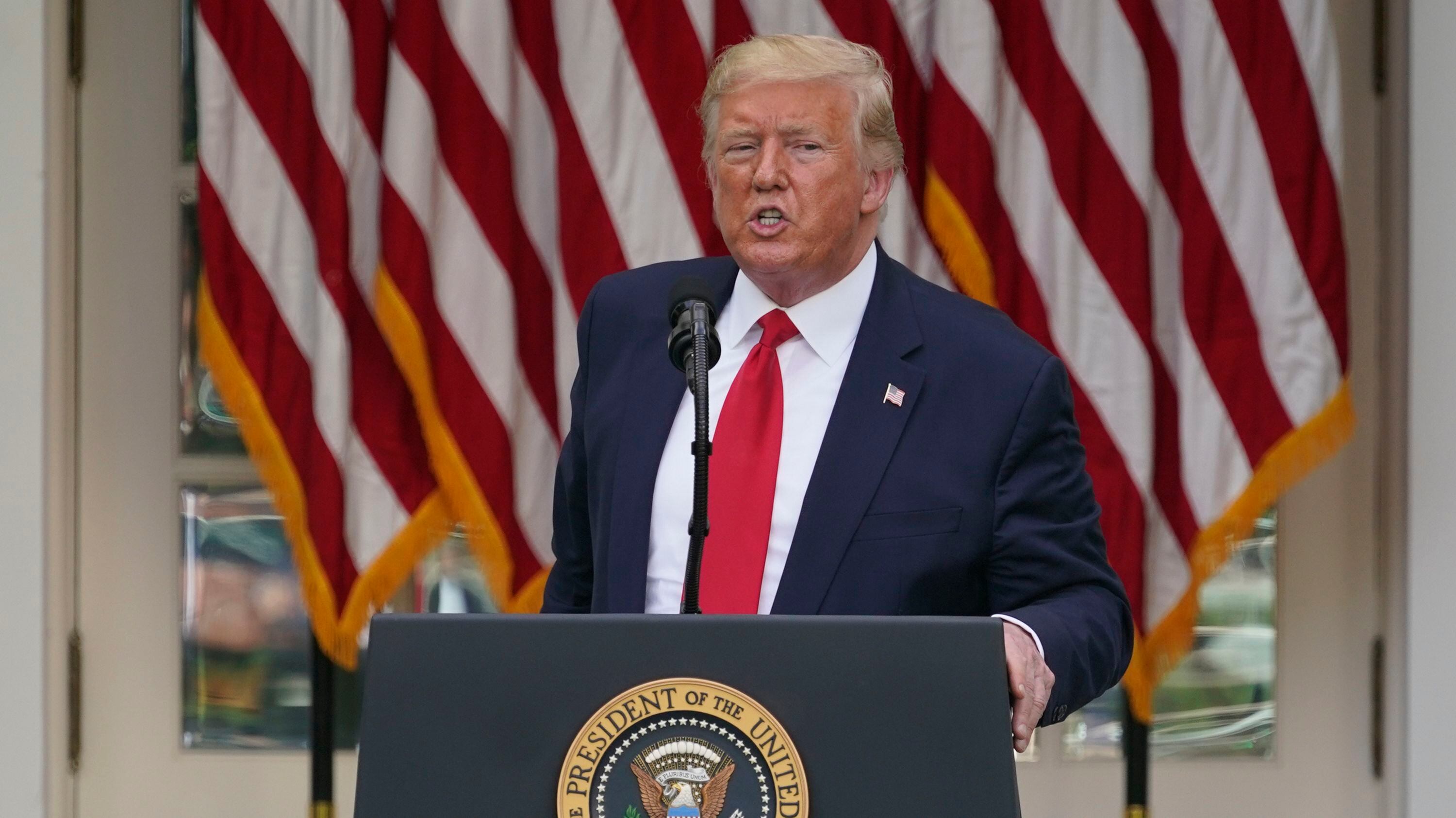
President Donald Trump answers questions from reporters during an event on protecting seniors with diabetes in the Rose Garden White House, Tuesday, May 26, 2020, in Washington. (AP Photo/Evan Vucci)
By Zeke Miller
President Donald Trump on Wednesday threatened social media companies with new regulations or even shuttering after Twitter added fact checks to two of his tweets.
The president can’t unilaterally regulate or close the companies, which would require action by Congress or the Federal Communications Commission. But that didn't stop Trump from angrily issuing strong warnings.
Claiming tech giants “silence conservative voices,” Trump tweeted early Wednesday, “We will strongly regulate, or close them down, before we can ever allow this to happen.” Later he tweeted without elaboration, “Big Action to follow.”
He repeated his unsubstantiated claim — which sparked his latest showdown with Silicon Valley — that expanding mail-in voting “would be a free for all on cheating, forgery and the theft of Ballots.”
There was no immediate reaction from Twitter or other social media companies to the president’s threats.
Trump and his campaign had lashed out Tuesday after Twitter added a warning phrase to two Trump tweets that called mail-in ballots “fraudulent” and predicted that “mail boxes will be robbed,” among other things. Under the tweets, there is now a link reading “Get the facts about mail-in ballots” that guides users to a Twitter “moments” page with fact checks and news stories about Trump’s unsubstantiated claims.
Trump replied on Twitter, accusing the platform of “interfering in the 2020 Presidential Election” and insisting that “as president, I will not allow this to happen.” His 2020 campaign manager, Brad Parscale, said Twitter’s “clear political bias” had led the campaign to pull “all our advertising from Twitter months ago.” Twitter has banned all political advertising since last November.
Trump did not explain his threat Wednesday, and the call to expand regulation appeared to fly in the face of long-held conservative principles on deregulation.
But some Trump allies, who have alleged bias on the part of tech companies, have questioned whether platforms like Twitter and Facebook should continue to enjoy liability protections as “platforms” under federal law — or be treated more like publishers, which can face lawsuits over content.
The protections have been credited with allowing the unfettered growth of the internet for more than two decades, but now some Trump allies are advocating that social media companies face more scrutiny.
“Big tech gets a huge handout from the federal government," Republican Sen. Josh Hawley told Fox News. “They get this special immunity, this special immunity from suits and from liability that’s worth billions of dollars to them every year. Why are they getting subsidized by federal taxpayers to censor conservatives, to censor people critical of China?”
There was no immediate reaction from Twitter or other social media companies to the president's threats.
Germany could be on track to legalize and regulate adult-use cannabis, which could represent a massive market opportunity for cannabis companies. Prohibition Partners' researcher Conor O'Brien joins Cheddar News' Closing Bell to discuss the potential legalization of recreational marijuana in Germany, Luxembourg's recent legalization, and what those moves mean for the broader cannabis industry.
ETF and mutual fund manager VanEck has launched its XBTF - the third Bitcoin-linked futures ETF to enter the market. This comes after VanEck's application for a spot product Bitcoin ETF was denied by the SEC, and also as the broader crypto markets slump this week. Kyle DaCruz, Director of Digital Asset Product for VanEck, joins Cheddar News' Closing Bell to discuss the XBTF's debut, investor demand, and more.
Major U.S. retailers, including Walmart, Home Depot, Lowe's, and Target have all reported better than expected earnings heading into the holiday season. This comes as retail sales climbed in October, despite the biggest inflation surge in more than 30 years. David Steinberg, co-founder, chairman and CEO of Zeta Global, explains why inflation doesn't seem to be scaring consumers away.
Bitcoin is getting a makeover. It's the first upgrade in four years for the cryptocurrency. The Taproot update offers greater transaction privacy and efficiency and will unlock the potential for smart contracts. Jeff Roberts, executive editor of Decrypt, joins Cheddar News to breakdown what this upgrade means for investors.
The nation's largest alcohol e-commerce and delivery platform is getting even bigger. Drizly is now collaborating with 7-Eleven to deliver alcohol in under 60 minutes from 7-eleven's 1,200 stores. The companies plan to expand the collaboration in the coming months. Cathy Lewenberg, COO at Drizly, joins Cheddar News to talk about the new collaboration.
Netlify, a platform that builds, deploys and hosts websites and apps, raised $105 million dollars in a Series D round, now valuing the company at $2 billion. Along with the funding, Netlify is also announcing the acquisition of the company OneGraph. Netlify says OneGraph's technology will drive a new wave of innovation on its platform, by making it easier to compose apps with the best developer tools available. Netlify co-founder and CEO Matt Biilmann joined Cheddar News' Closing Bell to discuss.
Chip Paucek, CEO and co-founder of 2U, an educational tech company, joined Cheddar's "Closing Bell" to talk about the company's $800 million acquisition of online course provider edX featuring curriculum from Harvard and MIT. He noted that added services will provide 2U users with high quality, free options. "Us coming together with edX should allow us to really continue to drive affordability for people to unlock their own potential in a variety of different kinds of programs," he said.
Beginning Christmas Day, the home of the Los Angeles Lakers, Clippers, Kings, and Sparks, the Staples Center, will go by the name Crypto.com Arena after a massive $700 million deal with AEG. Steven Kalifowitz, the chief marketing officer at Crypto.com, and Todd Goldstein, the chief revenue officer at AEG, joined Cheddar to talk about the historic changeover in naming rights and what other changes that fans entering the arena might expect.
Earlier this week, Qualcomm announced an extension of its partnership with BMW as it moves to help build the technology for automated driving. Nakul Duggal, general manager at Qualcomm, joined Cheddar to provide some background on the collaboration and how the company has been able to navigate the global chip shortage amid the pandemic. "We have invested in advance, in very specific packaging capacity and technology, with our suppliers so that we actually have the capacity available to be able to service that demand," Duggal said.