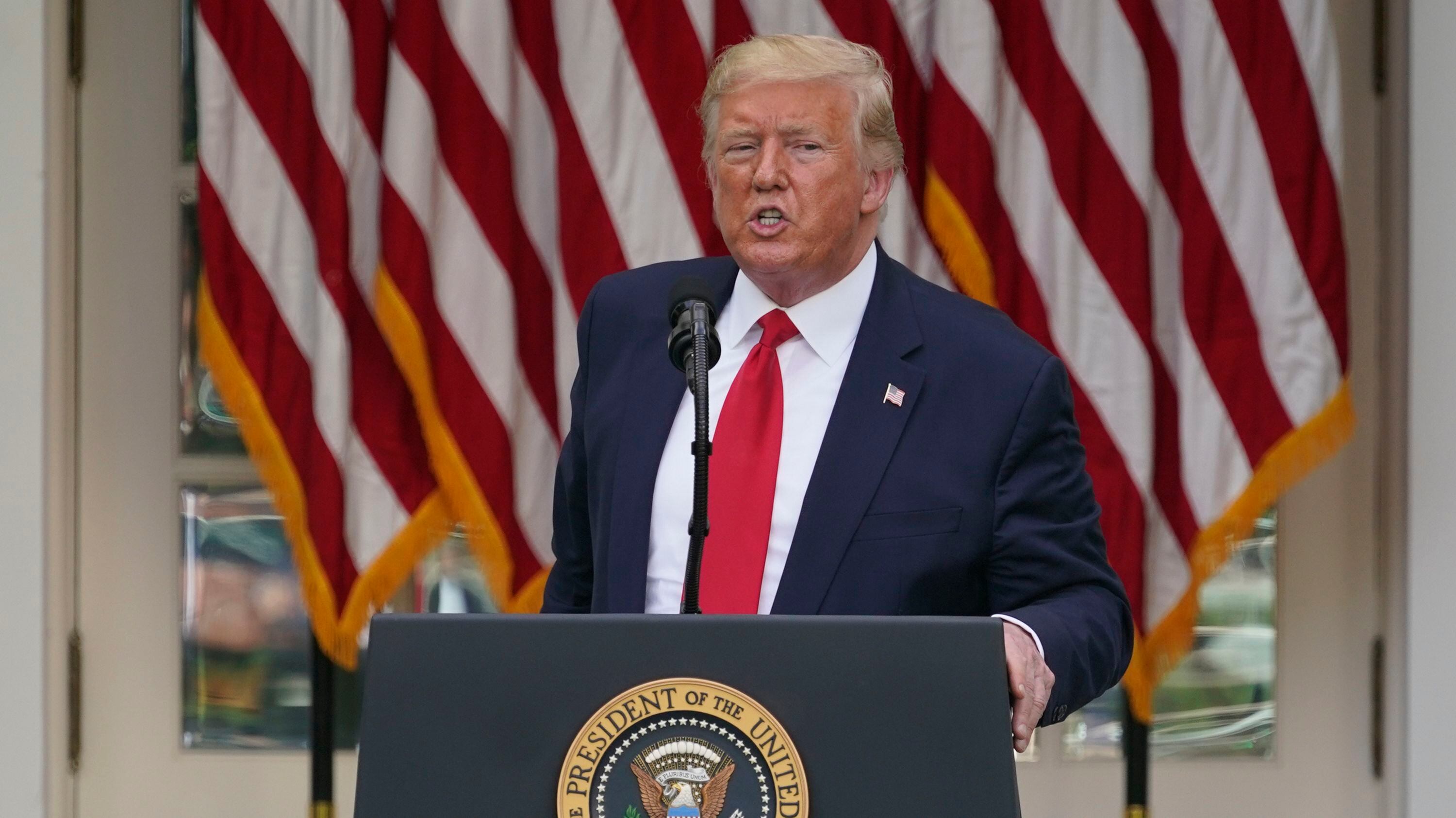
President Donald Trump answers questions from reporters during an event on protecting seniors with diabetes in the Rose Garden White House, Tuesday, May 26, 2020, in Washington. (AP Photo/Evan Vucci)
By Zeke Miller
President Donald Trump on Wednesday threatened social media companies with new regulations or even shuttering after Twitter added fact checks to two of his tweets.
The president can’t unilaterally regulate or close the companies, which would require action by Congress or the Federal Communications Commission. But that didn't stop Trump from angrily issuing strong warnings.
Claiming tech giants “silence conservative voices,” Trump tweeted early Wednesday, “We will strongly regulate, or close them down, before we can ever allow this to happen.” Later he tweeted without elaboration, “Big Action to follow.”
He repeated his unsubstantiated claim — which sparked his latest showdown with Silicon Valley — that expanding mail-in voting “would be a free for all on cheating, forgery and the theft of Ballots.”
There was no immediate reaction from Twitter or other social media companies to the president’s threats.
Trump and his campaign had lashed out Tuesday after Twitter added a warning phrase to two Trump tweets that called mail-in ballots “fraudulent” and predicted that “mail boxes will be robbed,” among other things. Under the tweets, there is now a link reading “Get the facts about mail-in ballots” that guides users to a Twitter “moments” page with fact checks and news stories about Trump’s unsubstantiated claims.
Trump replied on Twitter, accusing the platform of “interfering in the 2020 Presidential Election” and insisting that “as president, I will not allow this to happen.” His 2020 campaign manager, Brad Parscale, said Twitter’s “clear political bias” had led the campaign to pull “all our advertising from Twitter months ago.” Twitter has banned all political advertising since last November.
Trump did not explain his threat Wednesday, and the call to expand regulation appeared to fly in the face of long-held conservative principles on deregulation.
But some Trump allies, who have alleged bias on the part of tech companies, have questioned whether platforms like Twitter and Facebook should continue to enjoy liability protections as “platforms” under federal law — or be treated more like publishers, which can face lawsuits over content.
The protections have been credited with allowing the unfettered growth of the internet for more than two decades, but now some Trump allies are advocating that social media companies face more scrutiny.
“Big tech gets a huge handout from the federal government," Republican Sen. Josh Hawley told Fox News. “They get this special immunity, this special immunity from suits and from liability that’s worth billions of dollars to them every year. Why are they getting subsidized by federal taxpayers to censor conservatives, to censor people critical of China?”
There was no immediate reaction from Twitter or other social media companies to the president's threats.
Facebook is undergoing more than a name change. The company, now known as Meta, has also seen an exodus of executives this year. While the timing of some of these resignations came before whistleblower allegations, it's undeniable the tech giant is undergoing big changes. Doug Astrop, Managing Partner at Exponential Investment Partners, joins Cheddar News' Closing Bell to discuss Facebook's current state, possible regulatory scrutiny, the impact of Instagram chief Adam Mosseri's Congressional testimony, and more.
Businesses are likely to increase salaries budgets in 2022 by 3.9 percent according to a study by The Conference Board. Gad Levanon, head of the Labor Market Institute at The Conference Board, joined Cheddar to provide additional details about the survey's findings. He attributed the anticipated salary hikes to companies looking to retain current employees, a desire to attract a new crop of workers, and surging inflation.
Fast AF, a premiere quick commerce retailer for products and brands just announced the close of its Series A investment round. That round puts the value of the company at $200 million. The company gets items to customers ranging from masks to sneakers and is now launching its own in-house delivery service. Lee Hnetinka, founder and CEO of FastAF joins Cheddar News to discuss the announcement.
Carolina Navas, Snap's head of AR product strategy and product marketing, joins Cheddar News to discuss how Snapchat's augmented reality is changing the shopping game this holiday season.
Steve Case, Revolution Ventures CEO, joined Cheddar to discuss progress venture capitalists have made over 2021 and where investors are looking beyond Silicon Valley. Other locations VC firms are exploring include Los Angeles, Philadelphia, and Chicago among others. "Historically there's been a brain drain in a lot of these cities, people leaving for opportunity elsewhere. Now, people are staying," he said of the emerging tech hubs. "There tends to be a collaborative effort in the community to really support startups to recognize the future of the community."
A new study by Pfizer-BioNTech found that a third dose of their COVID-19 vaccine is effective against the emerging omicron variant. The pharmaceutical giants also look to manufacture a vaccine specific to the omicron variant by March 2022.
Chamber of Progress CEO Adam Kovacevich joined Wake Up With Cheddar to break down what to expect from the cryptocurrency executives appearing on Capitol Hill and how it could impact future crypto regulation. "I think what most people want to see from regulation is essentially channeling the good and the potential and putting in place guardrails to minimize the bad," he said.
Michael Steinhardt, 81, has surrendered 180 stolen artifacts from 11 different countries worth $70 million. The former hedge fund manager has also received a lifetime ban from the antiquities market.