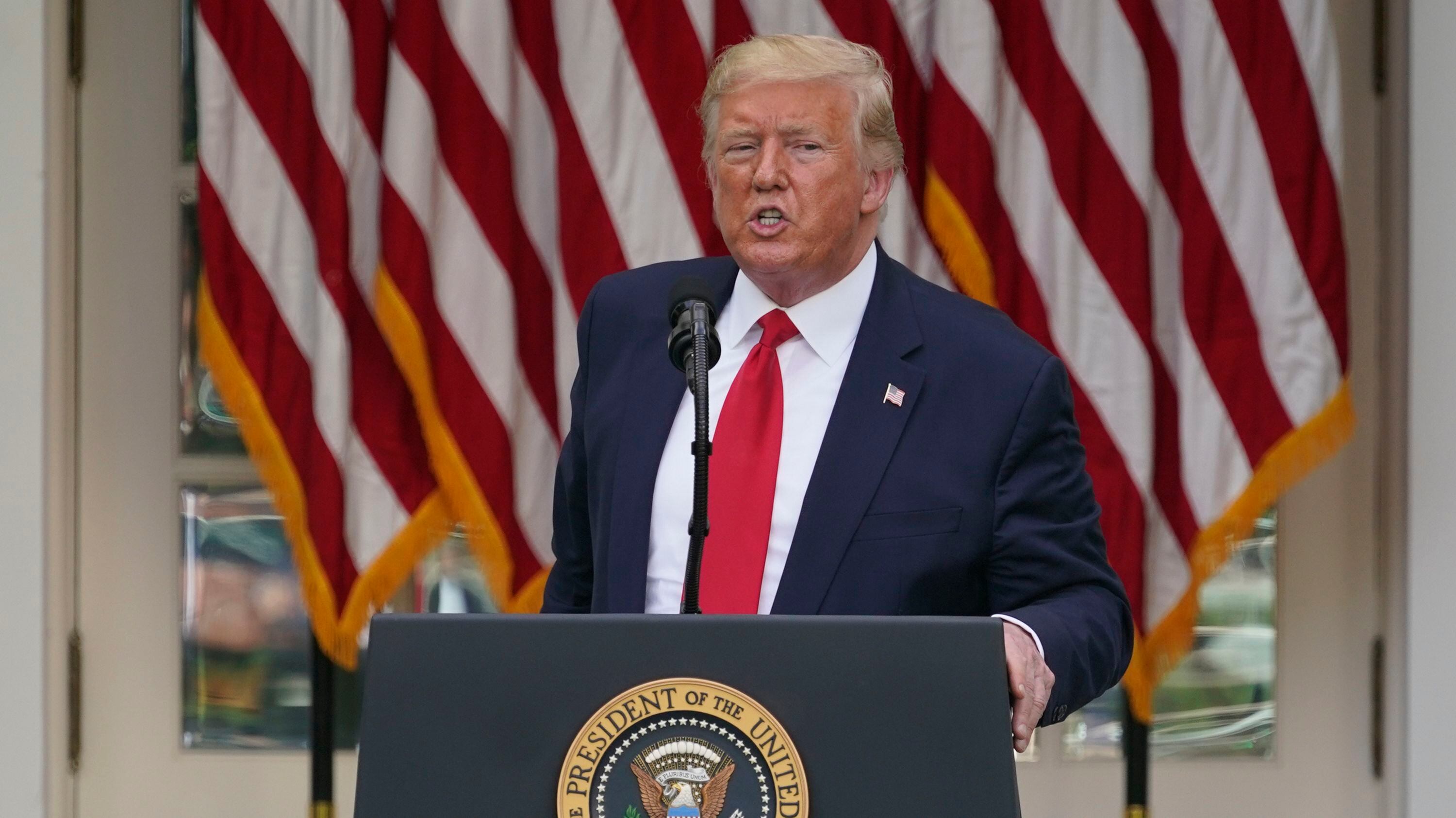
President Donald Trump answers questions from reporters during an event on protecting seniors with diabetes in the Rose Garden White House, Tuesday, May 26, 2020, in Washington. (AP Photo/Evan Vucci)
By Zeke Miller
President Donald Trump on Wednesday threatened social media companies with new regulations or even shuttering after Twitter added fact checks to two of his tweets.
The president can’t unilaterally regulate or close the companies, which would require action by Congress or the Federal Communications Commission. But that didn't stop Trump from angrily issuing strong warnings.
Claiming tech giants “silence conservative voices,” Trump tweeted early Wednesday, “We will strongly regulate, or close them down, before we can ever allow this to happen.” Later he tweeted without elaboration, “Big Action to follow.”
He repeated his unsubstantiated claim — which sparked his latest showdown with Silicon Valley — that expanding mail-in voting “would be a free for all on cheating, forgery and the theft of Ballots.”
There was no immediate reaction from Twitter or other social media companies to the president’s threats.
Trump and his campaign had lashed out Tuesday after Twitter added a warning phrase to two Trump tweets that called mail-in ballots “fraudulent” and predicted that “mail boxes will be robbed,” among other things. Under the tweets, there is now a link reading “Get the facts about mail-in ballots” that guides users to a Twitter “moments” page with fact checks and news stories about Trump’s unsubstantiated claims.
Trump replied on Twitter, accusing the platform of “interfering in the 2020 Presidential Election” and insisting that “as president, I will not allow this to happen.” His 2020 campaign manager, Brad Parscale, said Twitter’s “clear political bias” had led the campaign to pull “all our advertising from Twitter months ago.” Twitter has banned all political advertising since last November.
Trump did not explain his threat Wednesday, and the call to expand regulation appeared to fly in the face of long-held conservative principles on deregulation.
But some Trump allies, who have alleged bias on the part of tech companies, have questioned whether platforms like Twitter and Facebook should continue to enjoy liability protections as “platforms” under federal law — or be treated more like publishers, which can face lawsuits over content.
The protections have been credited with allowing the unfettered growth of the internet for more than two decades, but now some Trump allies are advocating that social media companies face more scrutiny.
“Big tech gets a huge handout from the federal government," Republican Sen. Josh Hawley told Fox News. “They get this special immunity, this special immunity from suits and from liability that’s worth billions of dollars to them every year. Why are they getting subsidized by federal taxpayers to censor conservatives, to censor people critical of China?”
There was no immediate reaction from Twitter or other social media companies to the president's threats.
The one-hour special 'Cannabiz: Legalization Goes Mainstream' explores the state of marijuana. Cheddar News is joined by Rep. Earl Blumenauer (D-OR), Village CEO Dan Pettigrew, and many more.
Bitcoin is still struggling to hold $47,000 and is well off from the near $68,000 high it saw in November. As the Federal Open Market Committee wraps up its two-day monetary policy meeting, some crypto investors are worried as they wait for news on policy. Shiv Madan, CEO of Moonwalk joins Cheddar News to discuss what's in store for the industry.
We're entering a brave new world of broadly legal sports betting. Over 30 states and Washington, DC, have legalized sports betting in the year and a half since the supreme court struck down the federal ban on the activity.
But legalization isn't a simple proposition. The federal law might be struck down but its still up to each state to decide whether to legalize sports betting, and answer a litany of questions that come with it. Should you include online gambling? How much should people be allowed to bet? Should there be limits on advertising for sports betting?
Darren Heitner, founder of Heitner Legal, and Daniel Wallach, founder of Wallach Legal, join None of the Above's "Business of Sports: The Year Gambling Took Over" special to discuss.
Over the past decade, the resale market has completely transformed, allowing people to utilize platforms such as Etsy, Poshmark, eBay, and more to create a lucrative business from the comfort of their homes. However, as the space of secondhand sellers and thrifters gets more and more crowded, small businesses are facing bigger obstacles to not only thrive in the market but also survive. Yvette Liebesman, a law professor at Saint Louis, joins Cheddar News to discuss.
Even as tech giant Google implements a vaccination mandate, charging its employees to declare their vaccine status within a time frame or risk dismissal, the federal government is tangled up in the court system trying to impose one of its own. Cindy Cohn, the executive director of the Electronic Frontier Foundation, and Harry Nelson, founder and managing partner of Nelson Hardiman LLP, joined Cheddar to debate the ethics, efficacy, and legality surrounding the issue. While Cohn noted that she thinks the federal mandate might be legally sound, her organization is also concerned with a separate question of privacy. "At EFF what we're most interested in is the digital surveillance that's going along with some of these attempts to try to track and confirm whether people are vaccinated or not," she said.
A new report from CNBC says Instagram recently reached a new milestone -- 2 billion monthly active users. It comes amid a year of controversy for the photo-sharing app and its parent company, Meta. SocialFlow CEO Jim Anderson joins Cheddar News' Closing Bell to discuss.
A report from KPMG International found that global mergers and acquisitions in 2021 reached $5.1 trillion in transactions. Carol Streicher, U.S. deal advisory and strategy service group leader for KPMG, joined Cheddar's "Closing Bell" to talk about the record-breaking year and next year's outlook, which KPMG says could be even more staggering. "We're not seeing any slow down in '22," she said, regarding survey results of 350 business leaders. "Things that were tailwinds for us in M&A activity this past year are going to continue to be tailwinds for us in 2022."
MotorTrend named the Rivian R1T as the 2022 truck of the year - a prestigious title given by the publication as a way for automakers to tout third-party validation. Rivian beat out traditional, legacy truck favorites like Ford and General Motors.
MotorTrend said the company earned high marks for safety, efficiency, value, advanced design, engineering excellence, and performance of intended function. MotorTend head of editorial Ed Loh joins Cheddar News' Closing Bell to discuss.