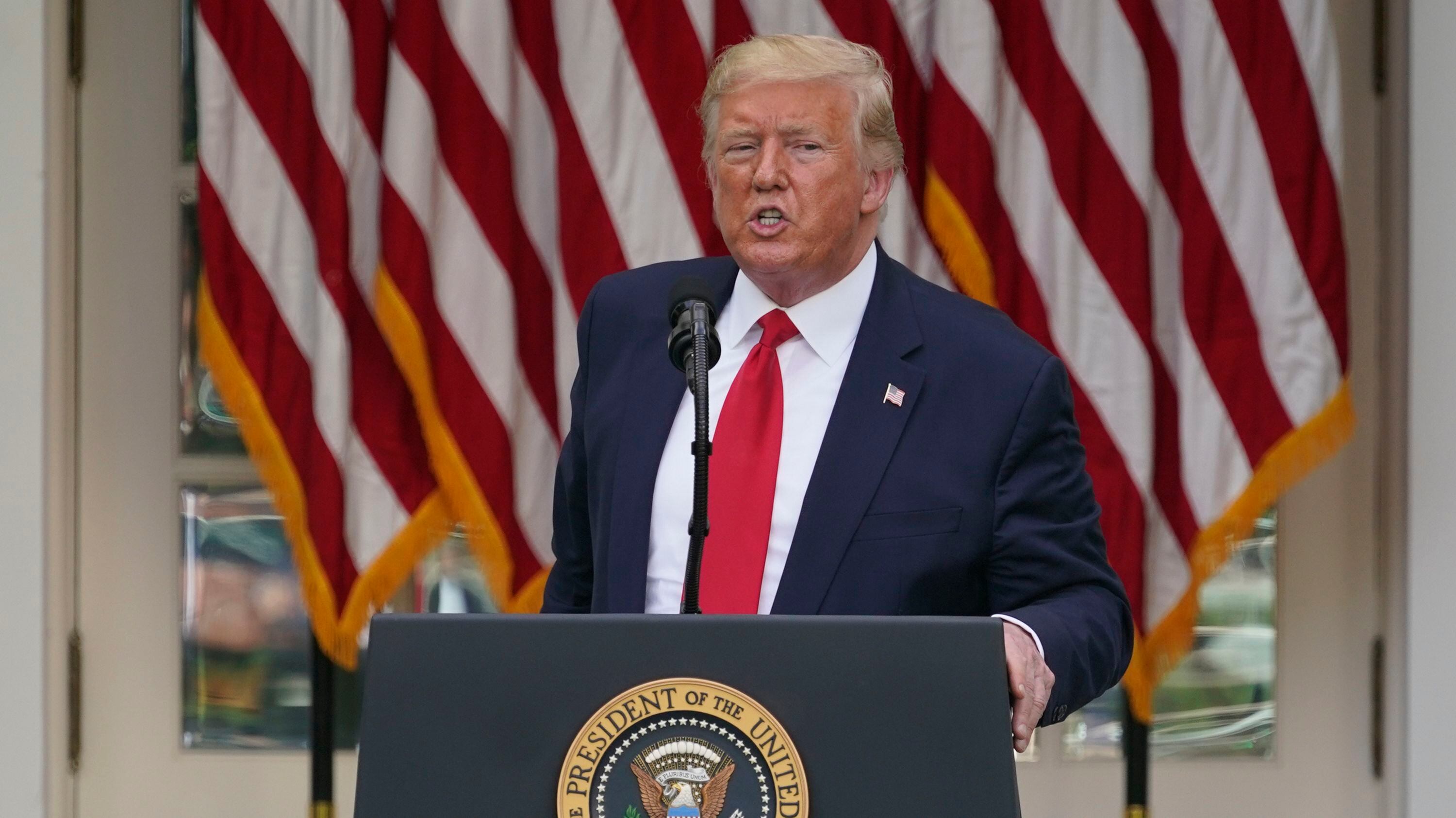
President Donald Trump answers questions from reporters during an event on protecting seniors with diabetes in the Rose Garden White House, Tuesday, May 26, 2020, in Washington. (AP Photo/Evan Vucci)
By Zeke Miller
President Donald Trump on Wednesday threatened social media companies with new regulations or even shuttering after Twitter added fact checks to two of his tweets.
The president can’t unilaterally regulate or close the companies, which would require action by Congress or the Federal Communications Commission. But that didn't stop Trump from angrily issuing strong warnings.
Claiming tech giants “silence conservative voices,” Trump tweeted early Wednesday, “We will strongly regulate, or close them down, before we can ever allow this to happen.” Later he tweeted without elaboration, “Big Action to follow.”
He repeated his unsubstantiated claim — which sparked his latest showdown with Silicon Valley — that expanding mail-in voting “would be a free for all on cheating, forgery and the theft of Ballots.”
There was no immediate reaction from Twitter or other social media companies to the president’s threats.
Trump and his campaign had lashed out Tuesday after Twitter added a warning phrase to two Trump tweets that called mail-in ballots “fraudulent” and predicted that “mail boxes will be robbed,” among other things. Under the tweets, there is now a link reading “Get the facts about mail-in ballots” that guides users to a Twitter “moments” page with fact checks and news stories about Trump’s unsubstantiated claims.
Trump replied on Twitter, accusing the platform of “interfering in the 2020 Presidential Election” and insisting that “as president, I will not allow this to happen.” His 2020 campaign manager, Brad Parscale, said Twitter’s “clear political bias” had led the campaign to pull “all our advertising from Twitter months ago.” Twitter has banned all political advertising since last November.
Trump did not explain his threat Wednesday, and the call to expand regulation appeared to fly in the face of long-held conservative principles on deregulation.
But some Trump allies, who have alleged bias on the part of tech companies, have questioned whether platforms like Twitter and Facebook should continue to enjoy liability protections as “platforms” under federal law — or be treated more like publishers, which can face lawsuits over content.
The protections have been credited with allowing the unfettered growth of the internet for more than two decades, but now some Trump allies are advocating that social media companies face more scrutiny.
“Big tech gets a huge handout from the federal government," Republican Sen. Josh Hawley told Fox News. “They get this special immunity, this special immunity from suits and from liability that’s worth billions of dollars to them every year. Why are they getting subsidized by federal taxpayers to censor conservatives, to censor people critical of China?”
There was no immediate reaction from Twitter or other social media companies to the president's threats.
Connected cars software development platform Smartcar announced this week it has raised $24 million in a Series B round led by Energize Ventures. Smartcar's software can be integrated into mobile and web apps from mobility businesses. It allows users to do things like locate and unlock a vehicle, as well as check its mileage, fuel level, and battery if the vehicle is electric. Smartcar's technology is compatible with 22 different vehicle brands in 31 different countries. Smartcar co-founder and CEO Sahas Katta joined Cheddar News' Closing Bell to discuss.
Google currently does not accept cryptocurrency as a form of payment in contrast with other big businesses that have taken advantage of the new crypto wealth that's accrued. The tech giant recently hired former PayPal executive Arnold Goldberg to lead its payment division, likely more firmly entering digital currency usage. "I think the real question is, why given the size of the industry, has Google not done this before or been actively accepting and using cryptocurrency, and it's really a lack of regulatory clarity," Halsey Minor, executive chairman of Public Mint, told Cheddar.
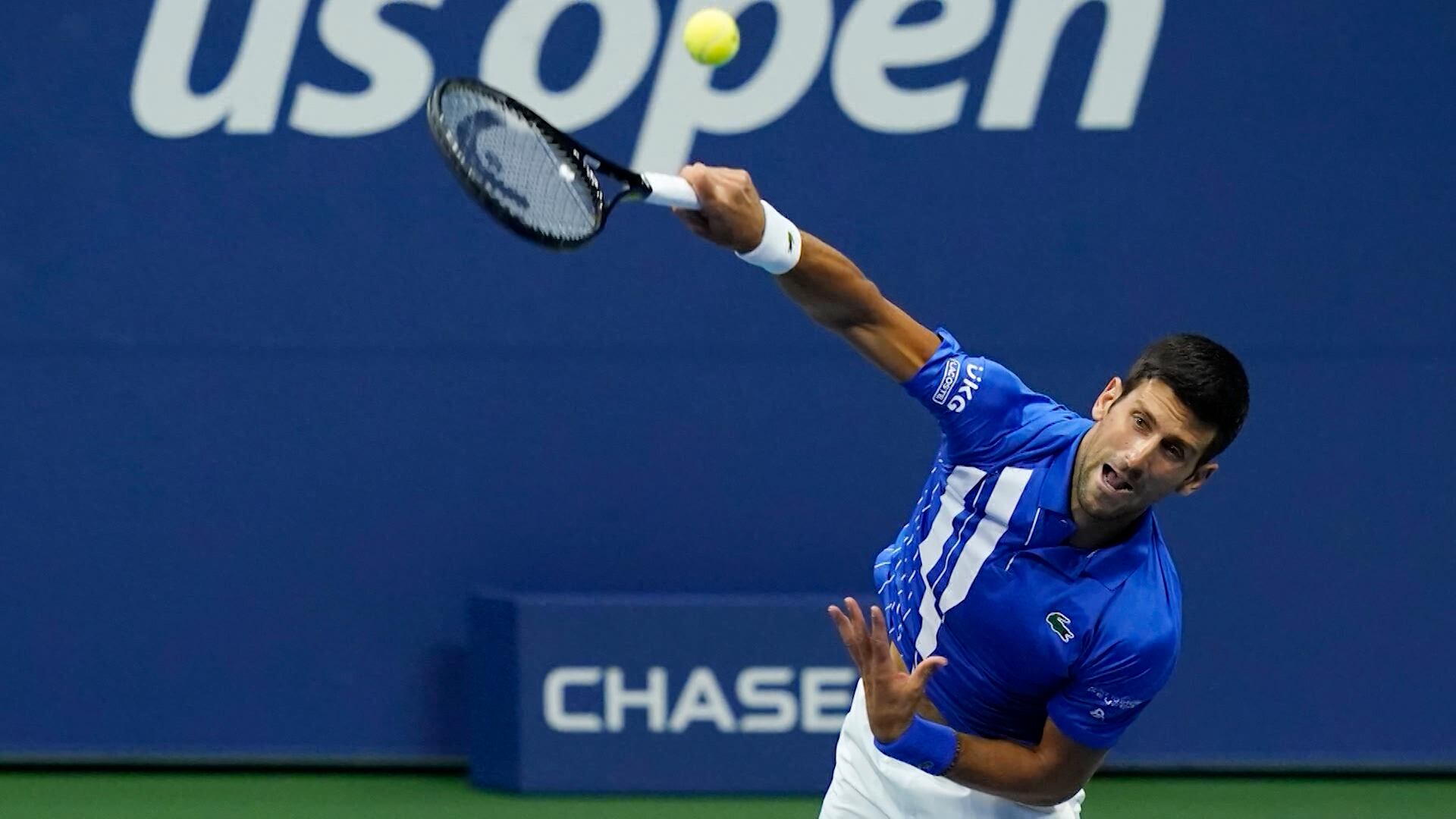
The drama surrounding tennis star Novak Djokovic continues after he was deported from Australia over the weekend due to the nation's COVID-19 vaccine requirements. Djokovic was forced to leave the country on the eve of what was to be his first match in defense of his Australian Open title after three judges ruled in favor of his removal and revealed their reasoning for doing so. Adding to his woes, a law recently passed in France is putting his chances of defending his French Open title in jeopardy. The director of Marist's Center for Sports Communication, Jane McManus, joined Cheddar to discuss the ongoing fallout.
Sports Illustrated Swimsuit is marking the 58th anniversary of its first print issue with the announcement of a new advertising mandate called Pay With Change. The magazine's annual print will now only feature brands who are helping drive gender equality forward, creating a sweeping call to action for the publishing industry. MJ Day, editor-in-chief of SI Swimsuit, joined Cheddar to discuss the goals of the new initiative.
Sonia Thompson, inclusive marketing strategist and consultant, breaks down the need to retool the hiring process and how organizations can make for a better workplace environment.
Netflix is set to report its Q4 earnings after the bell on Thursday. Wall Street is bullish on the streaming giant, estimating it will report its highest total of new subscribers for any quarter in 2021. But the company also faced major hurdles last year, from slowing revenue growth to rising streaming competition to increasing production costs. Chris Legg, senior managing director at Progress Partners, gives a preview.
PepsiCo and Beyond Meat are partnering together to launch a plant-based jerky. This is the first in a series of plant-based foods the pair will roll out together.