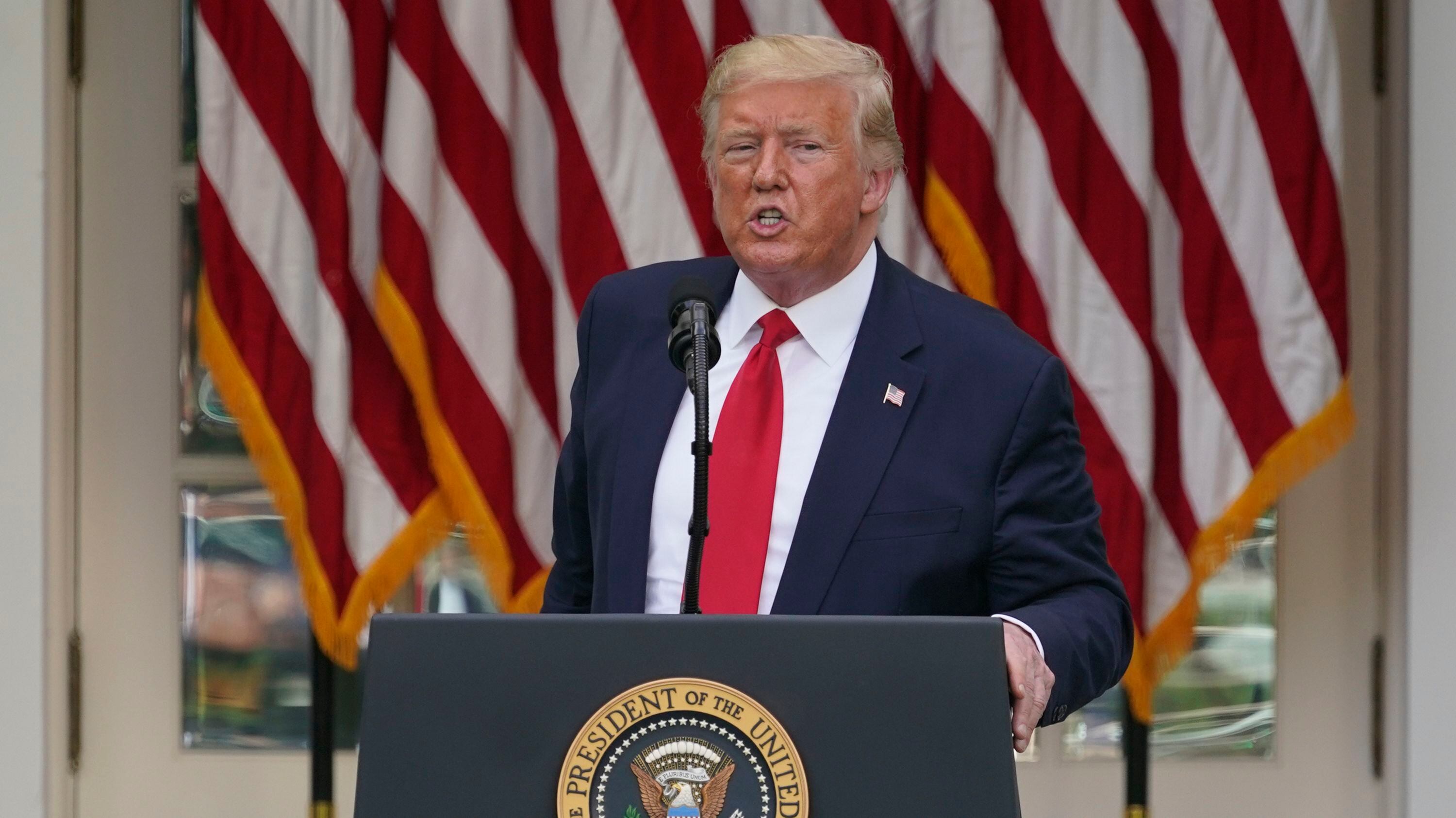
President Donald Trump answers questions from reporters during an event on protecting seniors with diabetes in the Rose Garden White House, Tuesday, May 26, 2020, in Washington. (AP Photo/Evan Vucci)
By Zeke Miller
President Donald Trump on Wednesday threatened social media companies with new regulations or even shuttering after Twitter added fact checks to two of his tweets.
The president can’t unilaterally regulate or close the companies, which would require action by Congress or the Federal Communications Commission. But that didn't stop Trump from angrily issuing strong warnings.
Claiming tech giants “silence conservative voices,” Trump tweeted early Wednesday, “We will strongly regulate, or close them down, before we can ever allow this to happen.” Later he tweeted without elaboration, “Big Action to follow.”
He repeated his unsubstantiated claim — which sparked his latest showdown with Silicon Valley — that expanding mail-in voting “would be a free for all on cheating, forgery and the theft of Ballots.”
There was no immediate reaction from Twitter or other social media companies to the president’s threats.
Trump and his campaign had lashed out Tuesday after Twitter added a warning phrase to two Trump tweets that called mail-in ballots “fraudulent” and predicted that “mail boxes will be robbed,” among other things. Under the tweets, there is now a link reading “Get the facts about mail-in ballots” that guides users to a Twitter “moments” page with fact checks and news stories about Trump’s unsubstantiated claims.
Trump replied on Twitter, accusing the platform of “interfering in the 2020 Presidential Election” and insisting that “as president, I will not allow this to happen.” His 2020 campaign manager, Brad Parscale, said Twitter’s “clear political bias” had led the campaign to pull “all our advertising from Twitter months ago.” Twitter has banned all political advertising since last November.
Trump did not explain his threat Wednesday, and the call to expand regulation appeared to fly in the face of long-held conservative principles on deregulation.
But some Trump allies, who have alleged bias on the part of tech companies, have questioned whether platforms like Twitter and Facebook should continue to enjoy liability protections as “platforms” under federal law — or be treated more like publishers, which can face lawsuits over content.
The protections have been credited with allowing the unfettered growth of the internet for more than two decades, but now some Trump allies are advocating that social media companies face more scrutiny.
“Big tech gets a huge handout from the federal government," Republican Sen. Josh Hawley told Fox News. “They get this special immunity, this special immunity from suits and from liability that’s worth billions of dollars to them every year. Why are they getting subsidized by federal taxpayers to censor conservatives, to censor people critical of China?”
There was no immediate reaction from Twitter or other social media companies to the president's threats.
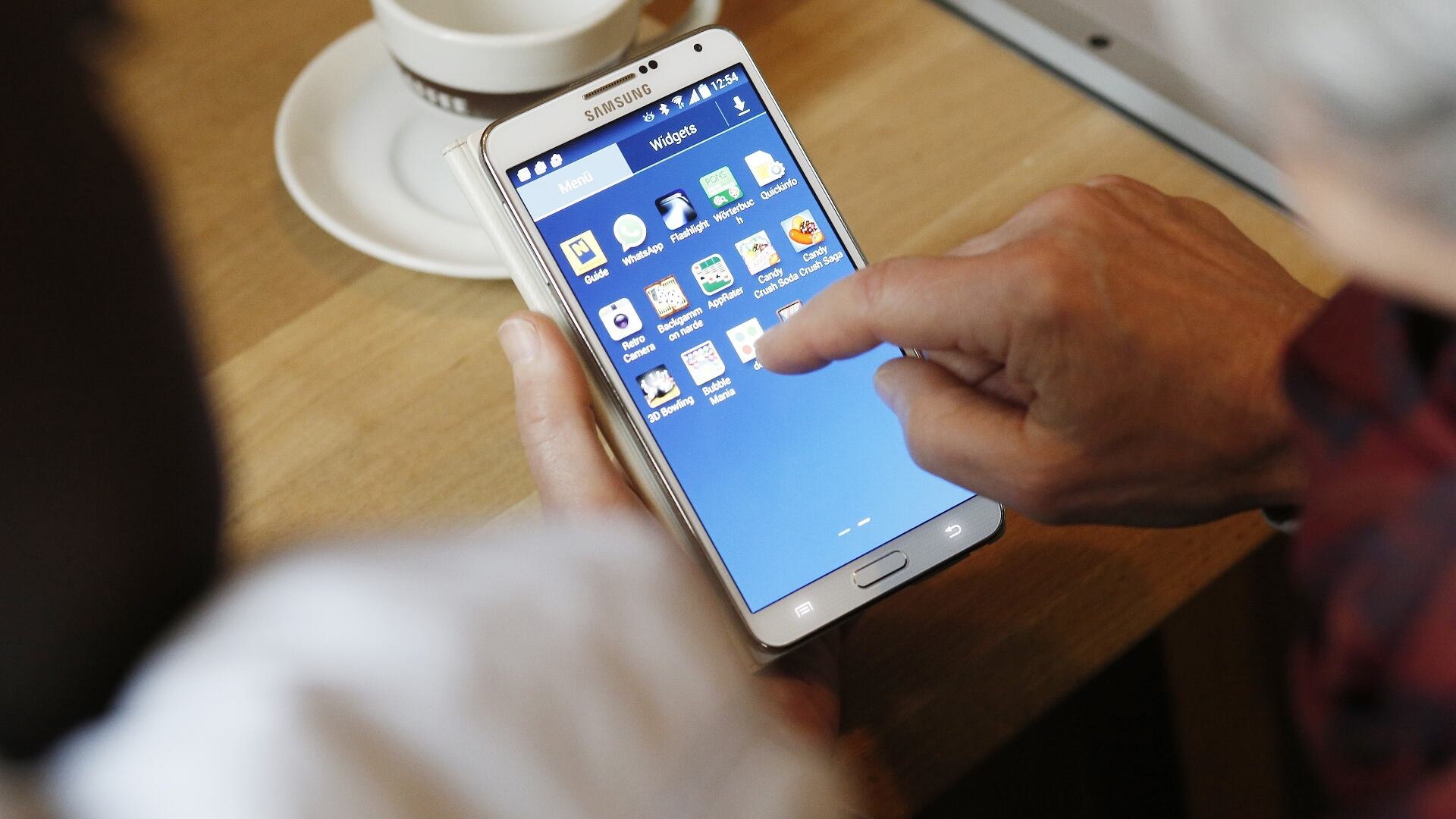
Google’s philanthropy arm, Google.org, recently announced a $10 million grant for the AARP Foundation to aid in teaching digital skills to low income older workers. As the implementation of hybrid work expands, a greater emphasis is being placed on helping workers 50 years old and up — especially among women and people of color — to be digitally literate in order to keep the workplace generationally diverse. Lisa Marsh Ryerson, president of the AARP Foundation, joined Cheddar News to talk about the curriculum of the partnership. "Those of us who are 50 and older are not digital natives, so we do have a learning curve that we have to address," she noted.
AT&T announced earlier today it is spinning off its media properties in WarnerMedia in a merger with Discovery in a $43 billion deal.Scott Rostan, founder and CEO at Training The Street, joined Cheddar to talk about what the unwinding of the telecom giant's Time Warner media properties means for investors. "I think the investor sentiment is they're digesting the new information, and they're looking into the dividend, especially the reduction of the dividend," said Rostan, noting the transaction allows AT&T to focus on its core telecommunications business.
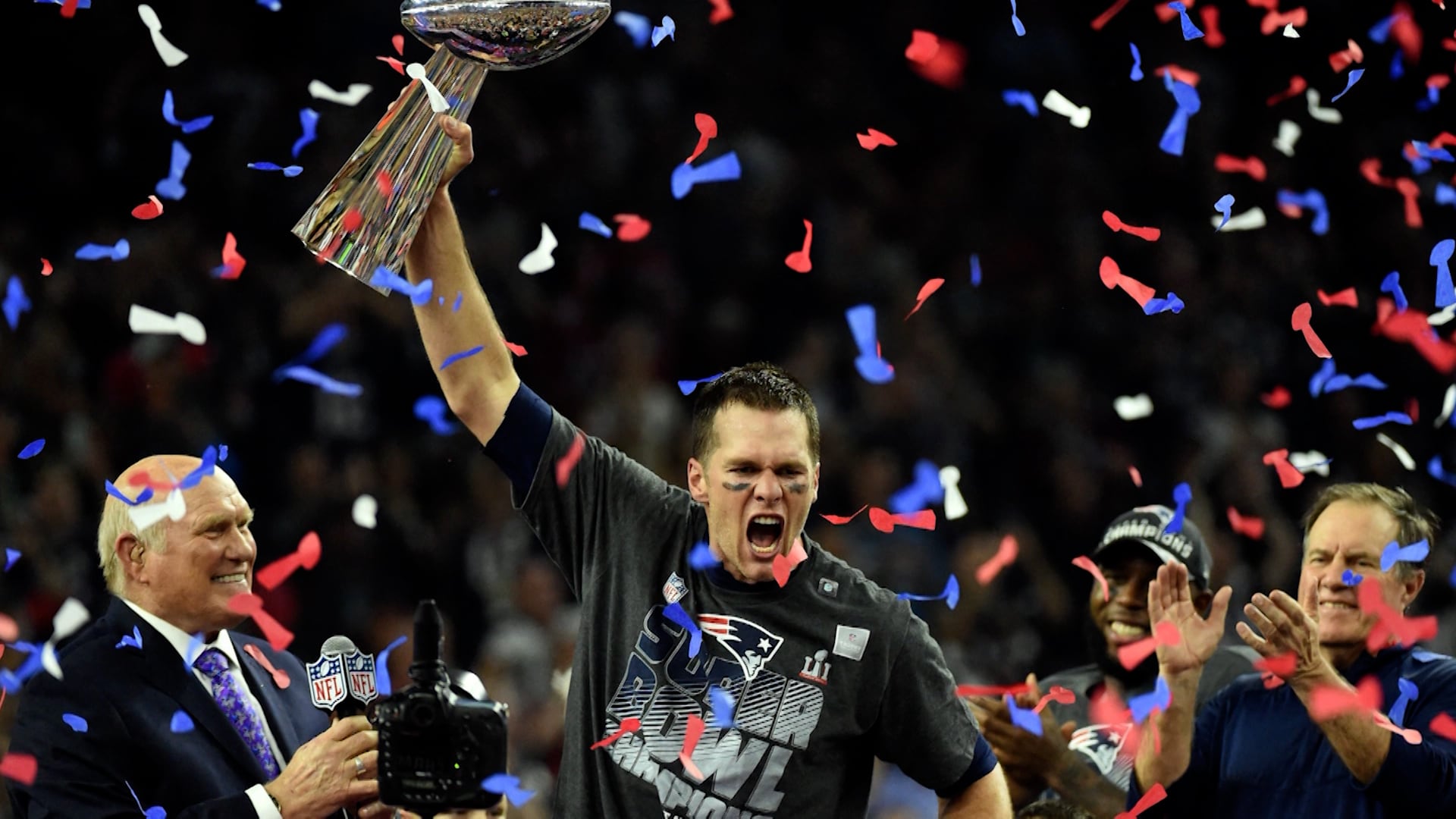
Greg Bishop, Senior Writer for Sports Illustrated, joins Cheddar News' Closing Bell, where he says Tom Brady's legacy is all about 'progress' and expects the future Hall of Famer to bolster his entrepreneurial ventures following his retirement.
Anthony Saccaro, Founder and President of Providence Financial, joins Cheddar News' Closing Bell, where he elaborates on why he is excited that the market is beginning to rebound and believes February has the potential to be a good month after a turbulent January.
A 2021 report from UK Research and Innovation found that the shipping industry makes up at least 2.5 percent of the world's total CO2 emissions. It's a problem that energy solutions company, Leclanché, is trying to solve. Founded in 1909, the company has been developing and producing batteries for more than 100 years. Today, Leclanché's lithium-ion battery is used to electrify not just ships, but also railroad locomotives, trucks, and specialty vehicles. Cheddar News spoke with Pierre Blanc, chief technology and industrial officer of Leclanché, to discuss.
Amazon is betting that ammonia could be the fuel of the future, participating in a Series A round for the Brooklyn-based company Amogy in December. Amogy aims to de-carbonize transportation with a clean energy system that uses ammonia as a renewable fuel. Amogy is partnering with Amazon on its first commercial product - an ammonia-powered cargo-shipping vessel. Amogy CEO Seonghoon Woo joins Cheddar Climate to discuss.
Joseph Pallant, Founder and Executive Director for the Blockchain for Climate Foundation, joins Cheddar Climate, where he discusses the among of energy crypto mining consumes and explains how his organization is on a mission to make the crypto industry more environmentally sustainable.
One of the world's largest transport companies is kicking off Black History Month with a new initiative aimed at the next generation of business leaders. Today, FedEx announced the launch of its Student Ambassador Program. Participants selected from eight historically black colleges and universities will receive career guidance from FedEx executives. The program is part of FedEx's ongoing commitment to HBCUs and will also help the company expand its pipeline for diverse talent. Cheddar News welcomes senior vice president at FedEx, Jenny Robertson, and Jerryl Briggs, President of Mississippi Valley State University, to discuss.