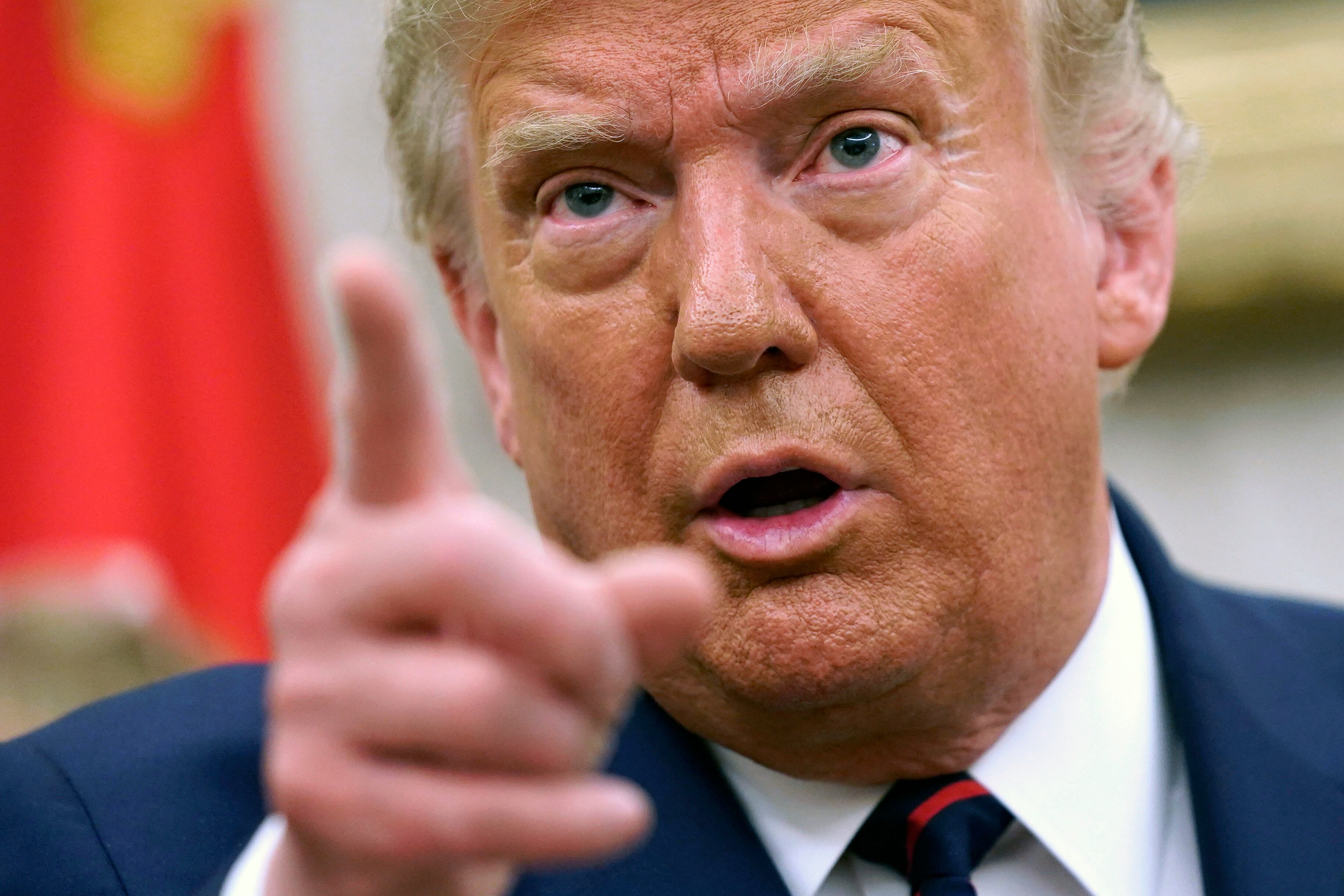
President Donald Trump speaks as he meets with Iraqi Prime Minister Mustafa al-Kadhimi in the Oval Office of the White House, Thursday, Aug. 20, 2020, in Washington. (AP Photo/Patrick Semansky)
By Mark Sherman
President Donald Trump is asking the Supreme Court to allow him to block critics from his personal Twitter account.
The administration said in a high-court filing Thursday that Trump's @realdonaldtrump account with more than 85 million followers is his personal property and blocking people from it is akin to elected officials who refuse to allow their opponents' yard signs on their front lawns.
"President Trump's ability to use the features of his personal Twitter account, including the blocking function, are independent of his presidential office," acting Solicitor General Jeffrey Wall wrote in urging the justices to review the case.
The federal appeals court in New York ruled last year that Trump uses the account to make daily pronouncements and observations that are overwhelmingly official in nature. It held that Trump violated the First Amendment whenever he blocked a critic to silence a viewpoint.
A decision about whether even to hear the case is not likely before the November election.
The case grew out of a challenge brought by the Knight First Amendment Institute at Columbia University, which sued on behalf of seven individuals blocked by Trump after criticizing his policies.
Jameel Jaffer, the Knight Institute's executive director, said the justices should decline to take up Trump's appeal.
"This case stands for a principle that is fundamental to our democracy and basically synonymous with the First Amendment: government officials can't exclude people from public forums simply because they disagree with their political views," Jaffer said in a statement.
The administration argued in its appeal that the Supreme Court, not lower courts, "should decide where to draw the line between the President's personal decisions and official conduct."
The pace of the case was slowed by the coronavirus pandemic as well as Trump's decision to ask the full 2nd U.S. Circuit Court of Appeals to review the ruling by a three-judge panel. The court refused to do so by a 7-2 vote in March. Two Trump appointees, Judges Michael H. Park and Richard J. Sullivan, were the only members of the court to side with the president.
The Supreme Court extended its deadline to file an appeal from 90 days to 150 days when it shut the building to the public and abandoned in-person meetings in favor of telephone conferences because of the virus outbreak.
Meta, the parent company of Facebook, is facing a lawsuit from Ohio's attorney general Dave Yost, who said the company misled the public about safety on the platform.
Cases of covid-19 are climbing in the Upper Midwest, Southwest, and parts of the Northeast. The seven-day national average is sitting at roughly 82,000 new cases which is an 11 percent jump from the week before. Dr. Amesh Adalja, Infectious Disease, Specialist, Sr. Scholar at Johns Hopkins Center for Health Security joined Cheddar's Opening Bell to discuss this recent uptick ahead of the holiday season.
Markets were pointing to a higher open to kick off the third trading week in November. It comes as stocks come off a losing week in reaction to October's consumer price index--which showed inflation at its highest point in over 30 years.
Ryan Detrick, Chief Market Strategist for LPL Financial joined Wake Up with Cheddar to discuss.
Harvard Business School Professor Ranjay Gulati joined Wake Up With Cheddar to break down the massive challenge the Biden Administration faces in ensuring projects in the $1.2 trillion infrastructure bill are completed on time and on budget.
Jill is joined by Baker Machado to talk all things infrastructure: where will the money go and who’s in charge? Plus, Sesame Street has its first Asian-American muppet. And a trailer for the trailer for Spiderman. Huh?
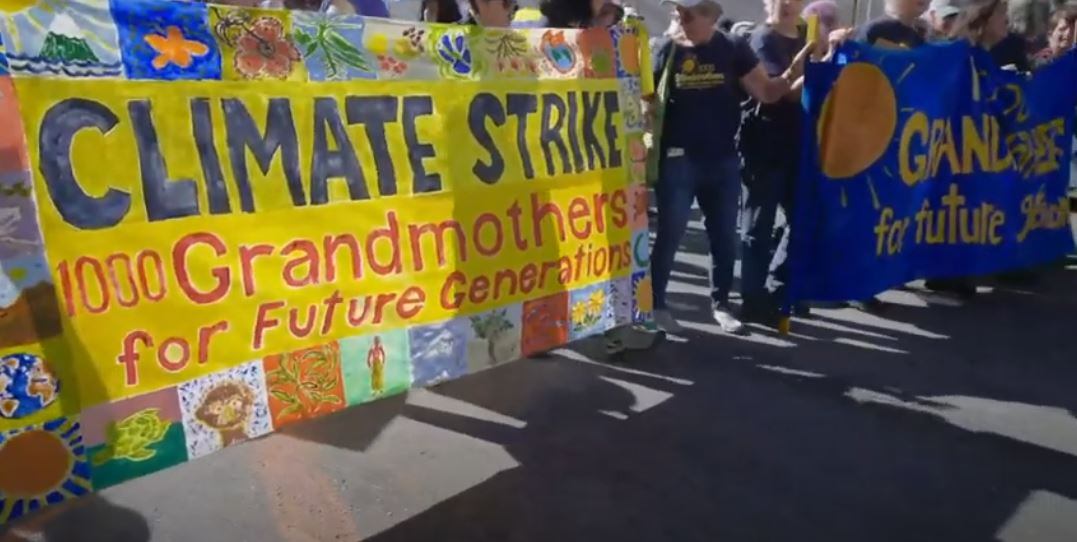
In this week's Cheddar Changemakers, Megan Pratz spoke with a 16-year-old climate activist Sarah Goody. She is the founder of a youth-led climate action group 'Climate NOW.'
We toss around the term "democracy is under attack" quite often without thinking too much, but one organization is actually stepping up to do something about it. The Fairness Project is a group that funds and organizes state ballot measures across the country. It has used ballot initiatives on campaigns aimed at expanding Medicaid, adding more paid time off, and raising minimum wage. It recently launched a new direct democracy campaign to fight back against attempts to make ballot measures inaccessible.
Kelly Hall, executive director of The Fairness Project, joined Cheddar Politics to discuss more about the group's efforts to push for economic and social justice, avoiding partisan gridlock.
Doug Flynn, Certified Financial Planner and Co-Founder of Flynn Zito Capital Management, joins Cheddar News' Closing Bell, where he says he believes the news of the infrastructure bill was already priced into the market and that inflation continues to loom large on Wall Street.
President Joe Biden signed into law today his landmark $1.2 trillion infrastructure bill, and it includes approximately $550 billion in new funding for increased broadband access, improving the power grid, and more. But what does this mean for the American economy, and American workers? Eliza Collins, Politics Reporter at The Wall Street Journal joins Cheddar News' Closing Bell to discuss what's included in the bill, which former mayor has been tapped to oversee how the bill is implemented, and how these new infrastructure investments will impact the economy.