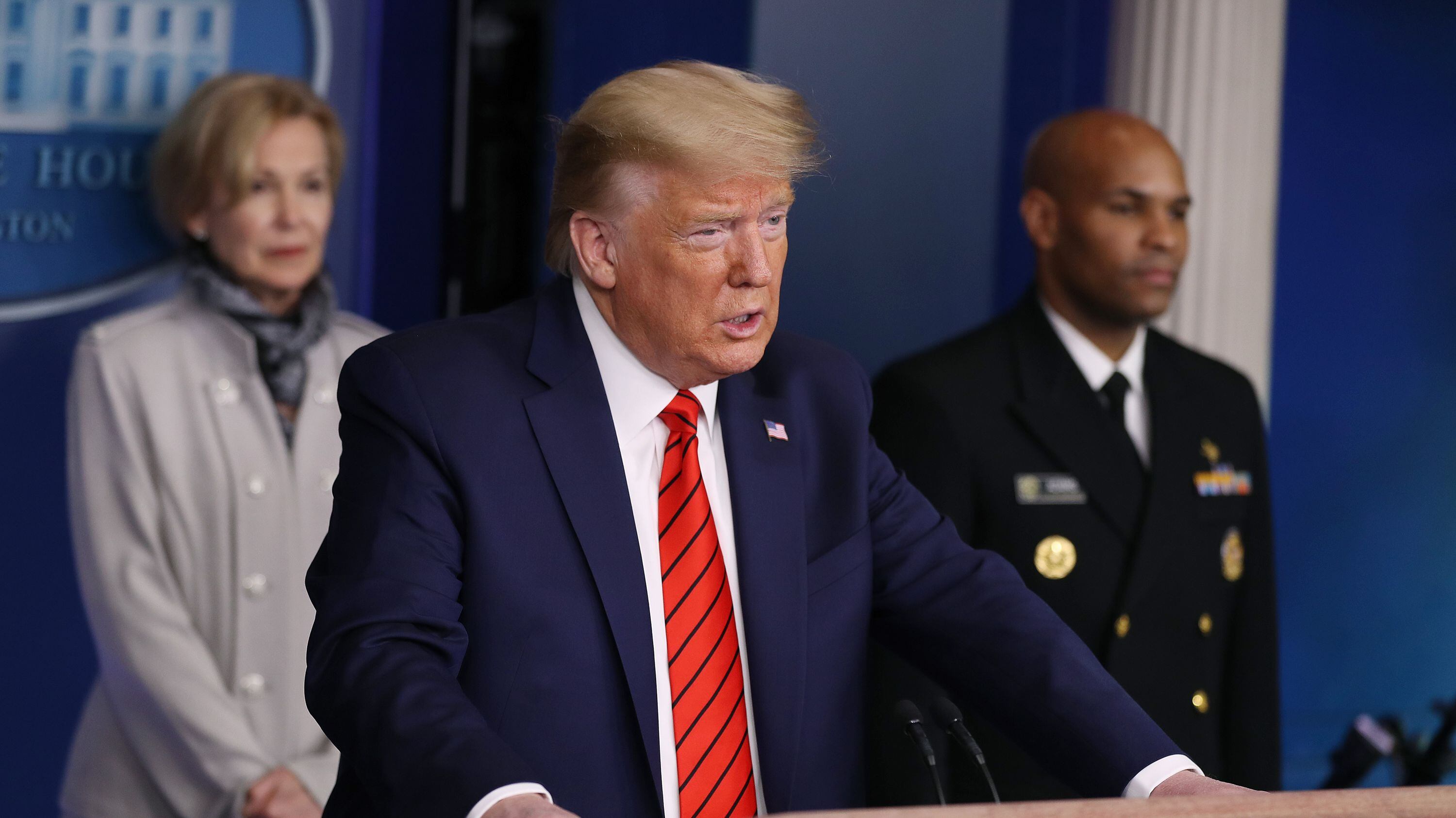
President Donald Trump speaks speaks on the latest developments of the coronavirus outbreak, while flanked by White House coronavirus response coordinator Debbie Birx (L), and U.S. Surgeon General Jerome Adams (R), in the James Brady Press Briefing Room at the White House March 19, 2020. (Photo by Chip Somodevilla/Getty Images)
President Donald Trump in a press conference on Thursday said the Food and Drug Administration is fast-tracking efforts to approve an antiviral therapy, best known for treating malaria, for use in coronavirus cases.
The drug, hydroxychloroquine, was developed more than a half-century ago and is approved for treating malaria, arthritis, and other ailments. Reports out of China and Italy suggest the drug may help, but there is no hard data yet.
"We're going to be able to make that drug available almost immediately," Trump said.
The FDA is working to conduct a "large, pragmatic clinical trial" quickly to confirm the drug's benefit to coronavirus patients, said Commissioner Dr. Stephen Hahn.
He also tempered the president's optimism about the still-untested solution.
"What's also important is not to provide false hope," he said. "We may have the right drug, but it might not be in the appropriate dosage form right now, and it might do more harm than good."
New antiviral therapies face a shorter and less arduous approval process than vaccines, several of which are under development with 12 to 18-month timelines.
"The therapies are something we could move on much faster potentially," Trump said.
He claimed the administration "slashed red tape" to develop new vaccines and therapies.
The president also held out on confirming whether he would invoke the Defense Production Act, which he signed on Wednesday, to mandate the production of needed medical supplies such as N95 respirators and surgical masks.
"If we find that we need something, then we will do that," he said.
Trump repeated that he was open to the federal government buying equity stakes in the airline, cruise, hospitality, and other industries hurt by the outbreak.
The press conference opened with more controversial language placing the blame squarely on China for the outbreak, despite concerns voiced about potentially exacerbating a backlash against Asian Americans.
"We continue our relentless effort to defeat the Chinese virus," Trump said.
Francesca Chambers, White House correspondent for McClatchy, joins Cheddar News to discuss all the topics President Biden has to juggle in his State of the Union address.
World Central Kitchen is Ukraine helping to feed people remaining in the country or fleeing from the Russian forces. Nate Mook, CEO for the non-profit, joined Cheddar New to discuss the efforts being made to help those in need in a very tenuous situation and how the invasion disrupted the lives of Ukrainian people."We met a young woman from Kyiv who had crossed into Poland, she had a great job, she just moved into a new apartment. She was really excited about decorating her apartment. You know, things that we all do on a day-to-day basis, and she had to just abandon her life," he said.
Bina Venkataraman, Boston Globe Editorial Page Editor & former White House disaster policy adviser joins Cheddar News to discuss the current state of the pandemic as well as Biden's handling of the crisis
Michael Li senior counsel for the Brennan Center's Democracy Program joins Cheddar News to discuss gerrymandering and how it's impacting American politics
As half a million Ukrainians fled when Russia invaded its neighbor, some civilians chose to stay in harm's way. Igor Gamaniuk, a 17-year-old Ukrainian college student, joined Cheddar News to talk about his decision to remain in his beloved country and volunteer to support soldiers with food, clothing, and supplies. "Right now people are pretty calm in my town. We are trying not to panic. But we have to be cautious because every day and every night the siren could sound and we have to move away from the window or go to the nearest shelter," Gamaniuk explained.