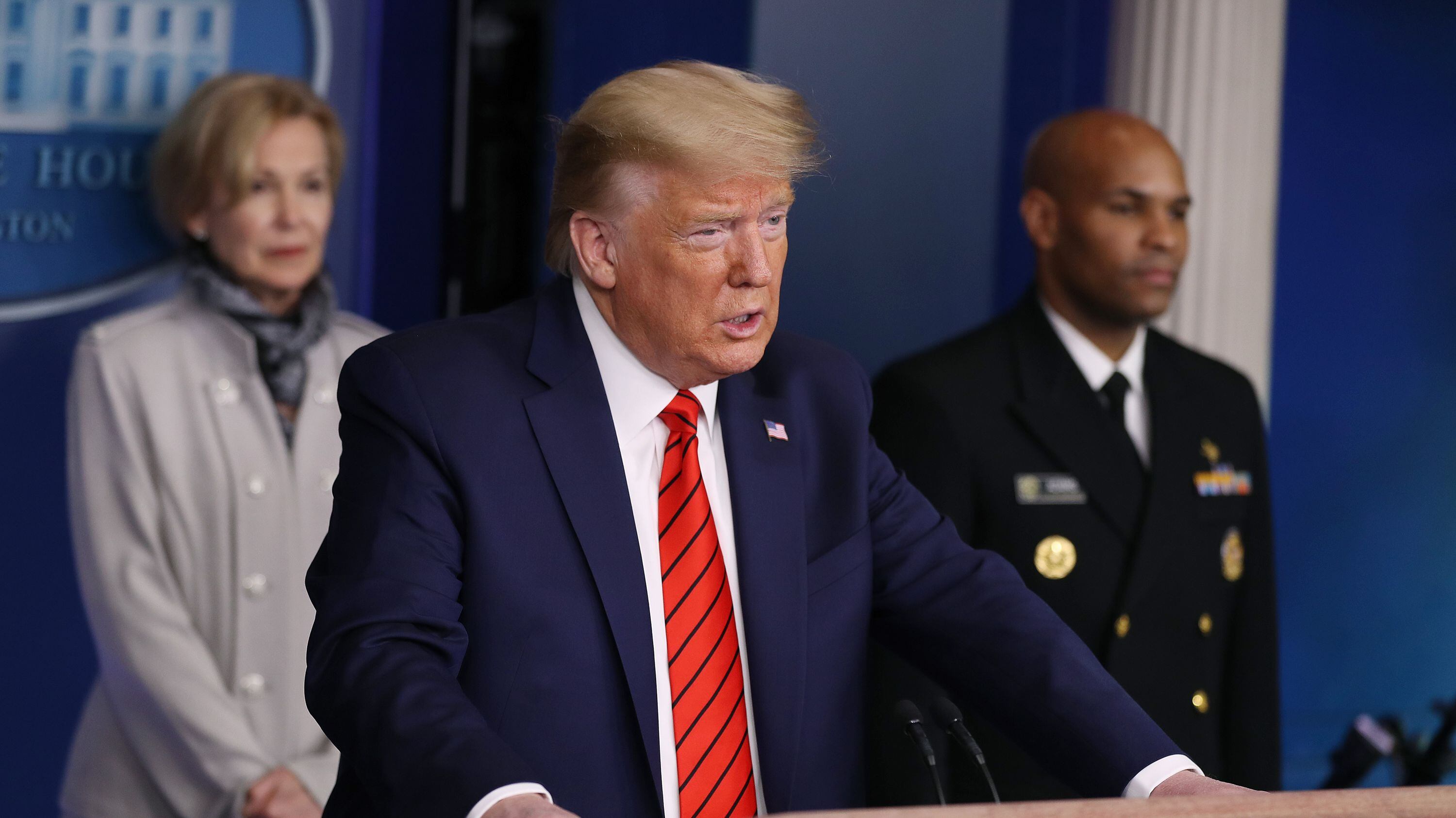
President Donald Trump speaks speaks on the latest developments of the coronavirus outbreak, while flanked by White House coronavirus response coordinator Debbie Birx (L), and U.S. Surgeon General Jerome Adams (R), in the James Brady Press Briefing Room at the White House March 19, 2020. (Photo by Chip Somodevilla/Getty Images)
President Donald Trump in a press conference on Thursday said the Food and Drug Administration is fast-tracking efforts to approve an antiviral therapy, best known for treating malaria, for use in coronavirus cases.
The drug, hydroxychloroquine, was developed more than a half-century ago and is approved for treating malaria, arthritis, and other ailments. Reports out of China and Italy suggest the drug may help, but there is no hard data yet.
"We're going to be able to make that drug available almost immediately," Trump said.
The FDA is working to conduct a "large, pragmatic clinical trial" quickly to confirm the drug's benefit to coronavirus patients, said Commissioner Dr. Stephen Hahn.
He also tempered the president's optimism about the still-untested solution.
"What's also important is not to provide false hope," he said. "We may have the right drug, but it might not be in the appropriate dosage form right now, and it might do more harm than good."
New antiviral therapies face a shorter and less arduous approval process than vaccines, several of which are under development with 12 to 18-month timelines.
"The therapies are something we could move on much faster potentially," Trump said.
He claimed the administration "slashed red tape" to develop new vaccines and therapies.
The president also held out on confirming whether he would invoke the Defense Production Act, which he signed on Wednesday, to mandate the production of needed medical supplies such as N95 respirators and surgical masks.
"If we find that we need something, then we will do that," he said.
Trump repeated that he was open to the federal government buying equity stakes in the airline, cruise, hospitality, and other industries hurt by the outbreak.
The press conference opened with more controversial language placing the blame squarely on China for the outbreak, despite concerns voiced about potentially exacerbating a backlash against Asian Americans.
"We continue our relentless effort to defeat the Chinese virus," Trump said.
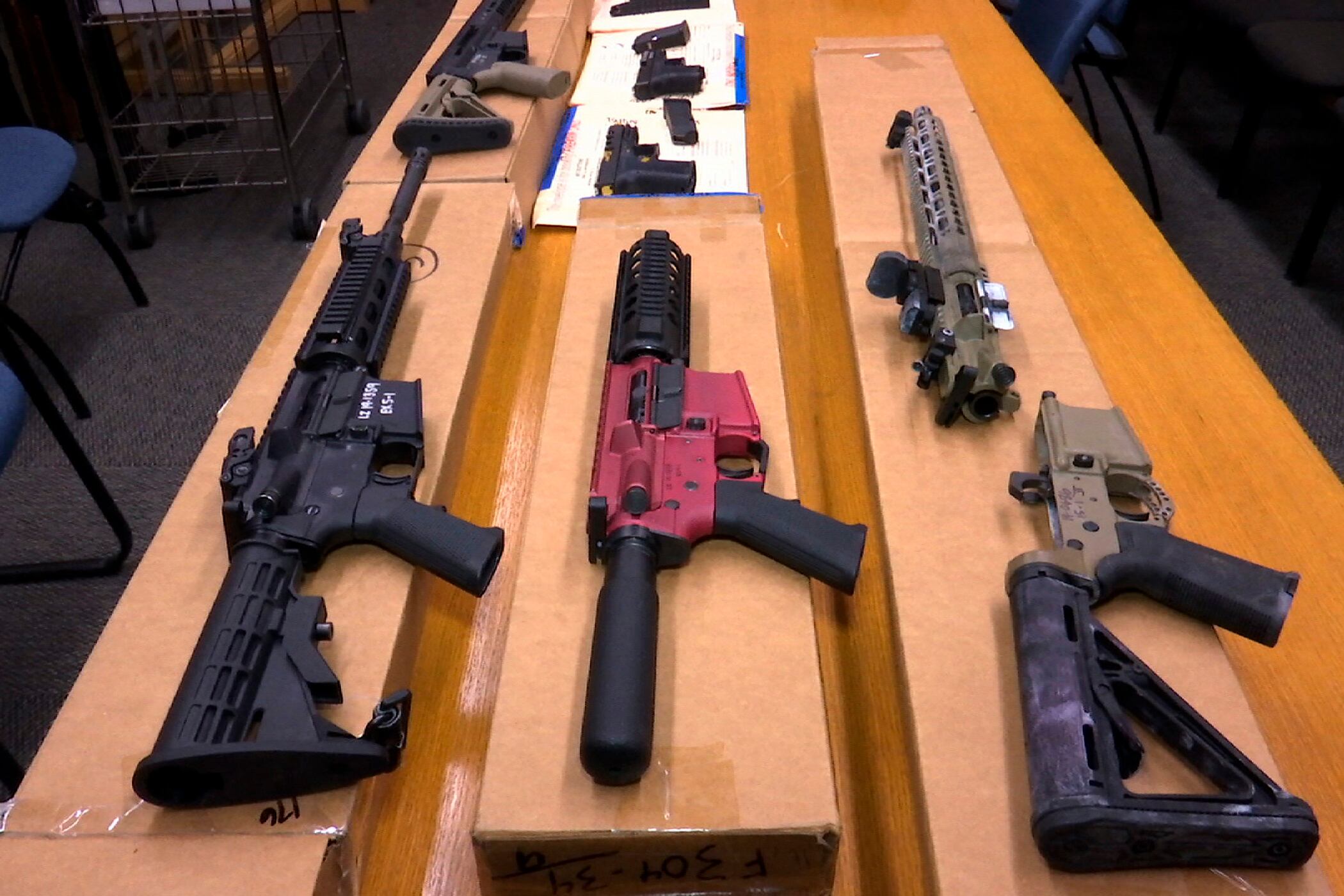
Rukmani Bhatia, Senior Federal Affairs Manager at Giffords, joined Cheddar News' Closing Bell to discuss the importance of regulating ghost guns as a way to curb U.S. gun violence, which kills more than 40,000 Americans every year.
Gary Schlossberg, Global Strategist at Wells Fargo Investment Institute, joined Cheddar News' Closing Bell to discuss the dire situation caused by Russia's war on Ukraine, as the region is key for exporting grains and corn, and as the UN Food & Agriculture Organization says food prices rose to the highest levels ever in March.
Christine McDaniel, Senior Research Fellow at the Mercatus Center, joined Cheddar News' Closing Bell to break down the long list of sanctions that the U.S. has levied against Russia since its invasion of Ukraine, and the impact - or lack thereof - they are having on Russia.
President Joe Biden is taking fresh aim at “ghost guns" and also announced the nomination of Steve Dettlebach, who served as a U.S. attorney in Ohio from 2009 to 2016, to run the ATF.
Stefanie O'Connell Rodriguez joined Cheddar's Opening Bell to discuss her newest mini-series on REAL SIMPLE's Money Confidential podcast, called 'Taxes in 10.'
As the Russian invasion of Ukraine continues, social media giant Meta said that it's using its technology to help the beleaguered nation Erin Egan, chief privacy officer, and Andrew Schroeder, vice president of research and analysis for direct relief, joined Cheddar News to discuss using data towards humanitarian relief. "Our goal with the program is to help organizations on the ground by sharing privacy-protected data sets to enable them to respond to crisis," Egan explained.
Catching you up on what you need to know on April 11, 2022, with updates on the Russia-Ukraine War, France’s presidential election, the record deforestation of the Amazon Rainforest, retail giant Amazon's objection to the Staten Island union vote, the worsening baby formula shortage, a lawsuit against Rutgers Law School, and a stomach illness possibly linked to Lucky Charms cereal.
Between Bells executive producer Conor White recaps some of the biggest stories of the week, and teaches Baker Machado and Hena Doba a thing or two at the same time. It's This Week In Trivia!