President Donald Trump abandoned his administration's pursuit to add a citizenship question to the 2020 census, but through an executive order demanded that all government agencies compile and disclose existing data on citizenship.
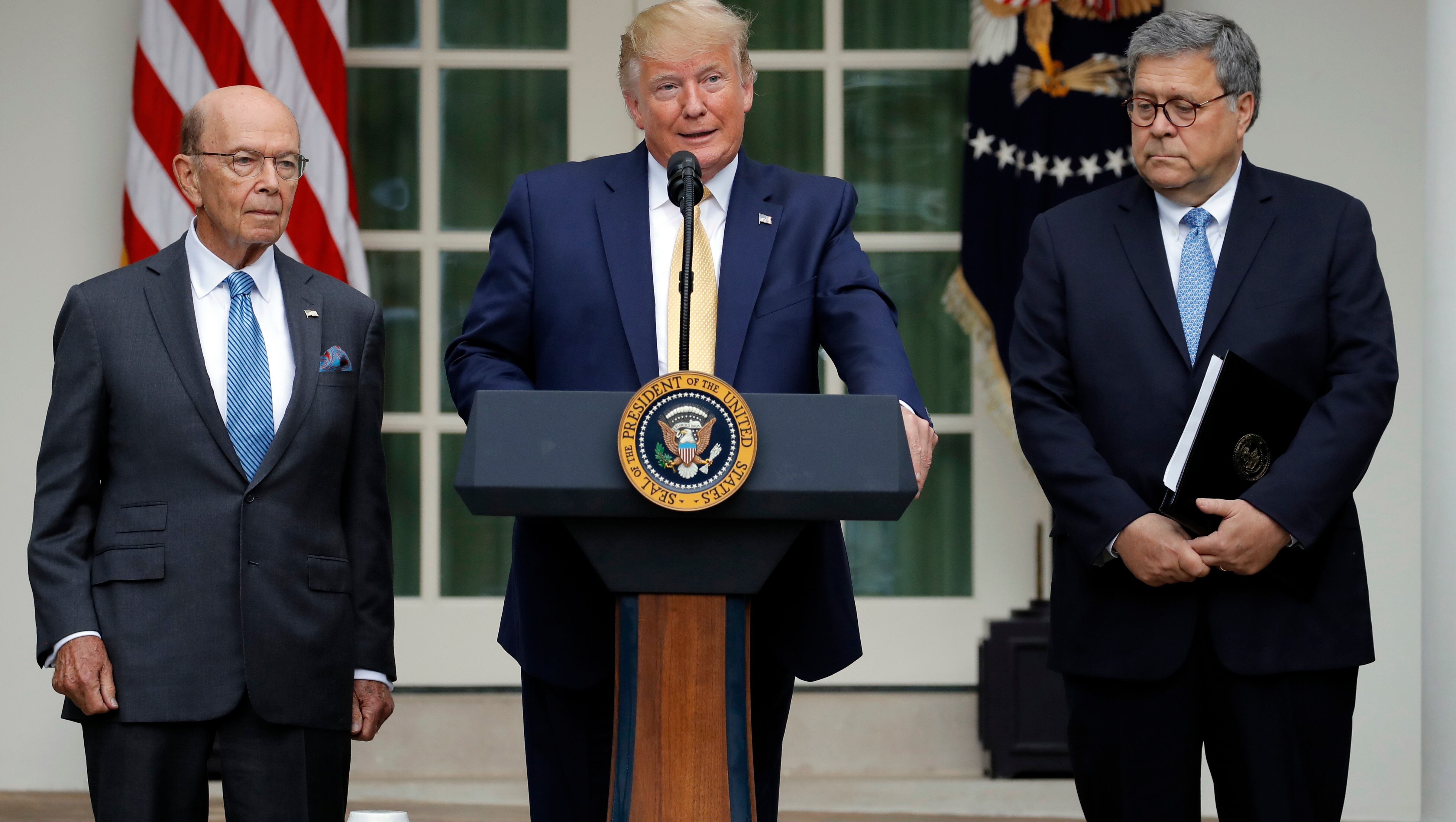
“I am hereby ordering every department and agency in the federal government to provide the Department of Commerce with all requested records regarding the number of citizens and non-citizens in our country,” Trump said on Thursday from the White House Rose Garden. “We will leave no stone unturned.”
The administration changed course just a week after saying it would continue its fight to include the citizenship question on the census, although it had been blocked by the Supreme Court in June.
At first, the White House had appeared to accept the Supreme Court’s decision and ordered the 2020 census to be printed without the controversial question: "Is this person a citizen of the United States?"
Yet in a whiplash-inducing turnaround, which seemed to be prompted by a tweet from Trump, the Justice Department later said it would pursue alternative legal avenues to add the question. The department even attempted to replace its legal team on the census-related cases — a request that was denied in federal court.
The government provided “no reasons, let alone satisfactory reasons” for the team change, U.S. District Judge Jesse Furman wrote in his decision, adding that “urgency — and the need for efficient judicial proceedings — has only grown” regarding the issue.
As recently as Tuesday, Attorney General William Barr told reporters that the administration was still pursuing a legal strategy that would “provide a pathway” for the question’s inclusion on the census.
Yet speaking after Trump on Thursday, Barr said that “as a practical matter, the Supreme Court decision closed all paths to adding the question to the 2020 census.”
He added that although a new rationale for the citizenship question’s inclusion would “ultimately survive legal review,” the government chose to obtain the data through an executive order to ensure the census is completed in a timely manner.
"This is a welcome reprieve of [Trump's] partisan agenda, and a win for all communities," Vanita Gupta, president and CEO of the civil rights group The Leadership Conference Education Fund, said in a statement. "Trump's remarks were pure propaganda and a continuation of his lies. His attempt to save face is just a repackaging of what the government already does through administrative records."
Critics of the citizenship question were quick to respond to the announcement on social media.
New York Attorney General Letitia James, who was the lead plaintiff in the Supreme Court case, said that "reason has finally prevailed" and that the decision will at "long last allow us to put this national nightmare behind us & ensure all people are counted."
"It’s official. There will be NO citizenship question on the 2020 census. It’s over. We won," Dale Ho, the director of the ACLU's Voting Rights Project, said on Twitter.
In 2018, when the administration first announced plans to include a citizenship question, several advocacy groups and a coalition of states filed lawsuits to block it, claiming it would suppress responses from immigrant communities. Opponents also argued that the Republican-led proposal was pursued to primarily stifle minority populations — which are often centered in urban, Democratic districts — to give more influence to rural areas.
“It is a means by which the administration can guarantee white, Republican rule for the next generation or so,” Aderson Francois, a law professor at Georgetown University, told Cheddar.
The concern was borne out after memos from a Republican strategist emerged during court proceedings that said the question should be added to benefit “Republicans and Non-Hispanic Whites.”
Trump said, however, that the data on citizenship is “vital for formulating sound public policy” and claimed that critics of the inquiry “are not proud to be U.S citizens.
Yet advocacy groups, such as the ACLU, have already said they will challenge the executive order in court.
"While Trump backing down is a victory, our fight is far from over," Tom Perez, the chairman of the Democratic National Committee, said on Twitter.
Trump and Barr, who spoke alongside Commerce Secretary Wilbur Ross, did not take questions from the press.