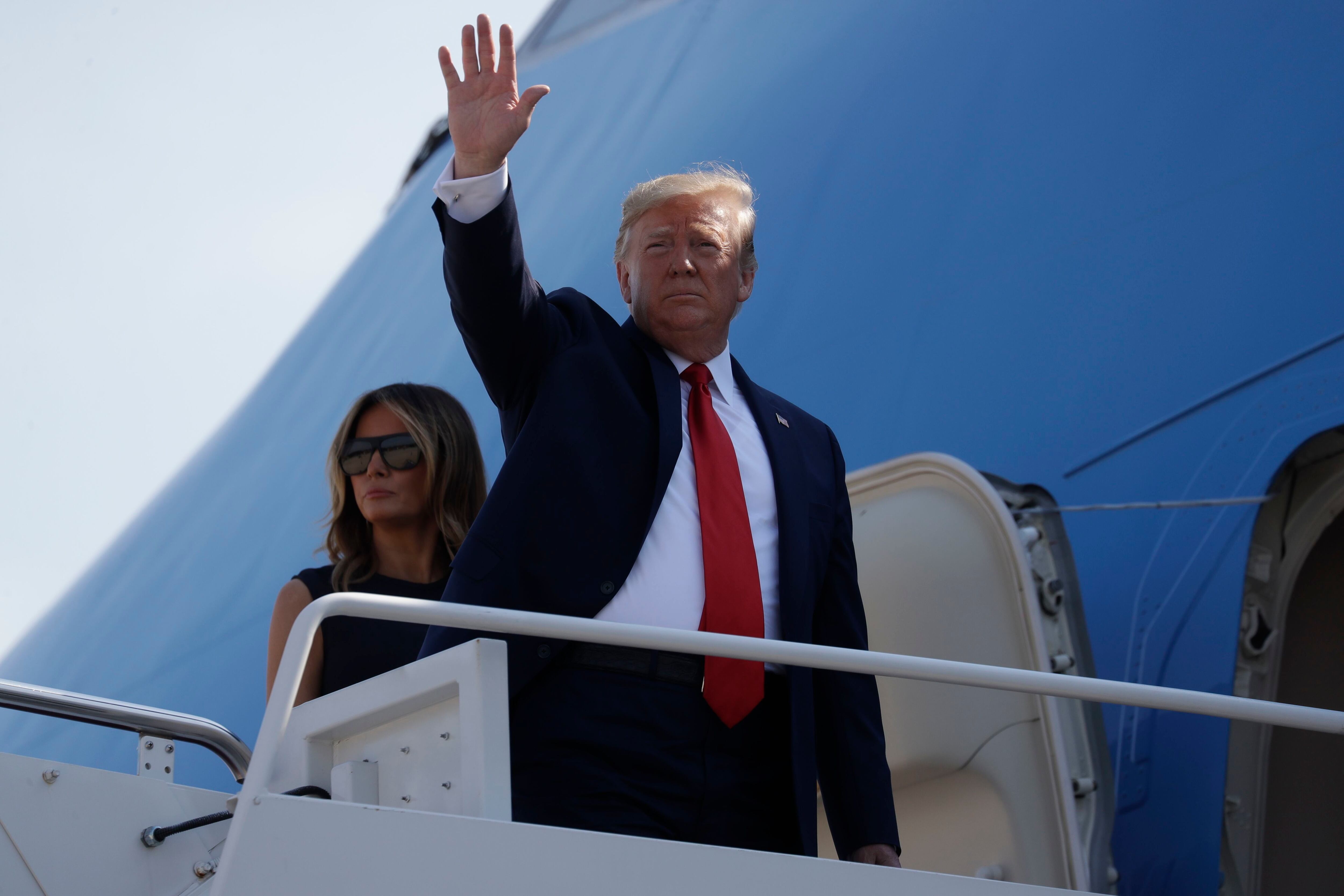
President Trump is scheduled to visit El Paso, Texas and Dayton, Ohio on Wednesday, two cities grieving after separate mass shootings killed at least 31 people over the weekend.
The visits are a “terrific opportunity to congratulate” local police and law enforcement, Trump told reporters as he left the White House.
The president’s visits, however, have created an atmosphere of angst, with some residents and lawmakers in both cities condemning Trump’s refusal to support stricter gun control measures and his divisive leadership.
“His rhetoric has been painful for many in our community and I think the people should stand up and say they’re not happy, if they’re not happy that he is coming,” Mayor Nan Whaley of Dayton, a Democrat, told reporters on Tuesday.
In the early hours of Sunday morning, a gunman killed nine people, including his younger sister, in an entertainment district of the western Ohio city.
The mood is also unnerved in El Paso, where at least 22 people were killed on Saturday by a white supremacist terrorist at a Walmart. In a racist manifesto believed to be from the suspect, which mirrored rhetoric used by Trump when speaking about immigrants, the shooter said he was specifically targeting Hispanics to stop their "invasion of Texas."
“I think my rhetoric brings people together,” Trump said on Wednesday in response to a question about the gunman parroting his language, adding that he is concerned about hate groups, “whether it’s white supremacy or any other kind of supremacy."
The Republican Mayor of El Paso, Dee Margo, said on Tuesday that he did not want Trump's visit to become political, but that he would "challenge any harmful and inaccurate statements" made about the city. Margo publically challenged the president after a February rally in El Paso where Trump said that murders committed by undocumented immigrants plagued the city.
Democratic state Rep. César Blanco, who represents El Paso in Austin, told Cheddar earlier this week that Trump’s “hateful anti-Latino, anti-immigrant” rhetoric created the fraught atmosphere at the border that led to the Walmart shooting.
“Everybody has it in their power to be a force to bring people together, and everybody has it in their power to be a force to bring people apart. That is up to the president of the United States,” Whaley added on Tuesday.
Matt Hayden, vice president of govtech solutions at Exiger and a former assistant secretary of cyber at Department of Homeland Security, joined Cheddar to discuss the surprise phone call initiated by Russian President Vladimir Putin to President Joe Biden, ahead of January security talks about the rising tensions over Ukraine. "We're hoping to hear that we're able to talk about the aggression and the leadup of the Ukrainian militarization," Hayden said. "But we're also looking to hear is how the Kremlin leveraged their talking points to try to test their negotiation stance with the United States leading into this January 10th meeting."
The No Surprises Act begins implementation on January 1, 2022. The legislation is meant to curb the practice of unexpected billing for care from providers the patient was unaware were out-of-network from their insurance. Patricia Kelmar, director of health care campaigns for U.S. PIRG joined Cheddar to describe the hundreds, sometimes thousands, of dollars charged to unsuspecting patients and how things will change under the new law. "If we are picking an in-network doctor and an in-network hospital, we should not see those added costs from anesthesiologists, radiologists, scrub-in surgeons," she said. "The other area it protects you is in air ambulances — not ground ambulances, unfortunately — but the helicopters or the airplanes you might need to transport you in an emergency situation."
President Joe Biden and Russian President Vladmir Putin are expected to have another conversation surrounding escalating tensions between Russia and Ukraine. Ariel Cohen, senior fellow at the Atlantic Council, joined Cheddar's Ken Buffa to discuss the ongoing tensions and why Putin's request for a conversation with Biden comes now. "This is very serious. This is the worst security crisis we had since the collapse of the Soviet Union," Cohen told Cheddar.
Stocks closed mixed on Wednesday, but two indexes - the Dow and the S&P 500 - ended the session with a new record. Akshata Bailkeri, Equity Analyst at Bruderman Asset Management, joins Cheddar News' Closing Bell, where she says there is a consensus for robust consumer spreading in 2022, especially as the Omicron variant is proving to be milder than other COVID-19 strains.
John Quelch, Dean of Miami Herbert Business School, joins Cheddar News' Closing Bell, where he says the retail giant is acting in accordance to President Biden's new law banning goods from China's Xinjiang region. Quelch also elaborates on the importance of China in Walmart's overall strategy.