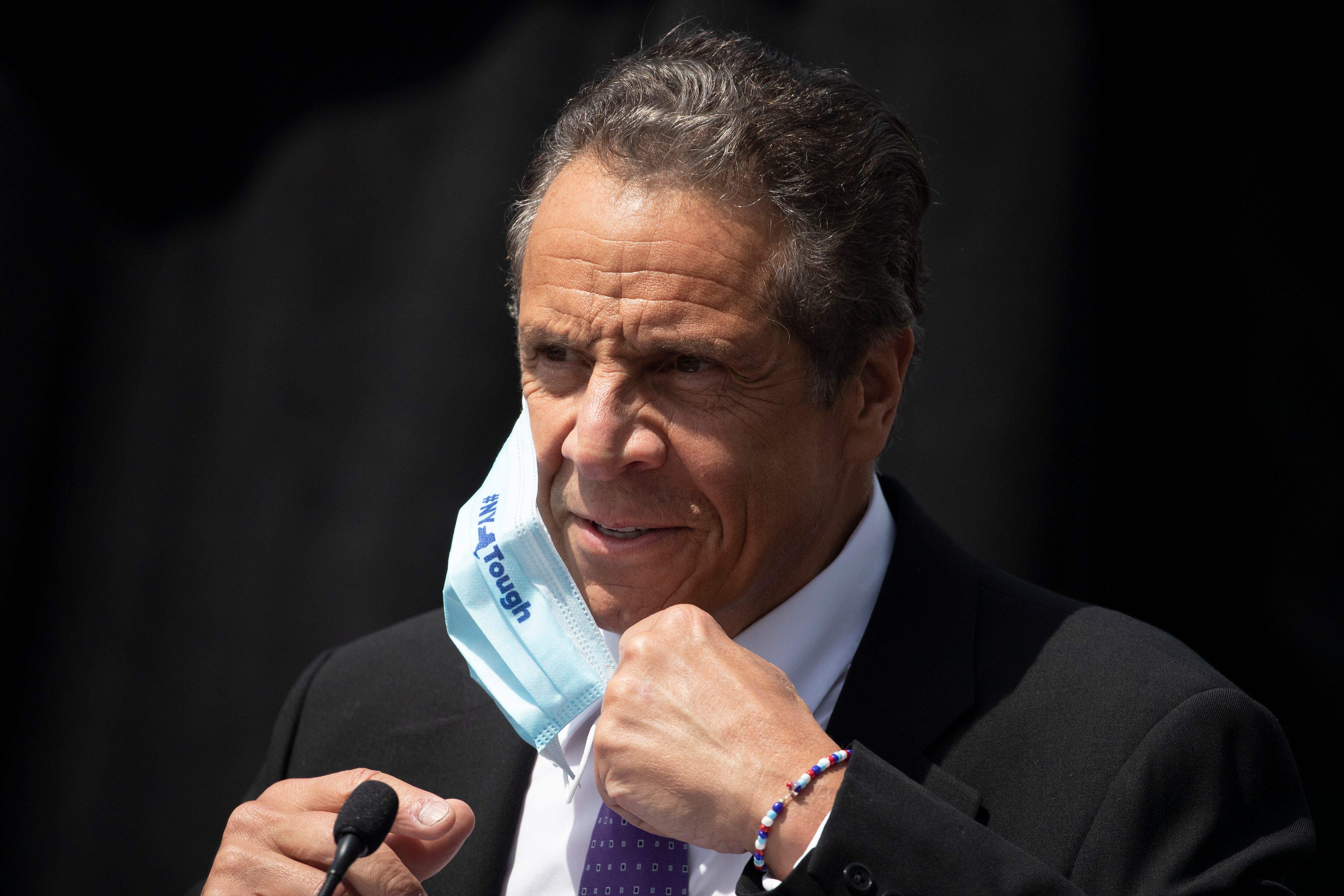
New York Gov. Andrew Cuomo removes a mask as he holds a news conference to announce the opening of a bicycle and pedestrian path across the Gov. Mario M. Cuomo Bridge, Monday, June 15, 2020 in Tarrytown, N.Y. (AP Photo/Mark Lennihan)
Updated 11:59 am ET
New York, Connecticut, and New Jersey will require visitors from states with high infection rates to quarantine for 14 days, New York Gov. Andrew Cuomo said Wednesday.
"We now have to make sure the rates continue to drop," Cuomo said. "We also have to make sure the virus doesn't come on a plane again."
Cuomo announced what was called a "travel advisory" at a briefing jointly via video feeds with New Jersey Gov. Phil Murphy and Connecticut Gov. Ned Lamont, both fellow Democrats.
The states' health departments will provide details of how the rule will work, Murphy said.
The announcement comes as summer travel to the states' beaches, parks, and other attractions -- not to mention New York City -- would normally swing into high gear.
Visitors from states over a set infection rate will have to quarantine, Cuomo said. As of Wednesday, states over the threshold were Alabama, Arkansas, Arizona, Florida, North Carolina, South Carolina, Washington, Utah, and Texas.
American citizens in Israel can start leaving the country on charter flights starting Friday after the State Department said flights will take Americans and immediate family members to either Athens, Greece or Frankfurt, Germany.
The Israeli military has ordered the 1.1 million residents of northern Gaza to evacuate to the south within 24 hours as U.S. Defense Secretary Lloyd Austin arrived in Israel.
U.S. Sen. Bob Menendez of New Jersey faced a new charge Thursday that he conspired to act as an agent of the Egyptian government, a remarkable accusation against a Democrat who had a powerful role in U.S. policy as head of the Senate’s Foreign Relations Committee.
An Israeli ground offensive in the Gaza Strip would further escalate the war raging since Hamas launched its unprecedented attack, killing hundreds of civilians.
A retired bank official testified that former president Donald Trump obtained hundreds of millions of dollars in loans based on financial statements that have since been deemed fraudulent.