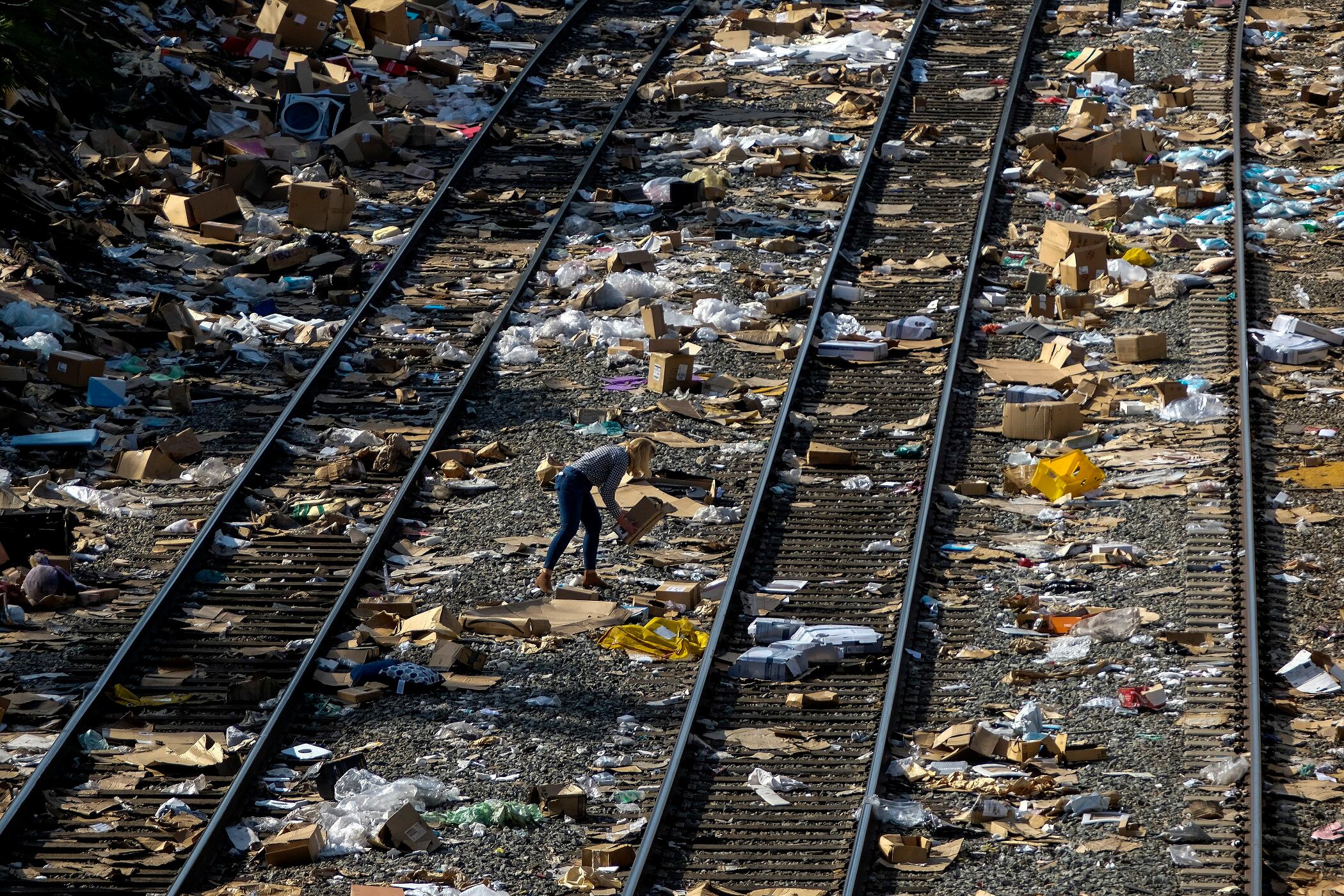
A member of the media picks up a shredded box at a section of the Union Pacific train tracks in downtown Los Angeles, Friday, Jan. 14, 2022. Thieves have been raiding cargo containers aboard trains nearing downtown Los Angeles for months, leaving the tracks blanketed with discarded packages. The sea of debris left behind included items that the thieves apparently didn't think were valuable enough to take, CBSLA reported Thursday. (AP Photo/Ringo H.W. Chiu)
Crews made railroad repairs in Los Angeles Monday after a train derailed near the location where thieves have been raiding cargo containers, leaving the tracks littered with emptied boxes of packaged good sent by retailers.
It wasn't immediately clear if the derailment that happened Saturday was caused by the debris left behind by thieves in the Lincoln Heights area near downtown Los Angeles. Union Pacific said the cause of the derailment was under investigation.
The derailment caused 17 train cars to go off the tracks, Union Pacific said in a statement. No injuries were reported.
Cargo containers aboard trains have been targeted by thieves for months, authorities said. The stolen packages are from retailers including Amazon, REI and others, the CBSLA television newscast reported last Thursday.
Union Pacific said in a statement to CBSLA that the railroad was concerned about increased cargo thefts in California.
“We have increased the number of Union Pacific special agents on patrol, and we have utilized and explored additional technologies to help us combat this criminal activity. We also will continue to work with our local law enforcement partners and elected leaders,” the railroad company said.
Amazon said it was directing inquiries to police. The United Parcel Service declined to comment on investigations into the cargo thefts but said the company was cooperating with authorities.
President Donald Trump's administration last month awarded a $1.2 billion contract to build and operate what's expected to become the nation’s largest immigration detention complex to a tiny Virginia firm with no experience running correction facilities.
Chipmaker Nvidia is poised to release a quarterly report that could provide a better sense of whether the stock market has been riding an overhyped artificial intelligence bubble or is being propelled by a technological boom that’s still gathering momentum.
Cracker Barrel said late Tuesday it’s returning to its old logo after critics — including President Donald Trump — protested the company’s plan to modernize.
Low-value imports are losing their duty-free status in the U.S. this week as part of President Donald Trump's agenda for making the nation less dependent on foreign goods. A widely used customs exemption for international shipments worth $800 or less is set to end starting on Friday. Trump already ended the “de minimis” rule for inexpensive items sent from China and Hong Kong, but having to pay import taxes on small parcels from everywhere else likely will be a big change for some small businesses and online shoppers. Purchases that previously entered the U.S. without needing to clear customs will be subject to the origin country’s tariff rate, which can range from 10% to 50%.
Southwest Airlines will soon require plus-size travelers to pay for an extra seat in advance if they can't fit within the armrests of one seat. This change is part of several updates the airline is making. The new rule starts on Jan. 27, the same day Southwest begins assigning seats. Currently, plus-size passengers can pay for an extra seat in advance and later get a refund, or request a free extra seat at the airport. Under the new policy, refunds are still possible but not guaranteed. Southwest said in a statement it is updating policies to prepare for assigned seating next year.
Cracker Barrel is sticking with its new logo. For now. But the chain is also apologizing to fans who were angered when the change was announced last week.
Elon Musk on Monday targeted Apple and OpenAI in an antitrust lawsuit alleging that the iPhone maker and the ChatGPT maker are teaming up to thwart competition in artificial intelligence.