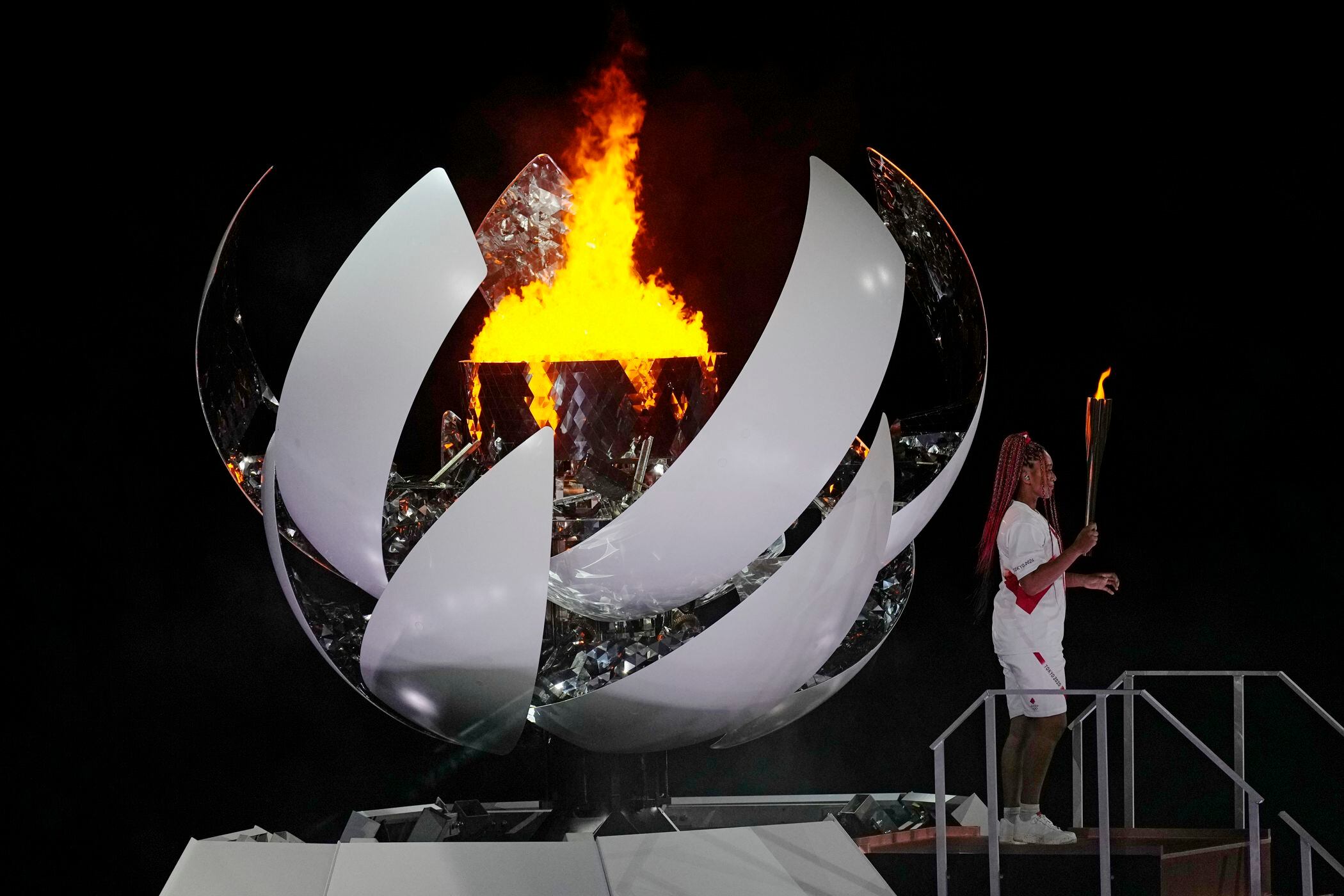
Naomi Osaka stands beside the Olympic flame after lighting it during the opening ceremony in the Olympic Stadium at the 2020 Summer Olympics, Friday, July 23, 2021, in Tokyo, Japan. (AP Photo/David J. Phillip)
Inspired by the sun, the Tokyo Olympic cauldron is designed to be better for the planet.
The flame at Tokyo’s National Stadium and another cauldron burning along the waterfront near Tokyo Bay throughout the games will be sustained in part by hydrogen, the first time the fuel source will be used to power an Olympic fire.
Previous flames have usually run on propane, although magnesium, gunpowder, resin and olive oil have also been used since the first modern cauldron was lit for the Amsterdam Games in 1928. The torch relay was introduced eight years later for Berlin.
Unlike propane, hydrogen does not produce carbon dioxide when combusted. The Tokyo cauldron is fueled by hydrogen produced by a factory in the Fukushima prefecture that runs on renewable energy. Propane and hydrogen were both used during the torch relay.
Organizers for the London Games in 2012 touted plans for a low-carbon torch but couldn’t get the design right in time. They instead used a mix of propane and butane. Brazilian officials commissioned a smaller cauldron for Rio in 2016 to reduce the amount of fuel needed.
The Tokyo cauldron was designed by Canadian architect Oki Sato. His sun-inspired orb unfolds like petals from a flower, which organizers say “embody vitality and hope.”
Tennis player Naomi Osaka lit the torch at 11:48 p.m., with performers from throughout the night's ceremony holding sunflowers — famous for blooming toward the sun.
The first torch for these games was lit in Olympia, Greece, 16 months ago, but the relay was suspended for much of 2020 due to the pandemic. Officials put the torch on display at prefectures affected by the earthquake and tsunami that ravaged the region in 2011 until the relay was officially restarted in Fukushima on March 25, 2021.
Some stages of the relay were pulled off roads this month due to fears about spreading the coronavirus before the flame made its way to the National Stadium in Tokyo’s Shinjuku City.
All major social media platforms do poorly at protecting LGBTQ+ users from hate speech and harassment — especially those who are transgender, non-binary or gender non-conforming, the advocacy group GLAAD said Thursday. But Twitter is the worst.
Sarah Burke, editor-in-chief of Them, spoke with Cheddar News about how its digital magazine offers a different setting for the LGBTQ+ community from other magazines. "From the very beginning, the intention was to create a platform that had a foundation of inclusivity and intersectionality across the entire LGBTQ+ spectrum," Burke said.
Imagine having a viral video with 5 million views but not even using a cell phone. That is the paradox of a Greek great-grandma touching hearts around the world just by doing her thing. Take a look at this.
Glenda Jackson, a two-time Academy Award-winning performer who had a second career in politics as a British lawmaker before an acclaimed late-life return to stage and screen, has died at age 87.
Cold plunges are super hot on social media right now. Experts say they boost mental health, soothe sore muscles, and even promote weight loss. Cheddar's Ashley Mastronardi visited Kardashian favorite, Remedy Place, to get the skinny on ice baths.
New details are emerging about Carrie Fisher's last film. Here's a look at Fisher in the upcoming fantasy movie Wonder Well, which co-stars Rita Ora. Deadline is reporting that the film has a theatrical release date of June 23.
An auction of artwork and furniture from philanthropists Ann and Gordon Getty is taking place at Christie's Wednesday with online sales set for Thursday. Cheddar News takes a peek at some of the arts and objects from the family's Temple of Wings home in Berkeley, Calif.