By AAMER MADHANI and RICARDO ALONSO-ZALDIVAR Associated Press
WASHINGTON (AP) — As a candidate for the White House, Donald Trump repeatedly promised that he would “immediately” replace President Barack Obama’s health care law with a plan of his own that would provide “insurance for everybody.”
Back then, Trump made it sound that his plan — “much less expensive and much better” than the Affordable Care Act — was imminent. And he put drug companies on notice that their pricing power no longer would be “politically protected.”
Nearly three years after taking office, Americans still are waiting for Trump’s big health insurance reveal. Prescription drug prices have edged lower but with major legislation stuck in Congress it's unclear if that relief is the start of a trend or merely a blip.
Meantime the uninsured rate has gone up on Trump’s watch, rising in 2018 for the first time in nearly a decade to 8.5% of the population, or 27.5 million people, according to the Census Bureau.
“Every time Trump utters the words ACA or Obamacare, he ends up frightening more people,” said Andy Slavitt, who served as acting administrator of the Centers for Medicare and Medicaid Services during the Obama administration. He's "deepening their fear of what they have to lose.”
While Trump has yet to deliver on his campaign pledge to replace Obamacare, White House officials argue that the president is improving the health care system in other ways, without dismantling private health care.
White House spokesman Judd Deere noted Trump's signing of the “Right-to-Try” act that allows some patients facing life-threatening diseases to access unapproved treatment, revamping the U.S. kidney donation system and the FDA approving more generic drugs as key improvements. Trump has also launched a drive to end the HIV/AIDS epidemic.
“The president’s policies are improving the American health care system for everyone, not just those in the individual market," Deere said.
But as the president gears up for his reelection campaign, the lack of a Trump health care plan is an issue that Democratic presidential contenders and their allies believe they can use against him.
This month, a federal appeals court struck down “Obamacare’s” individual mandate, the requirement that Americans carry health insurance, but sidestepped a ruling on the law’s overall constitutionality. The attorneys general of Texas and 18 other Republican-led states filed the underlying lawsuit, which was defended by Democrats and the U.S. House. Texas argued that due to the unlawfulness of the individual mandate, Obamacare must be entirely scrapped. Texas v. United States appears destined to be taken up by the Supreme Court, potentially teeing up a constitutional showdown before the 2020 presidential election.
Trump welcomed the court ruling as a major victory while Democrats accused him of trying to dismantle his predecessor’s health care law without offering a replacement.
Over the last three years, Trump and senior administration officials have periodically teased that a Trump plan was just around the corner.
In August, the administrator of the Centers for Medicare and Medicaid Services, Seema Verma, said officials were “actively engaged in conversations and working on things,” while Trump adviser Kellyanne Conway suggested that same month an announcement was on the horizon. In June, Trump told ABC News that he'd roll out his “phenomenal health care plan” in a couple of months, and that it would be a central part of his reelection pitch.
The country is still waiting. Meantime Trump officials say the administration has made strides by championing transparency on hospital prices, pursuing a range of actions to curb prescription drug costs, and expanding lower-cost health insurance alternatives for small businesses and individuals.
One of Trump's small business options — association health plans — is tied up in court. And taken together, the administration's health insurance options are modest when compared with Trump's original goal of rolling back the ACA, which Republicans blamed for rising premiums.
Although Trump has not come through on his promise of a big plan, internecine skirmishes among 2020 Democratic presidential hopefuls have largely driven the health care debate in recent months.
Bernie Sanders and Elizabeth Warren are leading the push among liberals for a “Medicare for All” plan that would effectively end private health insurance while more moderate candidates, like Joe Biden, Pete Buttigieg and Amy Klobuchar, advocate for what they contend is a more attainable expansion of Medicare.
Brad Woodhouse, a former Democratic National Committee official and executive director of the Obamacare advocacy group Protect Our Care, said it is important for Democrats to “put down the knives they’ve been wielding against one another on health care.”
“Instead turn their attention to this president and Republicans who are trying to take it away,” Woodhouse counseled.
Some Democratic hopefuls appear to be doing just that.
During a campaign stop in Memphis, Tenn. this month, former New York Mayor Michael Bloomberg called out Trump on health care, saying the president is “determined to throw Americans off the boat, without giving them a lifeline.”
“President Trump has spent three years sabotaging the Affordable Care Act — and offering Americans nothing in return but empty promises,” said Bloomberg, a late addition to the Democratic field. “He promised to repeal the Affordable Care Act and replace it with something better — but he has never had another plan.”
Polling suggests Trump’s failure to follow through on his promise to deliver a revamped health care system could be a drag on his reelection effort.
Voters have consistently named health care as one of their highest concerns in polling. And more narrowly, a recent Gallup-West Health poll found that 66% of adults believe the Trump administration has made little or no progress curtailing prescription drug costs.
Prescription drug prices did drop 1% in 2018, according to nonpartisan experts at U.S. Health and Human Services.
That was the first such price drop in 45 years, driven by declines for generic drugs, which account for nearly 9 out of 10 prescriptions dispensed. Prices continued to rise for brand-name drugs, although at a more moderate pace.
Trump’s broadsides against the pharmaceutical industry might well have helped check prices, though drug companies have been hammered by every major Democrat as well as many Republican lawmakers.
Trump says a health insurance overhaul can be done in a second term if voters give him a Republican Congress as well as a reelection win.
But Trump and the GOP had that chance when they were in full control and unable to deliver, because Republicans don’t agree among themselves.
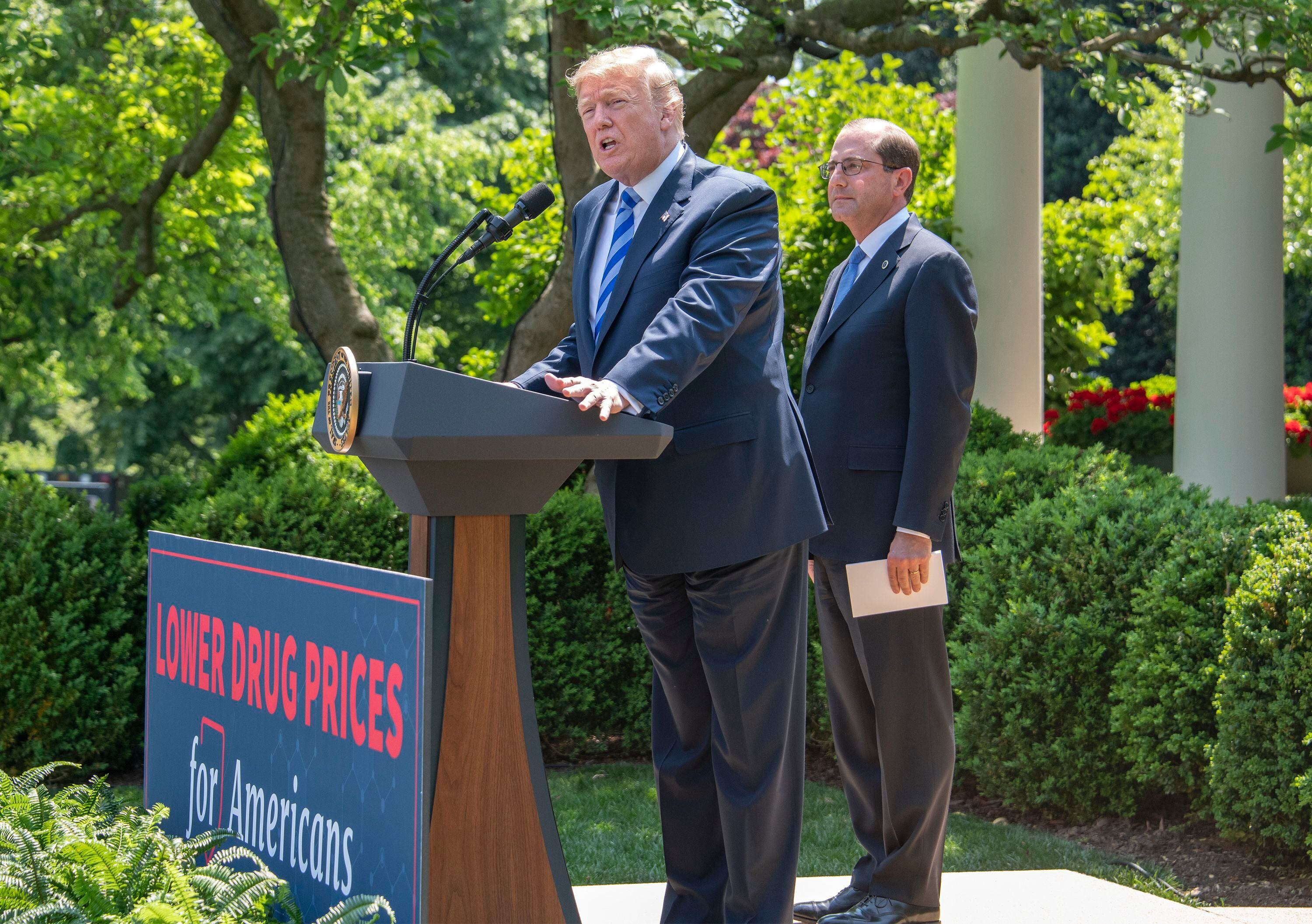
Trump could still score a big win on prescription drugs before the 2020 election. He’s backing a bipartisan Senate bill that would limit what Medicare recipients pay out of pocket for their medicines and require drug companies to pay rebates to the government if they increase prices above inflation.
Passing it would require the cooperation of House Speaker Nancy Pelosi, harshly criticized by Trump over impeachment.