The View From Nevada: Senate Race Too Close for GOP Comfort
*By J.D. Durkin*
When Dean Heller first entered national politics in his native Nevada, the likelihood of Donald Trump — then a real estate mega personality and TV host — entering the world of politics seemed an impossible joke to many. Trump, after all, was featured in both WWE Raw and WrestleMania 23 in 2007, the first year that Heller first served in Congress as a member of the House of Representatives.
Heller fought for years to establish his conservative credentials in the purple battleground he represents, clinching a U.S. Senate seat four years later. But years of Republican experience mean little when an outsider TV Manhattanite bulldozes longtime party orthodoxy, and now Heller is one of the few forces of Trump antagonism who remain standing.
But soon — he too may fall.
The tensions between Heller and Trump were never on display so clearly as they were on July 20, 2017, at the White House. Heller and other Republican Senators were stalled on healthcare that particular Wednesday; the President used his head-of-the-table bully pulpit to deliver a searing message to Heller seated just inches away:
"This was the one we were worried about. You weren't there. But you're gonna be. You're gonna be. Look, he wants to remain a senator, doesn't he? And I think the people of your state, which I know very well, I think they're gonna appreciate what you hopefully will do. Any senator who votes against starting debate is really telling America that you're fine with Obamacare. But being fine with Obamacare isn't enough for another reason. Because it's gone. It's failed. It's not gonna be around."
The subtext of Trump's quip was clear: Listen pal, I’m gonna be funny about this for the cameras but don’t take this as a joke.
Healthcare last summer sharply divided the two men, though Heller eventually fell in line to vote through the President’s Tax Cuts and Jobs Act. Trump’s choice of rhetoric, at times, was also a factor in Heller’s hesitancy to go full-MAGA. Forty-five percent of Nevada voters supported Trump in 2016, and the state’s ever-shifting demographics threaten Republican influence every year.
Now, in 2018 — with the healthcare fight long in the rearview and the rivalry between Heller and Trump (somewhat?) behind them, the uncertain political terrain could offer a sharp opportunity for Heller’s Democratic challenger, Rep. Jacky Rosen.
Rosen has been in Congress only two weeks longer than Trump has been President; but voters in the Silver State will have the opportunity in just weeks to decide between a household name they’ve known for decades versus a Congresswoman with momentum — and, perhaps most importantly for the moment, a clearly-defined and unequivocally vocal stance on the contentious confirmation of Justice Brett Kavanaugh.
The European Union is historically divided and slow when it comes to decision-making, but in the recent weeks, the 27 members have agreed upon several sanctions and decisions regarding foreign policy and defense. The EU has cut off Russian banks from the swift payment system, blocked Russian propaganda channels, and closed European skies for air travel to and from Russia. Germany, for example, who has refused to send any deadly weapons to conflict zones, has now agreed to send lethal weapons to Ukraine. Rupert Steiner, London Bureau Chief at Barron's, joins cheddar news to discuss.
Sam Stovall, Chief Investment Strategist at CFRA Research, joins Cheddar News' Closing Bell where he dives into the factors contributing to Monday's market plunge and what could be in store when February's CPI data comes out on Tuesday.
Derek Shearer, former U.S. Ambassador to Finland and contributing writer for Washington Monthly, joins Cheddar News to discuss the latest developments in the Russia-Ukraine conflict.
Americans continue to feel the pain at the pump as a result of Russia’s invasion of Ukraine. Patrick DeHaan, head of petroleum analysis at GasBuddy, joined Cheddar News to discuss how prices are being affected by the war and how much worse it could potentially get for drivers. "It's obviously a fluid situation. In one field today, I might feel differently in a half hour. But for now, I think we could see the national average realistically go somewhere into the mid $4 range, maybe $4.40 to $4.65 based on what we're seeing," he said.
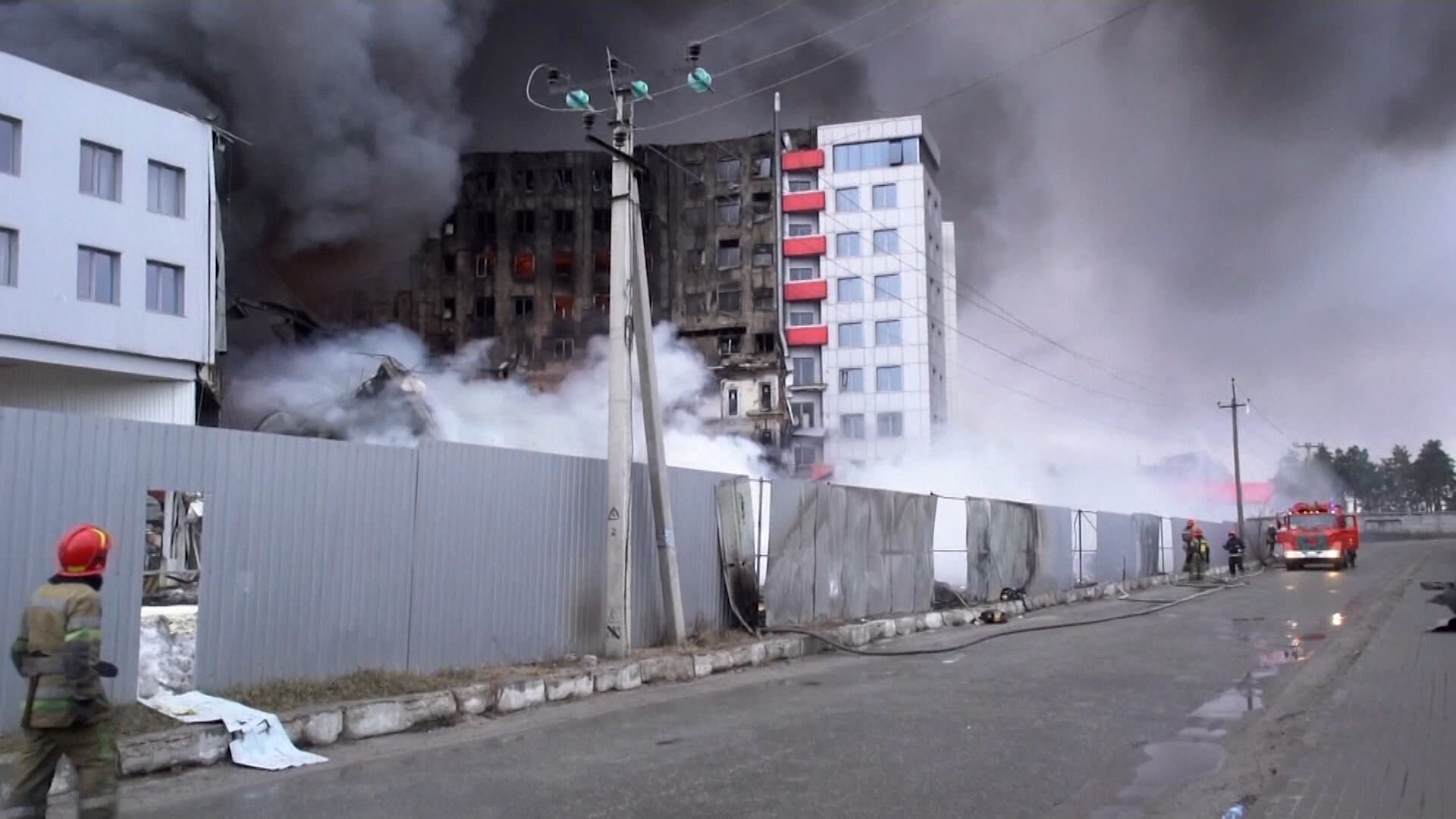
Russia’s invasion of Ukraine has entered its 12th day following what Ukrainian authorities described as increased shelling of encircled cities and another failed attempt to evacuate civilians from the port city of Mariupol.
Gasoline prices are pushing even farther above $4 a gallon, the highest price that American motorists have faced since July 2008, as calls grow to ban imports of Russian oil.
Jay Hatfield, Chief Investment Officer at ICAP, believes a lot of the bad news regarding the fighting in Ukraine and Fed is already priced into the market and looming uncertainty factored into Friday's movement. However, he also believes the upcoming Fed decision will be good news for Wall Street.
News of Russian forces taking control of a Ukrainian after artillery bombardment of a nuclear power plant raised concerns this week. Nuclear policy expert and Quincy Institute Distinguished Fellow Joe Cirincione joined Cheddar News to discuss the implications for a potential disaster. “I’m with the director general of the IAEA, the International Atomic Energy Agency. He says that he is extremely concerned, and that this Russian attack is a severe risk and that Russia clearly violated the fundamental principle of preserving the integrity of nuclear power plants," Cirincione said.