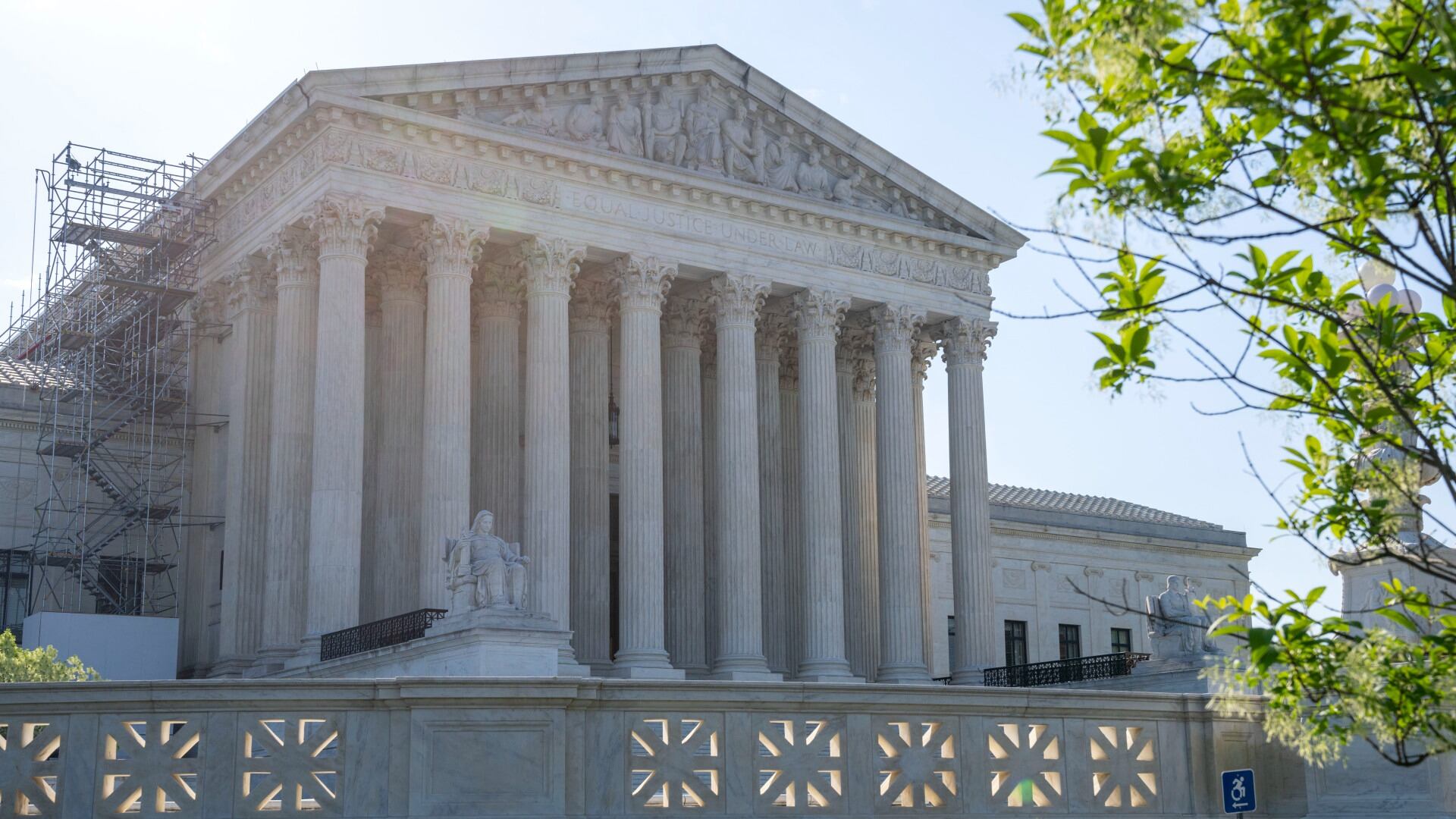
The Supreme Court is seen, Friday, April 21, 2023, ahead of an abortion pill decision in Washington. (AP Photo/Jacquelyn Martin)
By Mark Sherman
The Supreme Court on Tuesday allowed the drawing of a new Alabama congressional map with greater representation for Black voters to proceed. The new districts also could help Democrats trying to flip control of the House of Representatives.
The justices, without any noted dissent, rejected the state's plea to retain Republican-drawn lines that were turned down by a lower court.
In refusing to intervene, the high court allowed a court-appointed special master's work to continue. On Monday, he submitted three proposals that would create a second congressional district where Black voters comprise a majority of the voting age population or close to it.
The redrawing of the state's districts follows a June decision by the Supreme Court in which the state's congressional map that was drawn to reflect 2020 census results was found to dilute the voting power of the state’s Black residents. The map, which was used in the 2022 midterm elections, had just one majority Black district out of seven seats in a state where Black residents make up more than a quarter of the population.
A second district with a Democratic-leaning Black majority could send another Democrat to Congress at a time when Republicans hold a razor-thin majority in the House of Representatives. Federal lawsuits over state and congressional districts also are pending in Georgia, Louisiana and Texas.
Stark racial divisions characterize voting in Alabama. Black voters overwhelmingly favor Democratic candidates, and white voters prefer Republicans.
The lead plaintiff in the redistricting case, Evan Milligan, called Tuesday's ruling a “victory for all Alabamians” and said it puts the state closer to a map that provides fair representation. “It’s definitely a really positive step,” Milligan said in a telephone interview.
Alabama Attorney General Steve Marshall’s office did not immediately comment on the decision.
A three-judge panel has scheduled a hearing next week on proposed plans submitted by Richard Allen, the lawyer appointed by the judges. Allen's three proposals would alter the boundaries of Congressional District 2 so that Black voters comprise between 48.5% and 50.1% of the voting-age population, a shift that could put the seat in Democratic hands.
By contrast, the district drafted by GOP lawmakers and unanimously rejected by the three judges had a Black voting-age population of 39.9%, meaning it would continue to elect mostly white Republicans, according to data simulations run by those challenging the Republican plan.
The judges said Alabama lawmakers deliberately defied their directive to create a second district where Black voters could influence or determine the outcome.
Milligan and other Black voters had argued Alabama’s rearranged congressional map still meant that candidates preferred by Black voters had no chance of winning outside a single congressional district, now represented by Rep. Terri Sewell, the only Democrat and the only Black member of Alabama’s congressional delegation.
“It basically said if you were Black in Alabama, your vote would count for less,” Milligan said. “It was our duty and honor to challenge that.”
The state had wanted to use the newly drawn districts while it appeals the lower-court ruling to the Supreme Court.
Though Alabama lost its case in June by a 5-4 vote, the state leaned heavily on its hope of persuading one member of that slim majority, Justice Brett Kavanaugh, to essentially switch his vote.
The state’s court filing repeatedly cited a separate opinion Kavanaugh wrote in June that suggested he could be open to the state’s arguments in the right case. Kavanaugh, borrowing from Justice Clarence Thomas’ dissenting opinion, wrote that even if race-based redistricting was allowed under the Voting Rights Act for a period of time, “the authority to conduct race-based redistricting cannot extend indefinitely into the future.”
Associated Press writer Kim Chandler contributed to this report from Montgomery, Ala.
Inflation remains hot as the January PPI has increased by 1 percent, twice what analysts had been expecting with a jump of 9.7 over the year. Beth Ann Bovino, the U.S. chief economist, for S&P Global Ratings, joined Cheddar News to discuss the rapid pace of inflation alongside higher wages, predicting the Federal Reserve will act quickly and forcefully this year. "They haven't changed their forecast, yet, that's gonna come out soon. But we expect that a March rate hike is basically pretty much baked in the cake," she said. "We think six rate hikes in total for 2022."
For black history month, Cheddar is highlighting black business leaders who are driving the need for representation forward. On February 10, the U.S. Chamber of Commerce hosted an event called 'Developing the Black-Owned Business Ecosystem.' The virtual event was organized under the lobbying group's two initiatives -- the Equality of Opportunity Initiative, and the Coalition to Back Black Businesses. The event highlighted the developments needed to develop more black-owned businesses in the U.S. Dr. Anthony Wilbon, Dean of the School of Business at Howard University, joined Cheddar News' Closing Bell to discuss his experience as a speaker at the event.
A newly declassified letter by senators Ron Wyden and Martin Heinrich claimed the CIA. has been conducting a Secret Surveillance Program which has been collecting a bulk of data from American citizens. The letter which was written in April of 2021 urges the CIA to come clean about the kind of data it collects and how many Americans have been impacted. According to these two senators, the program did not have the safeguards of congressional oversight.
Art Hogan, Chief Market Strategist at National Securities, joined Cheddar News' Closing Bell, where he says investors are taking a wait-and-see approach when it comes to the situation between Russia and the Ukraine and elaborates on the impact higher oil prices stemming from the conflict would have on the market.
Last week, Senators Ron Wyden of Oregon and Martin Heinrich of New Mexico, Democrats on the Senate Intelligence Committee, wrote a a letter airing concerns that the CIA is collecting the data of American citizens without their consent. The lawmakers fear that the program might be exploiting private data. Morgan Wright, the chief security advisor at cybersecurity firm SentinelOne, joined Cheddar News to discuss the ramifications of the letter. "We don't have all the dots in one place to connect them," said Wright, cautioning against jumping to conclusions.
Russian President Vladimir Putin and his Foreign Minister Sergey Lavrov said that diplomacy is still possible, while U.S. officials warn that an attack on Ukraine is imminent. Cheddar News speaks with James Astill, Washington bureau chief of The Economist on the latest developments in Eastern Europe.
As the number of Russian troops rose to 130,000 along its Ukrainian border, hopes for a diplomatic solution remain among world leaders. Jason McMann, head of geopolitical risk analysis at Morning Consult, joined Cheddar News to break down the fluid situation. "We saw signs pointing towards an increase in tensions between Ukraine and Russia, whereas today we're seeing some signs that the Russian government may be willing to continue down a path of diplomatic negotiations to try and find some sort of non-military solution," he said.
Nancy Pelosi and House Democratic leaders are now planning to amend the stop trading on congressional knowledge act, otherwise known as the 'Stock' Act. This 2012 law governs how members disclose the purchase or sale of stocks and amending it would close a loophole, eliminating the trading of individual stocks by members of congress. Pelosi has consistently opposed a ban on stock trading by lawmakers and congressional staff...so what's changed? Kedric Payne, Vice President of Campaign Legal Center, joins Cheddar News to discuss.
In a 5-4 vote, the U.S. Supreme Court allowed for a controversial new version of the Alabama congressional map to remain in place. The lower court had previously ordered that the state must redraw that congressional map because it violates the Voting Rights Act by diluting the political power of Black voters. Redistricting expert Yurij Rudensky joins Cheddar News to weigh in.