Six different calculations found 2021 was between the fifth and seventh hottest year since the late 1800s. NASA said 2021 tied with 2018 for sixth warmest, while NOAA puts last year in sixth place by itself, ahead of 2018.
Scientists say a La Nina — natural cooling of parts of the central Pacific that changes weather patterns globally and brings chilly deep ocean water to the surface — dampened global temperatures just as its flip side, El Nino, boosted them in 2016.
Still, they said 2021 was the hottest La Nina year on record and that the year did not represent a cooling off of human-caused climate change but provided more of the same heat.
“So it’s not quite as headline-dominating as being the warmest on record, but give it another few years and we’ll see another one of those” records, said climate scientist Zeke Hausfather of the Berkeley Earth monitoring group that also ranked 2021 the sixth hottest. “It’s the long-term trend, and it’s an indomitable march upward.”
Gavin Schmidt, the climate scientist who heads NASA’s temperature team, said “the long-term trend is very, very clear. And it’s because of us. And it’s not going to go away until we stop increasing the amount of carbon dioxide in the atmosphere.”
The last eight years have been the eight hottest on record, NASA and NOAA data agree. Global temperatures, averaged over a 10-year period to take out natural variability, are nearly 2 degrees (1.1 degrees Celsius) warmer than 140 years ago, their data shows.
There was such a distinctive jump in temperatures about eight to 10 years ago that scientists have started looking at whether the rise in temperatures is speeding up. Both Schmidt and Hausfather said early signs point to that but it's hard to know for sure.
“I think you can see the acceleration, but whether it’s statistically robust is not quite clear,” Schmidt said in an interview. “If you just look at the last the last 10 years, how many of them are way above the trend line from the previous 10 years? Almost all of them.”
The global average temperature last year was 58.5 degrees (14.7 Celsius), according to NOAA. In 1988, NASA’s then-chief climate scientist James Hansen grabbed headlines when he testified to Congress about global warming in a year that was the hottest on record at the time. Now, the 57.7 degrees (14.3 Celsius) of 1988 ranks as the 28th hottest year on record.
Last year, 1.8 billion people in 25 Asian, African and Middle Eastern nations had their hottest years on record, including China, Nigeria, Bangladesh, Iran, Myanmar and South Korea, according to Berkeley Earth.
The deep ocean, where most heat is stored in the seas, also set a record for warmth in 2021, according to a separate new study.
“Ocean warming, aside from causing coral bleaching and threatening sea life and fish populations we rely upon for roughly 25% of our protein intake globally, is destabilizing Antarctic ice shelves and threatens massive ... sea level rise if we don’t act,” said study co-author Michael Mann, a Pennsylvania State University climate scientist.
The last time Earth had a cooler than normal year by NOAA or NASA calculations was 1976. That means 69% of the people on the planet — more than 5 billion people under age 45 — have never experienced such a year, based on United Nations data.
North Carolina state climatologist Kathie Dello, 39, who wasn’t part of the new reports but said they make sense, said, “I’ve only lived in a warming world and I wish that the younger generations did not have to say the same. It didn’t have to be this way.”
___
The Associated Press Health and Science Department receives support from the Howard Hughes Medical Institute’s Department of Science Education. The AP is solely responsible for all content.
Pfizer said it will be shipping its vaccines at not-for-profit prices to 45 low-income countries. The pharmaceutical giant will be exporting 23 drugs, including those that treat cancer, heart conditions, autoimmune diseases, as well as COVID-19.
It's not a scene from a movie: an asteroid the size of Mount Everest is headed toward earth. It's bigger than 99% of the asteroids in our solar system. But Cheddar anchor Shannon Lanier says fear not. The giant rock will miss us by more than 2 million miles.
After the latest school shooting in Uvalde, Texas, it wouldn't be a surprise if the traumatic event takes a toll on your mental health — or that of your children. Amy Morin, the editor-in-chief of Verywell Mind and licensed psychotherapist, joined Cheddar News to share coping skills and offer advice about how to talk to your children about these increasingly common tragic events. “I think its important for parents to know what the school’s plan is, what the teacher's plan is, and then we can have our own plans with kids too," she noted. "It's so important for us to talk to kids about how they're feeling — guaranteed they've heard something about it, so ask them what they know already, use age-appropriate language, and rather than just dismissing their fears by saying don't worry about it or I'm sure you'll be safe, talk to them about their feelings."
An recently conducted AP-NORC poll found that majorities of the Black and Hispanic populations in the U.S. still find themselves either somewhat worried or extremely worried over the pandemic, while more than half of white Americans responded with either being not too worried or not worried at all. Dr. Chris Pernell, the chief strategic integration and health equity officer at University Hospital, joined Cheddar News to talk about how perceptions of COVID-19 differ between groups of Americans. "We’re still seeing people get infected, and because of the toll of the disproportionate impact, we have concerns among the Black and brown community about whether or not they have an increased risk of exposure because of where they work, because of the use of public transportation, because they live in homes that they may not be able to safely quarantine and or isolate in, and because they have at baseline chronic health conditions that may make coronavirus more severe in those persons," she said.
Judith Enck, a former regional administrator for the EPA and the president of Beyond Plastics, joined Cheddar News to talk about the role of plastics in the climate crisis and California's investigation of ExxonMobil and other oil companies for misleading the public on the ability to recycle plastics. "The reason why petrochemical companies like Exxon have gotten away with selling more and more plastic is that they've lied to the public and told us don't worry about all those negative upstream impacts and downstream impacts of plastics. Just be sure to recycle it. Well, guess what? Plastics largely are not recycled," Enck said.
Catching you up on what you need to know on April 29, 2022, with President Biden asking Congress for a $33 billion aid package for Ukraine, a shrinking GDP potentially leading to a recession, Beijing banning weddings and funerals while closings schools amid COVID, and more.
Virtual care and digital medicine provider Biofourmis recently raised $300 million in a Series D round led by General Atlantic and with participation from CVS Health. Biofourmis offers at-home care and digital therapies backed by artificial intelligence, which can remotely monitor patients while they are at home. The company says it hopes its technology can improve patient outcomes while reducing the cost and burden of care. Kuldeep Signh Rajput, Founder and CEO of Biofourmis, joins Cheddar News' Closing Bell to discuss.
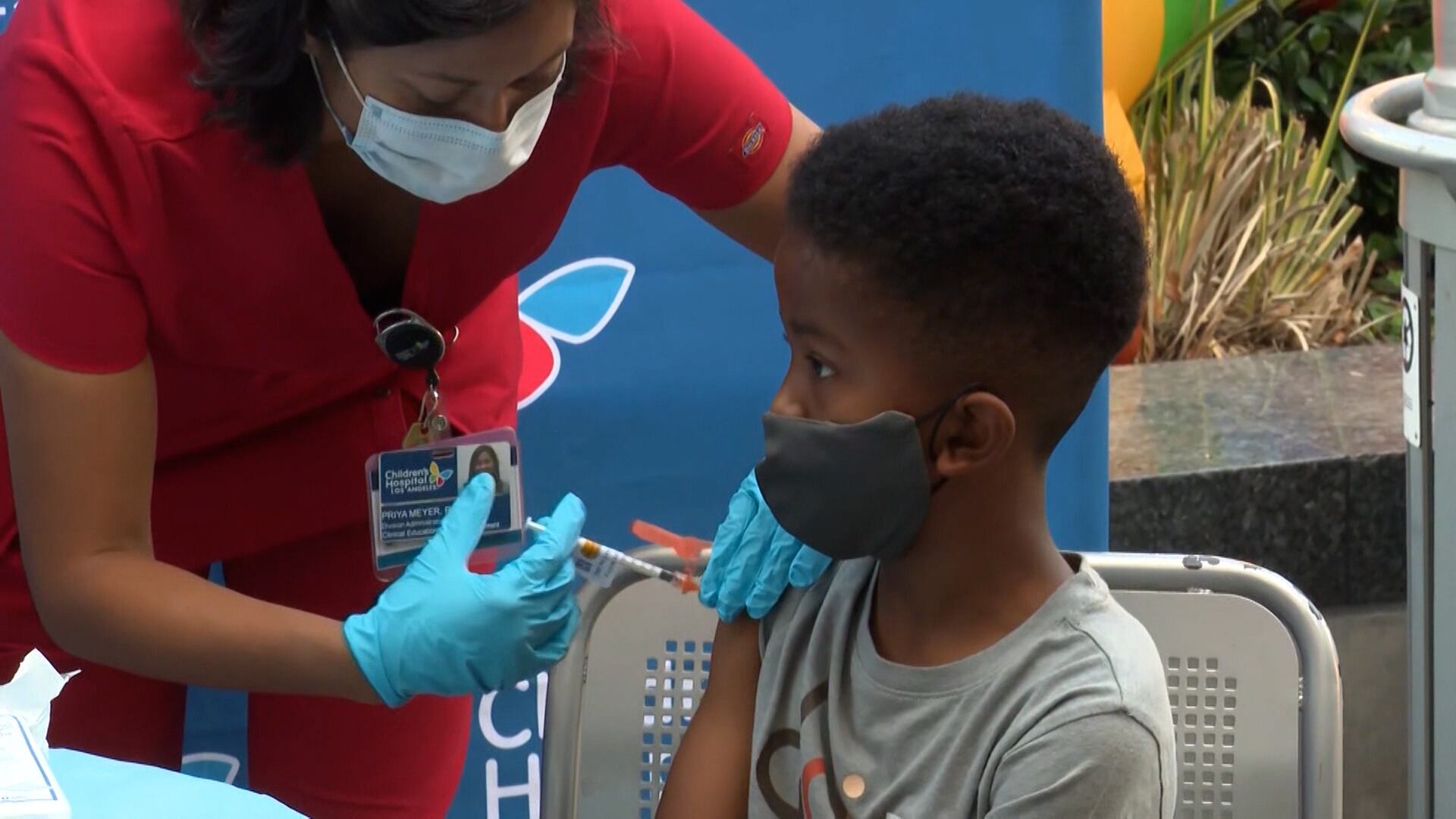
Moderna is asking the FDA to consider emergency use authorization for its COVID vaccine to be used with children under 6 years old. Dr. Christina Johns, a senior medical advisor at PM Pediatrics, joined Cheddar News to talk about the pharmaceutical company's research into the safety and efficacy of the vaccine for the very youngest of children. "This is very exciting news because children met that goal in their neutralizing antibody response in this age group — means that we really can extrapolate a lot from what we know about data in adults," she said. "I will say that there's a caveat that we have not seen yet the full dataset released, so I'm waiting for that and my fingers are crossed for next week."