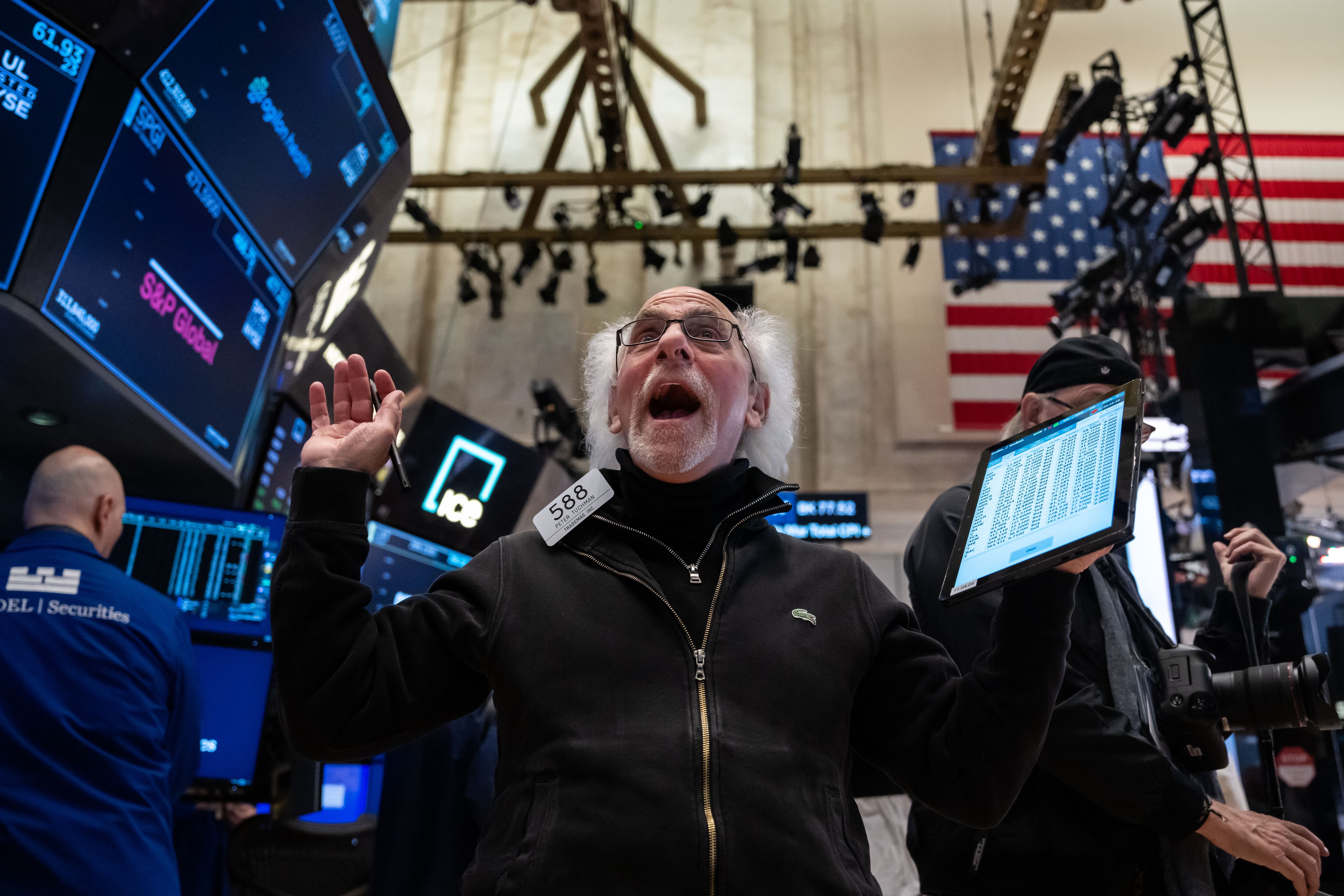
The Dow Jones Industrial Average just topped 40,000 for the first time, the latest pop in what’s been a surprisingly good year for Wall Street.
But just like New Year’s represents an arbitrary point in time in the Earth’s revolution around the sun, such milestones for the Dow don’t mean that much inherently.
For one, with just 30 companies, the Dow represents a tiny slice of Corporate America. For another, almost no one’s 401(k) account sees its performance depend on the Dow, which has become more of a relic used for historical comparisons.
Here’s a look at what the Dow is, how it got here and how its use among investors is on the wane:
WHAT IS THE DOW?
It’s a measure of 30 established, well-known companies. These stocks are sometimes known as “blue chips,” which are supposed to be on the steadier and safer side of Wall Street.
WHAT’S IN THE DOW?
Not just industrial companies like Caterpillar and Honeywell, despite the name.
The roster has changed many times since the Dow began in 1896 as the U.S. economy has transformed. Out, for example, was Standard Rope & Twine, and in recently have been big technology companies.
Apple, Intel and Microsoft are some of the newer-economy names currently in the Dow. The financial industry also has a healthy representation with American Express, Goldman Sachs, JPMorgan Chase and Travelers. So does health care with Amgen, Johnson & Johnson, Merck and UnitedHealth Group.
WHAT’S ALL THE HUBBUB NOW?
The Dow just crossed its latest 10,000 point threshold to top 40,000 briefly in midday trading on Thursday. It took about three and a half years to make the leap from 30,000 points, which it first crossed in November 2020.
It’s kept chugging mostly higher despite the worst inflation in decades, painfully high interest rates meant to get inflation under control and worries that high rates would make a recession inevitable for the U.S. economy.
Companies are now in the midst of reporting their best profit growth in nearly two years, and the economy has managed to avoid a recession, at least so far.
IS THE DOW THE MAIN MEASURE OF WALL STREET?
No. The Dow represents only a narrow slice of the economy. Professional investors tend to look at broader measures of the market, such as the S&P 500 index, which has nearly 17 times the number of companies within it.
More than $11.2 trillion in investments were benchmarked to the S&P 500 at the end of 2019, according to estimates from S&P Dow Jones Indices. That’s 350 times more than the $32 billion benchmarked to the Dow Jones Industrial Average.
Investors’ 401(k) accounts are much more likely to include an S&P 500 index fund than anything tied to the Dow. The S&P 500 crossed above its own milestone Wednesday, topping 5,300 points for the first time.
That’s what more investors care about. Well, 100-point milestones matter for the S&P 500 as little as others, but the fact that the S&P 500 is higher than ever matters a lot.
HOW DIFFERENT ARE THE DOW AND THE S&P 500?
Their performances have historically tracked relatively closely with each other, but the S&P 500 has been better recently. Its 29.3% rise for the last 12 months easily tops the 21.1% gain for the Dow.
That’s in part because the S&P 500 has more of an emphasis on Big Tech stocks, which were responsible for most of the S&P 500′s gains last year. Hopes for an easing of interest rates by the Federal Reserve and a frenzy around artificial-intelligence technology have pushed them to dizzying heights.
The Dow reflects none of the movements of such marquee stocks as Alphabet, Meta Platforms or Nvidia.
IS THAT IT?
No, the Dow and S&P 500 also take different approaches to measuring how an index should move.
The Dow gives more weight to stocks with higher price tags. That means stocks that add or subtract more dollars to their stock price push and pull it the most, such as UnitedHealth Group and its $523 stock price. A 1% move for that stock, which is about $5, packs a radically harder punch than a 1% move for Walmart, which is about 63 cents
The S&P 500, meanwhile, gives more weight to stocks depending on their overall size. That means a 1% move for Walmart carries more weight than a 1% move for UnitedHealth Group because Walmart is a slightly bigger company by total market value.
SO WHY CARE ABOUT THE DOW?
Because it’s so old, it has a longer track record than other measures of the market.
For a while, a triple-digit move for the Dow also offered an easy shorthand way to show the stock market was having a big day. Now, though, it means much less. A 100 point swing for the Dow means a move of less than 0.3%.