Senators will get four hours of debate Friday before voting on whether to call witnesses and introduce documents — a vote that is expected to fail after Senator Lamar Alexander (R-Tenn.), announced late last night.
Alexander said that though the House Managers indeed proved the president used Ukraine aid to force an investigation into former Vice President Joe Biden and his son, he does not believe the conduct rises to the level of an impeachable offense.
Without Alexander's vote, the push for witnesses all but assuredly ended as Senator Lisa Murkowski (R-Alaska) joined him Friday in rejecting the call. Even if Senators Susan Collins (R-Maine) and Mitt Romney (R-Utah) were to vote yes, the motion will fail unless Chief Justice John Roberts makes a ruling that would set the vote aside, a ruling he is not expected to make.
Once the Senate votes on the witness issue, it's not clear what happens next. Senator Mike Braun (R-Ind.) told Cheddar that after the initial vote "it's not necessarily quick. There's a lot of parliamentary wrestling that goes on to bring it to the ultimate vote, which is the verdict.
"Even in Senator Alexander's statement, though he came to the wrong conclusion, he's said it was proven the president did what he was accused of," Senator Minority Leader Chuck Schumer (D-N.Y.) told reporters before the start of what may be the last day of the president's impeachment trial.
Republicans have made a few key arguments against witnesses, primarily that the House should have pushed harder to call witnesses, a court fight over testimony could prolong the trial for months, and that if the House says its case is clear it shouldn't need more evidence.
Democrats have argued Senate Republicans could keep the trial short by having Chief Justice John Roberts sign off on subpoenas because that would likely limit court reviews from lower courts. If Republicans do not vote for witnesses, Schumer says they are aiding the president in "the greatest cover-up since Watergate."
"The truth will eventually come out," Schumer said.
"Despite all the arguments back and forth, the bottom, bottom thing, is: I don't know how you can not want to hear from Bolton … One of the senators called it circumstantial evidence, so why wouldn't you want to hear from the man who was in the room where it happens," Senator Amy Klobuchar (D-Minn.) told reporters after the conclusion of yesterday's question and answer session at almost 11 pm ET.
She said she has always seen this as "an economic check, but also a decency check, a patriotism check on this president" and called today "game day."
Today's vote on allowing witnesses will ultimately set a precedent for impeachment trials moving forward, but also for questions about executive privilege and congressional oversight, as both House Managers and defense lawyers have repeatedly warned senators.
"You cannot have a true acquittal if you've not had a fair trial," Senator Kamala Harris (D-Calif.) said at a press conference on Friday morning.
"Let fairness ring … Americans know Democrats are for a fair trial and witnesses and documents are needed," Minority Leader Schumer said.
The House narrowly passed President Biden's $1.7 trillion Build Back Better bill, the largest expansion of the social safety net in decades. The final vote was 220 to 213, with only one Democrat joining all Republicans in opposing the bill. It now heads to the Senate, where it faces an uncertain fate. Jennifer Haberkorn, congressional reporter for the Los Angeles Times, joins Cheddar News' Closing Bell, where she breaks down the current version of the bill, where it goes next, and what it could mean for the country if it eventually reaches the president's desk.
Two murder trials in focus in America — Wisconsin V. Kyle Rittenhouse and Georgia V. Travis Mcmichael, Gregory Mcmichael, and William Bryan, the Men who killed Ahmaud Arbery. Civil rights and criminal defense lawyer Anthony Tall and the Founder and CEO of Kim Crowder consulting Kim Crowder, joined Cheddar to discuss more.
Rep. Ruben Gallego (D - Arizona) joined Cheddar to discuss the passing of President Biden's Infrastructure Bill and his new book, 'They Called us 'Lucky,' about his time serving in the Iraq War.
Markets were pointing mostly lower to end the week as investors reacted to the threat of a Covid resurgence in Europe. Jeff Schulze, Investment Strategist at ClearBridge Investments joined Cheddar's Opening Bell to discuss Friday's pre-market activity.
A federal judge tossed out a lawsuit against financial services platform Robinhood following the meme stock saga that swept the investment world. The judge said it found no wrongdoing on Robinhood's part after the platform halted trading on popular meme stocks Gamestop and AMC.
Jill and Carlo are back to cover the latest in the Rittenhouse trial, new information on the origins of Covid, return-to-office and more.
JOIN US FOR THE YOUTUBE WATCH PARTY @ 9aET: http://www.youtube.com/cheddarnow
The U.S. Justice Department has filed a lawsuit against Uber after it was discovered that disabled people were being disproportionately affected by extra “wait time” fees. Attorney Jonathan Bell joined Cheddar to discuss.
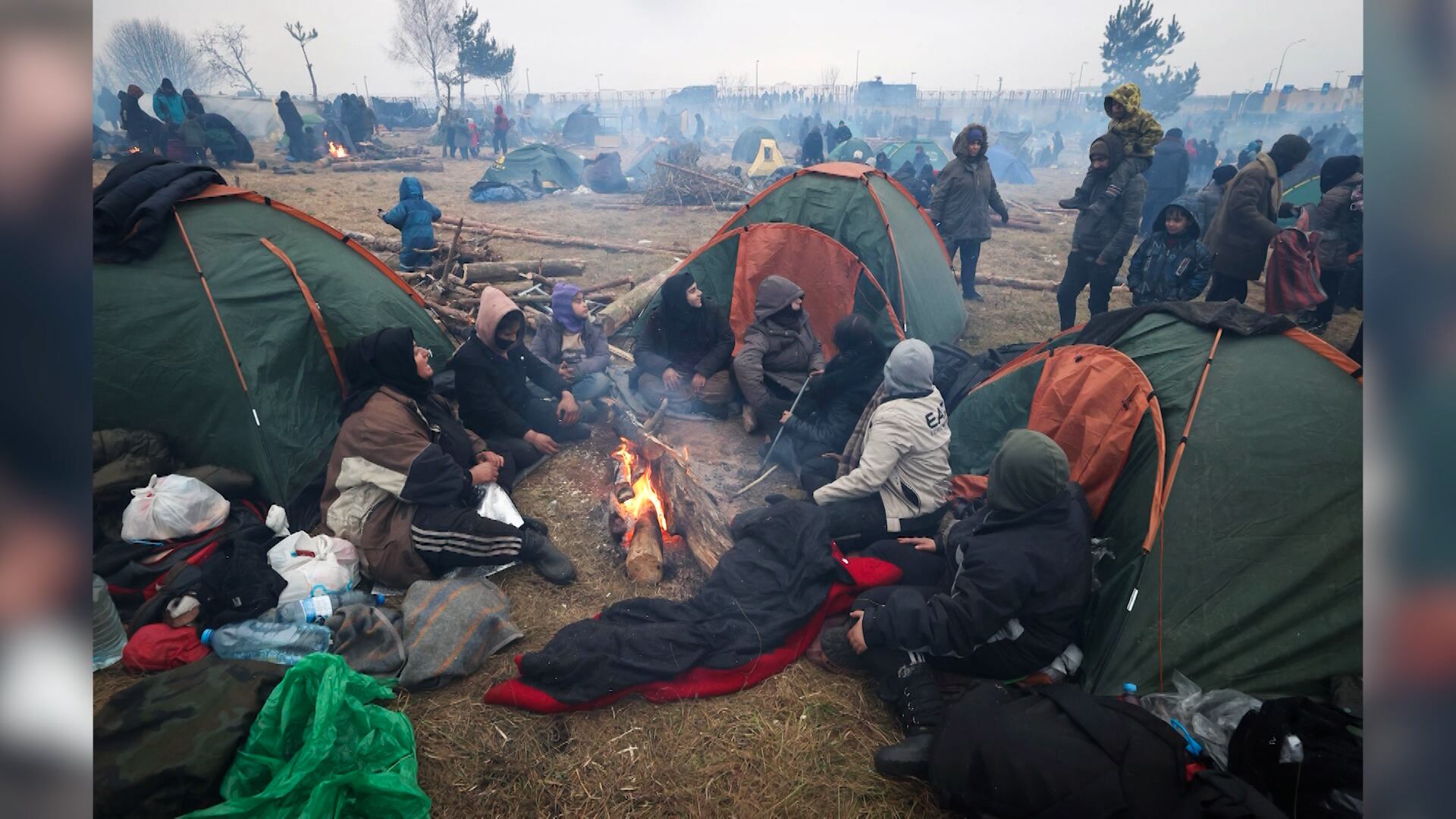
Belarus President Alexander Lukashenko has been accused by the EU of manufacturing a migration crisis along his border with Poland. But, even as tensions appear to be stabilizing at the moment, Ali Noorani, the president and CEO of National Immigration Forum and the host of the "Only in America" podcast spoke to Cheddar about the ongoing danger to the migrants who hail from countries like Iraq and Afghanistan. "What is going to happen to folks who are in Belarus who came from these countries? Is Lukashenko going to provide them asylum and protection in Belarus, or are they going to continue to be political pawns in a geopolitical battle," he said. "Real people's lives are being put at great risk."
A group of crypto investors has come together to raise millions of dollars in the hopes of owning a rare piece of the U.S. Constitution. According to the crypto group, "Constitution DAO" It is time to put the constitution in the hands of the people. CEO and Founder of Metaversal Yossi Hasson, joined Cheddar to discuss more.
Polarization is among the defining traits of American politics in the 21st century. Sometimes it seems like the only thing we can all agree on is the fact that we don't really agree on anything. But those divisions don't just stop at whether you vote red or blue.
A new survey from the Pew Research Center finds that rather than just two political buckets, we have nine. The "2021 political typology" as it's called distinguishes between different ideological subsets in the Democratic and Republican party. It encompasses everyone from the loudest revolutionary lefties, to the loudest insurrection apologists on the right.
Andrew Daniller, research associate at the Pew Research Center, joins None of the Above to discuss.