By Kimberlee Kruesi and Jonathan Mattise
In an extraordinary act of political retaliation, Tennessee Republicans on Thursday expelled two Democratic lawmakers from the state Legislature for their role in a protest calling for more gun control in the aftermath of a deadly school shooting in Nashville. A third Democrat was narrowly spared by a one-vote margin.
The split votes drew accusations of racism, with lawmakers ousting Reps. Justin Jones and Justin Pearson, who are both Black, while Rep. Gloria Johnson, who is white, survived the vote on her expulsion. Republican leadership denied that race was a factor, however.
Banishment is a move the chamber has used only a handful times since the Civil War. Most state legislatures possess the power to expel members, but it is generally reserved as a punishment for lawmakers accused of serious misconduct, not used as a weapon against political opponents.
Jones, Pearson and Johnson joined in protesting last week as hundreds of protesters packed the Capitol to call for passage of gun-control measures. While demonstrators filled galleries, the three Democrats approached the front of the House chamber with a bullhorn and participated in a chant.
The protest unfolded days after the shooting at the Covenant School, a private Christian school where six people were killed, including three children.
“We are losing our democracy. This is not normal. This is not OK," Pearson told reporters Thursday. The three “broke a House rule because we’re fighting for kids who are dying from gun violence and people in our communities who want to see an end to the proliferation of weaponry in our communities.”
Johnson, a retired teacher, said her concern about school shootings was personal, recalling a day in 2008 when students came running toward her out of a cafeteria because a student had just been shot and killed there.
“The trauma on those faces, you will never, ever forget. I don’t want to forget it,” she said.
Thousands of people flocked to the Capitol to support the Democrats, cheering and chanting outside the House chamber so loudly that the noise drowned out the proceedings.
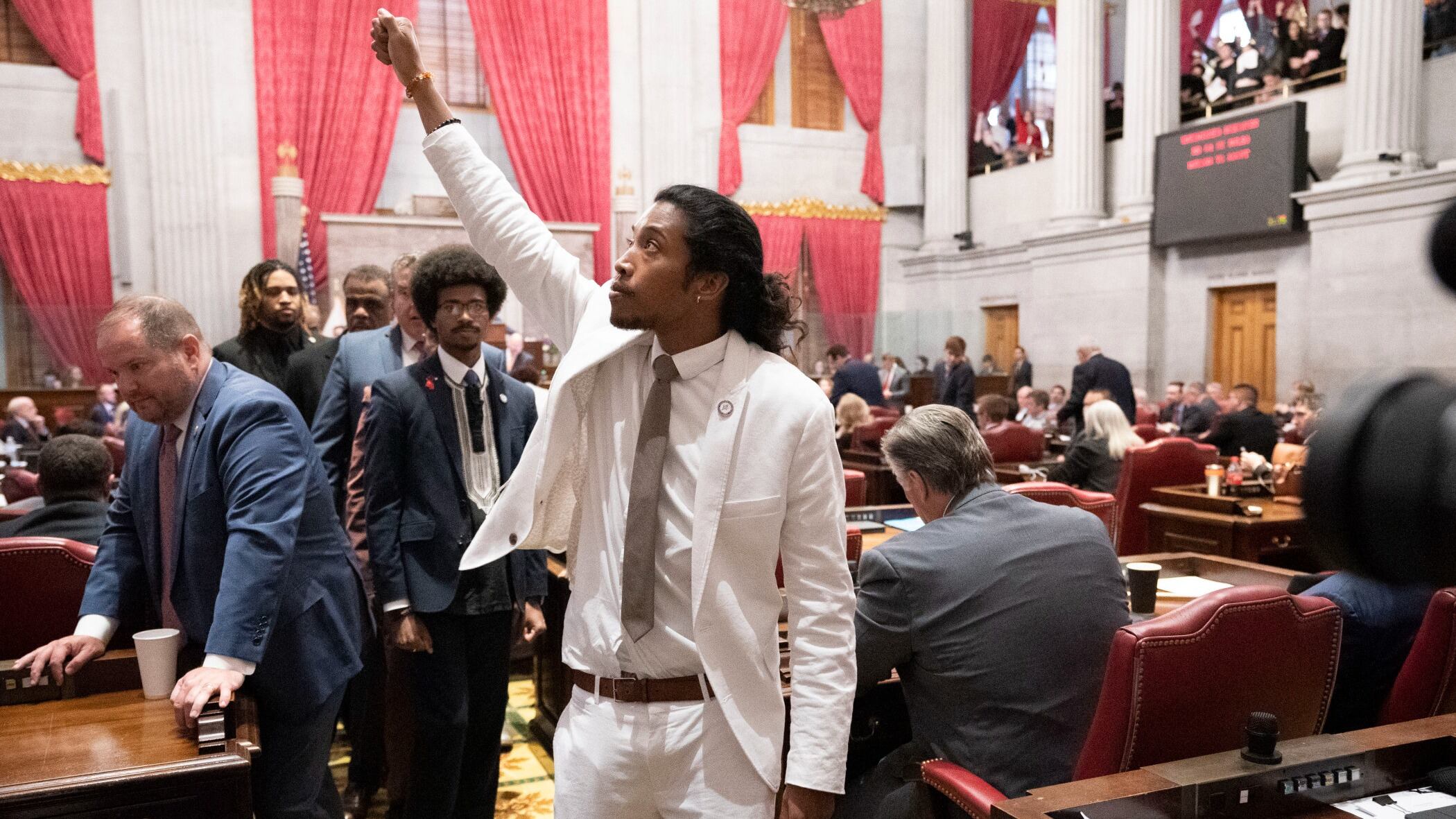
The trio held hands as they walked onto the floor, and Pearson raised his fist to the crowd during the Pledge of Allegiance.
Offered a chance to defend himself before the vote, Jones said the GOP responded to the shooting with a different kind of attack.
“We called for you all to ban assault weapons, and you respond with an assault on democracy,” he said.
Jones vowed that even if expelled, he would continue pressing for action on guns.
“I’ll be out there with the people every week, demanding that you act,” he said.
Republican Rep. Gino Bulso said the three Democratic representatives “effectively conducted a mutiny."
“The gentleman shows no remorse," Bulso said, referring to Jones. "He does not even recognize that what he did was wrong. So not to expel him would simply invite him and his colleagues to engage in mutiny on the House floor.”
The two expelled lawmakers may not be gone for long. County commissions in their districts get to pick replacements to serve until a special election can be scheduled, and they also would be eligible to run in the special election.
Under the Tennessee Constitution, lawmakers cannot be expelled for the same offense twice.
During discussion, Republican Rep. Sabi Kumar advised Jones to be more collegial and less focused on race.
“You have a lot to offer, but offer it in a vein where people are accepting of your ideas,” Kumar said.
Jones said he did not intend to assimilate in order to be accepted. “I’m not here to make friends. I’m here to make a change for my community,” he replied.
Fielding questions from lawmakers, Johnson reminded them that she did not raise her voice nor did she use the bullhorn — as did the other two, both of whom are new lawmakers and among the youngest members in the chamber.
But she also suggested that race was likely a factor on why Jones and Pearson were ousted but not her, telling reporters that it “might have to do with the color of our skin.”
That notion was echoed by state Sen. London Lamar, a Democrat representing Memphis.
Lawmakers “expelled the two black men and kept the white woman,” Lamar, a Black woman, said via Twitter. “The racism that is on display today! Wow!”
However House Speaker Cameron Sexton, a Republican who voted to expel all three, denied that race was at play, arguing that Johnson’s arguments might have swayed other members.
“Our members literally didn’t look at the ethnicity of the members up for expulsion,” Majority Leader William Lamberth added. He alleged that Jones and Pearson were trying to incite a riot last week, while Johnson was more subdued.
After sitting quietly for hours and hushing anyone who cried out during the proceedings, people in the gallery erupted in screams and boos following the final vote. There were chants of “Shame!” and “Fascists!”
Lawmakers quickly adjourned for the evening.
GOP leaders told journalists afterward that Thursday's actions were necessary to avoid setting a precedent that lawmakers disrupting House proceedings through protest would be tolerated.
Outrage over the expulsions underscored not only the ability of the Republican supermajority to silence opponents, but its increasing willingness to do so.
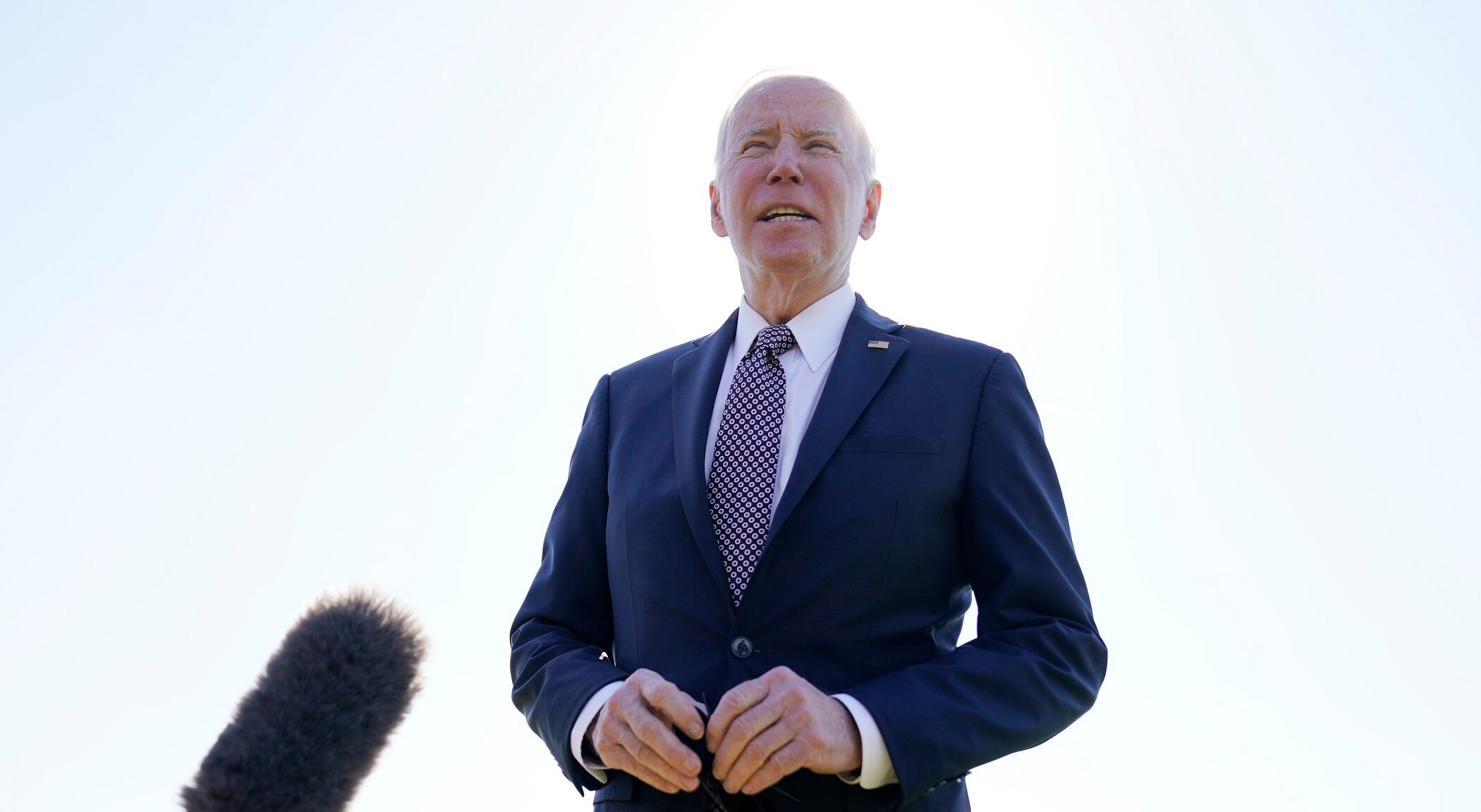
In Washington, President Joe Biden blasted the GOP's priorities.
“Three kids and three officials gunned down in yet another mass shooting. And what are GOP officials focused on? Punishing lawmakers who joined thousands of peaceful protesters calling for action. It’s shocking, undemocratic, and without precedent,” Biden tweeted.
Many of the protesters traveled from Memphis and Knoxville, areas that Pearson and Johnson represent, and stood in a line that wrapped around the Capitol to get inside.
Protesters outside the chamber held up signs that said, “School zones shouldn’t be war zones,” “Muskets didn’t fire 950 rounds per minute” with a photo of George Washington, and “You can silence a gun ... but not the voice of the people.“
Before the expulsion votes, House members debated more than 20 bills, including a school safety proposal requiring public and private schools to submit their building safety plans to the state. The bill did not address gun control, sparking criticism from some Democratic members that lawmakers were only addressing a symptom and not the cause of school shootings.
Past expulsion votes have taken place under distinctly different circumstances.
In 2019, lawmakers faced pressure to expel former Republican Rep. David Byrd after he faced accusations of sexual misconduct dating to when he was a high school basketball coach three decades earlier. Republicans declined to take any action, pointing out that he was reelected as the allegations surfaced. Byrd retired last year.
Last year, the state Senate expelled Democrat Katrina Robinson after she was convicted of using about $3,400 in federal grant money on wedding expenses instead of her nursing school.
Before that case, state lawmakers last ousted a House member in 2016 when the chamber voted 70-2 to remove Republican Rep. Jeremy Durham after an attorney general’s investigation detailed allegations of improper sexual contact with at least 22 women during his four years in office.