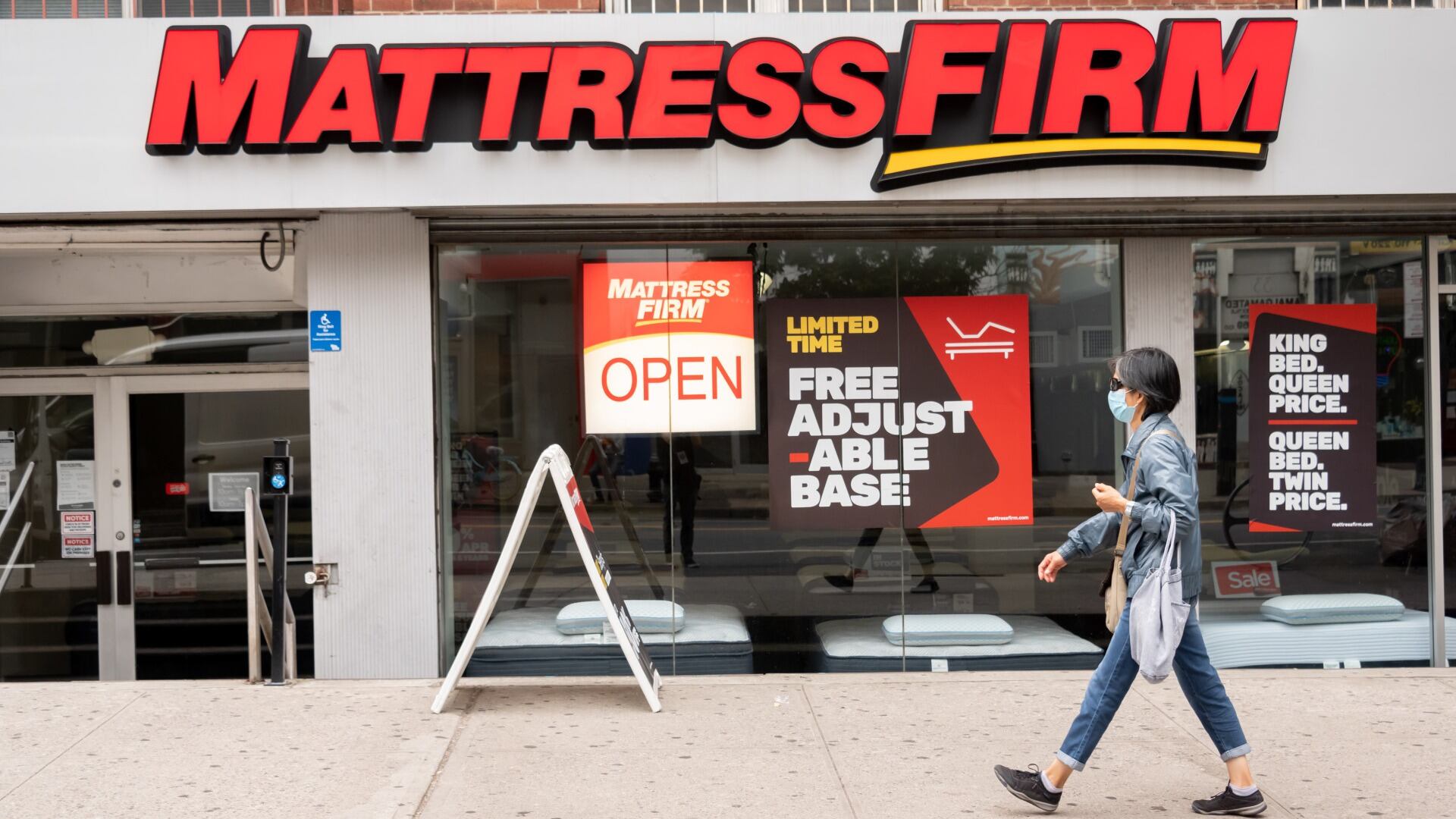
A person wears a face mask outside Mattress Firm store near Union Square as the city continues Phase 4 of re-opening following restrictions imposed to slow the spread of coronavirus on September 24, 2020 in New York City. The fourth phase allows outdoor arts and entertainment, sporting events without fans and media production. (Photo by Noam Galai/Getty Images)
By Wyatte Grantham-Philips
Bedding provider Tempur Sealy has agreed to acquire Mattress Firm in a cash-and stock-transaction valued at about $4 billion, the companies said Tuesday.
Mattress Firm operates more than 2,300 brick-and-mortar retail locations and an e-commerce platfom. After the Tempur Sealy acquistion is complete, the two companies will have a total of some 3,000 retail stores, 30 e-commerce platforms, 71 manufacturing facilities and four research and development facilities worldwide.
“This combination will accelerate our growth trajectory and enhance operating cash flow,” Tempur Sealy Chairman and CEO Scott Thompson said in a statement. “Mattress Firm has been a valued retail partner for more than 35 years, and we look forward to welcoming their talented workforce of more than 8,100 employees to the Tempur Sealy family.”
Mattress Firm CEO John Eck added that the transaction will increase the companies' ability "to better address consumers’ needs and drive growth.”
In the transaction, Tempur Sealy is expected to pay about $2.7 billion in cash and $1.3 billion in stock to Mattress Firm, which is privately held. That reflects the issuance of 34.2 million common shares, based on Monday's closing share price of $37.62.
The companies expect to complete the transaction in the second half of 2024. After the acquistion is complete, Mattress Firm is set to operate as a separate business unit within Tempur Sealy.
On a per-share basis, the Kentucky-based mattress maker said it had a profit of 48 cents. Earnings, adjusted for one-time gains and costs, were 53 cents per share.
President Donald Trump's administration last month awarded a $1.2 billion contract to build and operate what's expected to become the nation’s largest immigration detention complex to a tiny Virginia firm with no experience running correction facilities.
Chipmaker Nvidia is poised to release a quarterly report that could provide a better sense of whether the stock market has been riding an overhyped artificial intelligence bubble or is being propelled by a technological boom that’s still gathering momentum.
Cracker Barrel said late Tuesday it’s returning to its old logo after critics — including President Donald Trump — protested the company’s plan to modernize.
Low-value imports are losing their duty-free status in the U.S. this week as part of President Donald Trump's agenda for making the nation less dependent on foreign goods. A widely used customs exemption for international shipments worth $800 or less is set to end starting on Friday. Trump already ended the “de minimis” rule for inexpensive items sent from China and Hong Kong, but having to pay import taxes on small parcels from everywhere else likely will be a big change for some small businesses and online shoppers. Purchases that previously entered the U.S. without needing to clear customs will be subject to the origin country’s tariff rate, which can range from 10% to 50%.
Southwest Airlines will soon require plus-size travelers to pay for an extra seat in advance if they can't fit within the armrests of one seat. This change is part of several updates the airline is making. The new rule starts on Jan. 27, the same day Southwest begins assigning seats. Currently, plus-size passengers can pay for an extra seat in advance and later get a refund, or request a free extra seat at the airport. Under the new policy, refunds are still possible but not guaranteed. Southwest said in a statement it is updating policies to prepare for assigned seating next year.
Cracker Barrel is sticking with its new logo. For now. But the chain is also apologizing to fans who were angered when the change was announced last week.
Elon Musk on Monday targeted Apple and OpenAI in an antitrust lawsuit alleging that the iPhone maker and the ChatGPT maker are teaming up to thwart competition in artificial intelligence.