By Ahmad Seir, Rahim Faiez, Kathy Gannon, and Joseph Krauss
The Taliban vowed Tuesday to respect women's rights, forgive those who fought them and ensure Afghanistan does not become a haven for terrorists as part of a publicity blitz aimed at reassuring world powers and a fearful population.
Following a lightning offensive across Afghanistan that saw many cities fall to the insurgents without a fight, the Taliban have sought to portray themselves as more moderate than when they imposed a strict form of Islamic rule in the late 1990s. But many Afghans remain skeptical — and thousands have raced to the airport, desperate to flee the country.
Older generations remember the Taliban’s previous rule, when they largely confined women to their homes, banned television and music, and held public executions. A U.S.-led invasion drove them from power months after the 9/11 attacks, which al-Qaida had orchestrated from Afghanistan while being sheltered by the Taliban.
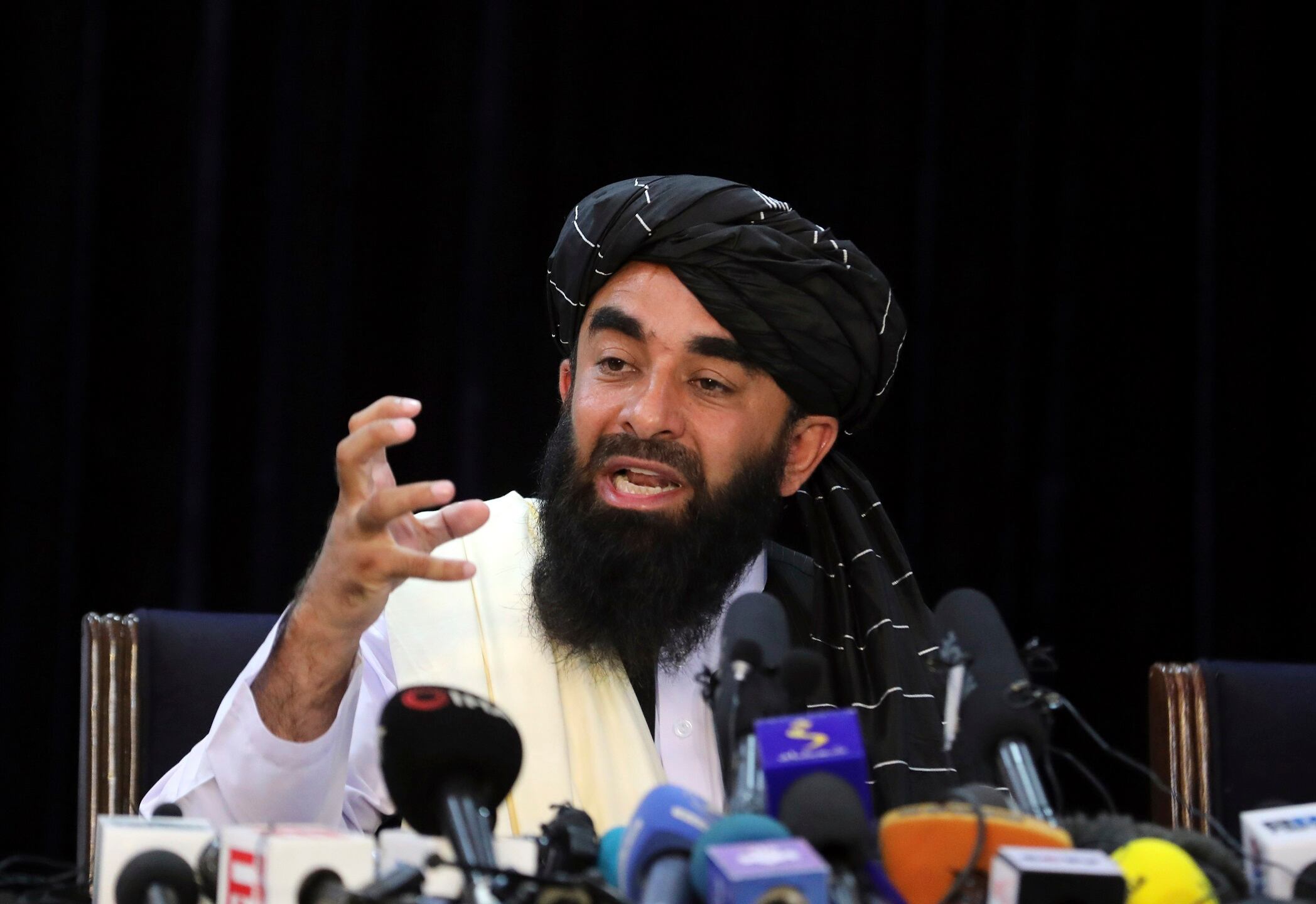
Zabihullah Mujahid, the Taliban's longtime spokesman, emerged from the shadows Tuesday in his first-ever public appearance to address those concerns at a news conference.
He promised the Taliban would honor women’s rights within the norms of Islamic law, without elaborating. The Taliban have encouraged women to return to work and have allowed girls to return to school, handing out Islamic headscarves at the door. A female news anchor interviewed a Taliban official Monday in a TV studio.
The treatment of women varies widely across the Muslim world and sometimes even within the same country, with rural areas tending to be far more conservative. Some Muslim countries, including neighboring Pakistan, have had female prime ministers, while ultraconservative Saudi Arabia only recently allowed women to drive.
Mujahid also said the Taliban would not allow Afghanistan to be used as a base for attacking other countries, as it was in the years before 9/11. That assurance was part of a 2020 peace deal reached between the Taliban and the Trump administration that paved the way for the American withdrawal.
The Pentagon said U.S. commanders are communicating with the Taliban as they work to evacuate thousands of people through Kabul's international airport. It said the Taliban have taken no hostile actions there.
Mujahid reiterated that the Taliban have offered full amnesty to Afghans who worked for the U.S. and the Western-backed government, saying “nobody will go to their doors to ask why they helped.” He said private media should “remain independent" but that journalists “should not work against national values.”
Kabul, the capital, has remained calm as the Taliban patrol its streets. But many remain fearful after prisons and armories emptied out during the insurgents' sweep across the country.
Kabul residents say groups of armed men have been going door-to-door seeking out individuals who worked with the ousted government and security forces, but it was unclear if the gunmen were Taliban or criminals posing as militants. Mujahid blamed the security breakdown on the former government, saying the Taliban only entered Kabul in order to restore law and order after the police melted away.
A broadcaster in Afghanistan said she was hiding at a relative’s house, too frightened to return home much less go to work. She said she and other women do not believe the Taliban have changed their ways. She spoke on condition of anonymity because she feared for her safety.
A group of women wearing Islamic headscarves demonstrated briefly in Kabul, holding signs demanding the Taliban not “eliminate women” from public life.
U.S. national security adviser Jake Sullivan said the U.S. and other governments will not simply take the Taliban at their word when it comes to women's rights.
“Like I’ve said all along, this is not about trust. This is about verify,” Sullivan said at a White House briefing. “And we’ll see what the Taliban end up doing in the days and weeks ahead, and when I say we, I mean the entire international community.”
Whatever their true intentions, the Taliban have an interest in projecting moderation to prevent the international community from isolating their government, as it did in the 1990s.
The European Union said it was suspending development assistance to Afghanistan until the political situation is more clear but that it would consider boosting humanitarian aid.
EU foreign policy chief Josep Borrell said the Taliban must respect U.N. Security Council resolutions and human rights to earn access to some 1.2 billion euros ($1.4 billion) in development funds earmarked through 2024.
Foreign Secretary Dominic Raab said Britain might provide up to 10% more humanitarian aid, but the the Taliban would not get any money previously earmarked for security.
Evacuation flights resumed after being suspended on Monday, when thousands of people rushed the airport. In shocking scenes captured on video, some clung to a plane as it took off and then fell to their deaths. At least seven people died in the airport chaos, U.S. officials said.
On Tuesday, the Taliban entered the civilian half of the airport, firing into the air to drive out around 500 people there, said an Afghan official who spoke on condition of anonymity because he wasn’t authorized to brief journalists.
The Taliban appeared to be trying to control the crowd rather than prevent people from leaving. A video circulating online showed the Taliban supervising the orderly departure of dozens of foreigners.
The U.S. Embassy in Kabul, now operating from the military side of the airport, urged Americans to register online for evacuation but not to come to the airport before being contacted.
The German Foreign Ministry said a first German military transport plane landed in Kabul but took off with only seven people on board due to the chaos. Another left later with 125 people.
U.S. President Joe Biden has defended his decision to end America's longest war, blaming the rapid Taliban takeover on Afghanistan's Western-backed government and security forces. NATO Secretary-General Jens Stoltenberg echoed that assessment, while saying the alliance must investigate the flaws in its efforts to train the Afghan military.
Talks continued Tuesday between the Taliban and several Afghan politicians, including former President Hamid Karzai and Abdullah Abdullah, who once headed the country’s negotiating council. The Taliban have said they want to form an “inclusive, Islamic government.”
The talks focused on how a Taliban-dominated government would operate given the changes in Afghanistan over the last 20 years, rather than just dividing up ministries, officials with knowledge of the negotiations said on condition of anonymity to discuss the closed-door talks.
A top Taliban leader, Mullah Abdul Ghani Baradar, arrived in Kandahar on Tuesday night from Qatar, potentially signaling a deal is close at hand.
The vice president of the ousted government, meanwhile, tweeted that he was the country's “legitimate” caretaker president. Amrullah Saleh said that under the constitution, he should be in charge because President Ashraf Ghani has fled the country.
___
Faiez reported from Istanbul, Gannon from Guelph, Canada, and Krauss from Jerusalem. Associated Press writers Tameem Akhgar in Istanbul, Jon Gambrell in Dubai, United Arab Emirates, Kirsten Grieshaber in Berlin, Jan M. Olsen in Copenhagen, Denmark, Pan Pylas in London, and Aya Batrawy in Dubai contributed to this report.
Updated on August 17, 2021, at 3:41 p.m. ET.