By Tamara Lush, Nathan Ellgren, and Tammy Webber
Updated 4:09 pm ET
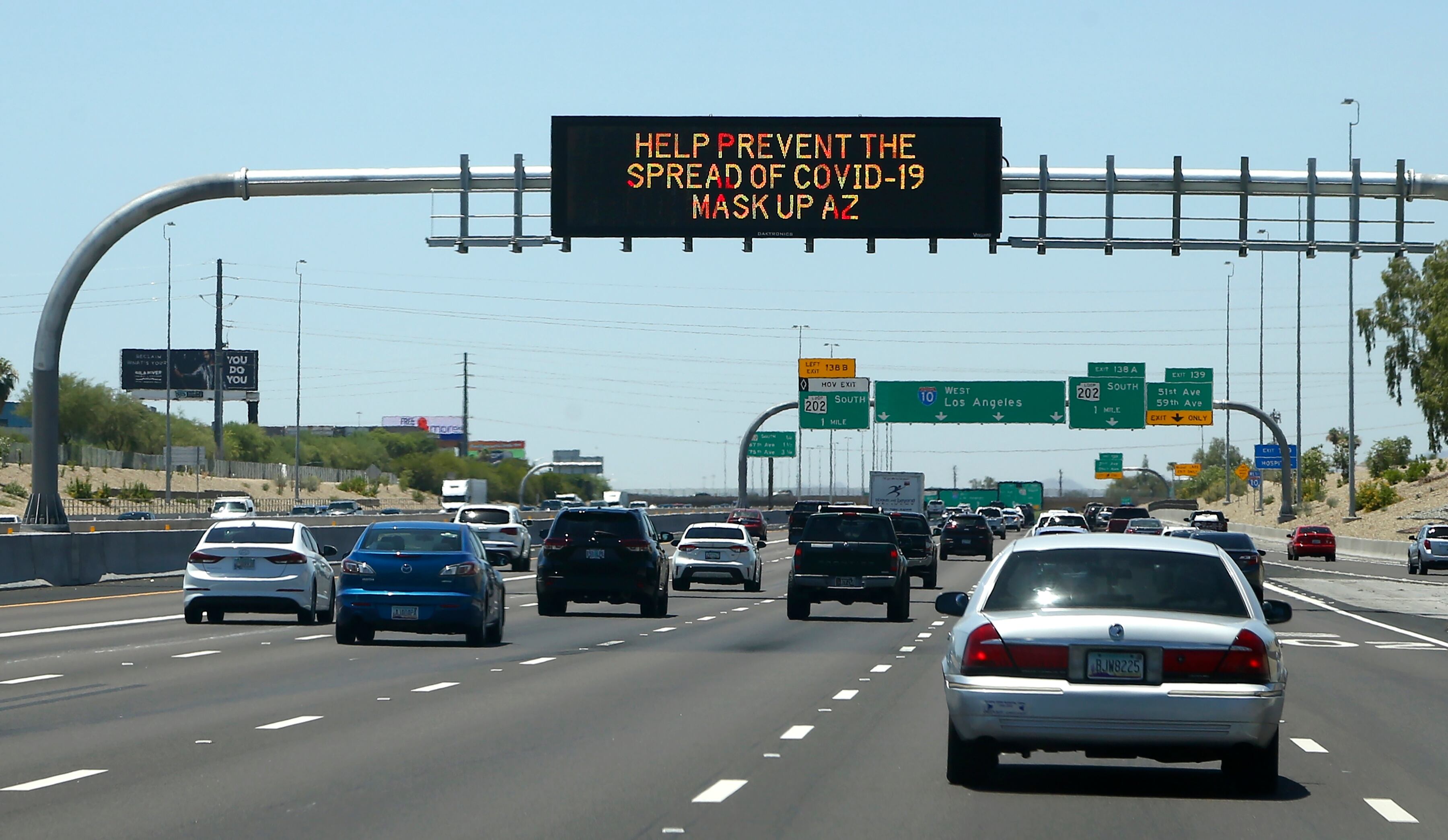
Alarming surges in coronavirus cases across the South and West raised fears Monday that the outbreak is spiraling out of control and that hard-won progress against the scourge is slipping away because of resistance among many Americans to wearing masks and staying away from others.
Confirming predictions that the easing of state lockdowns over the past month and a half could lead to a comeback by the virus, cases surpassed 100,000 in Florida, hospitalizations are rising dramatically in Houston, and a startling 1 in 5 of those tested in Arizona are proving to be infected.
Over the weekend, the virus seemed to be everywhere at once: Six staff members helping set up for President Donald Trump's rally in Tulsa, Oklahoma, tested positive, as did 23 Clemson University football players in South Carolina. At least 30 members of the Louisiana State University team were isolated after becoming infected or coming into contact with someone who was. Meatpacking plants were also hit with outbreaks.
"It is snowballing. We will most certainly see more people die as a result of this spike," said Dr. Marc Boom, CEO and president of Houston Methodist Hospital, noting that the number of COVID-19 hospital admissions has tripled since Memorial Day to more then 1,400 across eight hospital systems in the Houston metropolitan area.
He predicted that in three weeks hospitals could be overwhelmed, and he pleaded with people to cover their faces and practice social distancing.
"It is possible to open up at a judicious pace and coexist with the virus, but it requires millions and millions of people to do the right thing. Right now, we don't have that" because people have let their guard down, Boom said.
Texas is among a number of states -- including Arizona, Alabama, Florida and South Carolina -- whose governors have resisted statewide mask requirements, leaving the matter to local authorities.
The number of newly confirmed coronavirus cases across the country per day has reached more than 26,000, up from about 21,000 two weeks ago, according to an Associated Press analysis of data compiled by Johns Hopkins University. Over 120,000 deaths in the U.S. have been blamed on the virus, the highest death toll in the world.
In Orlando, 152 coronavirus cases were linked to one bar near the University of Central Florida campus, said Dr. Raul Pino, a state health officer in the resort city.
"A lot of transmission happened there," Pino said. "People are very close. People are not wearing masks. People are drinking, shouting, dancing, sweating, kissing and hugging, all the things that happen in bars. And all those things that happen are not good for COVID-19."
Although he asked health officials to renew calls for people to wear masks and keep their distance, Gov. Ron DeSantis has not signaled he will retreat from reopening the state after three months of shutdowns that have damaged the economy.
In Louisiana, Gov. John Bel Edwards weighed whether to proceed with any further loosening of restrictions amid a spike in cases. Some businesses have closed again because of infections among staff members or patrons. And a cluster of bars near LSU reported at least 100 customers and employees tested positive.
Countries such as Brazil, India and Pakistan are also seeing surging cases.
Dr. Michael Ryan, the World Health Organization's emergencies chief, said that the outbreak is "definitely accelerating" in the U.S. and a number of other countries, dismissing the notion that the record daily levels of new cases simply reflect more testing. He noted that numerous countries have seen marked increases in hospital admissions and deaths.
"The epidemic is now peaking or moving towards a peak in a number of large countries," he warned.
In the U.S., Arizona, in particular, is seeing disturbing trends in several benchmarks, including the percentage of tests that prove positive for the virus. Arizona's is the highest in the nation.
The state's positive test rate is at a seven-day average of over 20 percent, well above the national average of 8.4 percent and the 10 percent level that public health officials say is a problem. When the positive test rate rises, it means that an outbreak is worsening -- not just that more people are getting tested.
At Maryland's Fort Washington Medical Center on the outskirts of the nation's capital, workers described a scramble to find new beds, heartbreaking encounters with family members of critically ill patients, and their frustration with Americans who do not believe the coronavirus threat is real.
"Everybody is out lounging on the beaches. Just thinking that it's over. And it's not," respiratory therapist Kevin Cole said. "It's far from being over. And unfortunately, it's those people that will keep this pandemic going."
Meanwhile, New York City, once the most lethal hot spot in the U.S., lifted more of its restrictions, moving a big step closer to normal. Restaurants can serve diners outdoors, customers can browse through stores and get a haircut, and children can return to playgrounds.
Eve Gonzalez, a 27-year-old food industry worker in New York whose job had not yet resumed, said it is too soon: "I'm dying to go out, but people's health is more important."
In Illinois, museums, gyms, and zoos can reopen on Friday with restrictions. Indoor dining can resume at 25 percent capacity, and some places, such as the Lincoln Park Zoo, will require reservations.
Worldwide, 9 million people have been confirmed infected by the virus and about 470,000 have died, according to Johns Hopkins, though experts say the actual numbers are much higher because of limited testing and cases in which patients had no symptoms.
Amid the global surge, the head of WHO warned that world leaders must not politicize the outbreak but unite to fight it.
Tedros Adhanom Ghebreyesus, who has faced criticism from President Donald Trump, said during a videoconference for the Dubai-based World Government Summit that it took over three months for the world to see 1 million confirmed infections, but just eight days to see the most recent 1 million cases.
Tedros did not mention Trump by name or his determination to pull the United States out of the U.N. health agency but warned: "The greatest threat we face now is not the virus itself; it's the lack of global solidarity and global leadership." He added, "We cannot defeat this pandemic with a divided world."
Trump has criticized the WHO over its early response to the outbreak and what he considers its excessive praise of China, where the outbreak began, though his own administration's handling of the crisis in the U.S. has come under attack. Trump has threatened to cut off U.S. funding for the WHO.
Companies around the world are racing to find a vaccine, and there is fierce debate over how to make sure it is distributed fairly. WHO's special envoy on COVID-19, Dr. David Nabarro, said he believes it will be "2 1/2 years until there will be vaccine for everybody in the world."
Brazil, with over 50,000 deaths, the second-highest toll in the world, registered a record 54,000 new coronavirus cases in its latest single-day count. And nearly 1 in 3 people tested overall have turned up positive, according to the WHO's Ryan, who said that the startlingly high number suggests cases are going either unreported or undetected because of a low rate of testing.
India's health care system has been slammed by the virus. The caseload in the impoverished country of more than 1.3 billion people climbed by nearly 15,000 Monday to over 425,000, with more than 13,000 deaths.
After easing a nationwide lockdown, the Indian government in recent weeks ran special trains to return thousands of migrant workers to their home villages.
In Pakistan, infections are accelerating and hospitals are having to turn away patients, with new cases up to 6,800 a day. The government has relaxed its coronavirus restrictions, hoping to salvage a near-collapsed economy in the country of 220 million people.
-----
Associated Press journalists from around the world contributed.