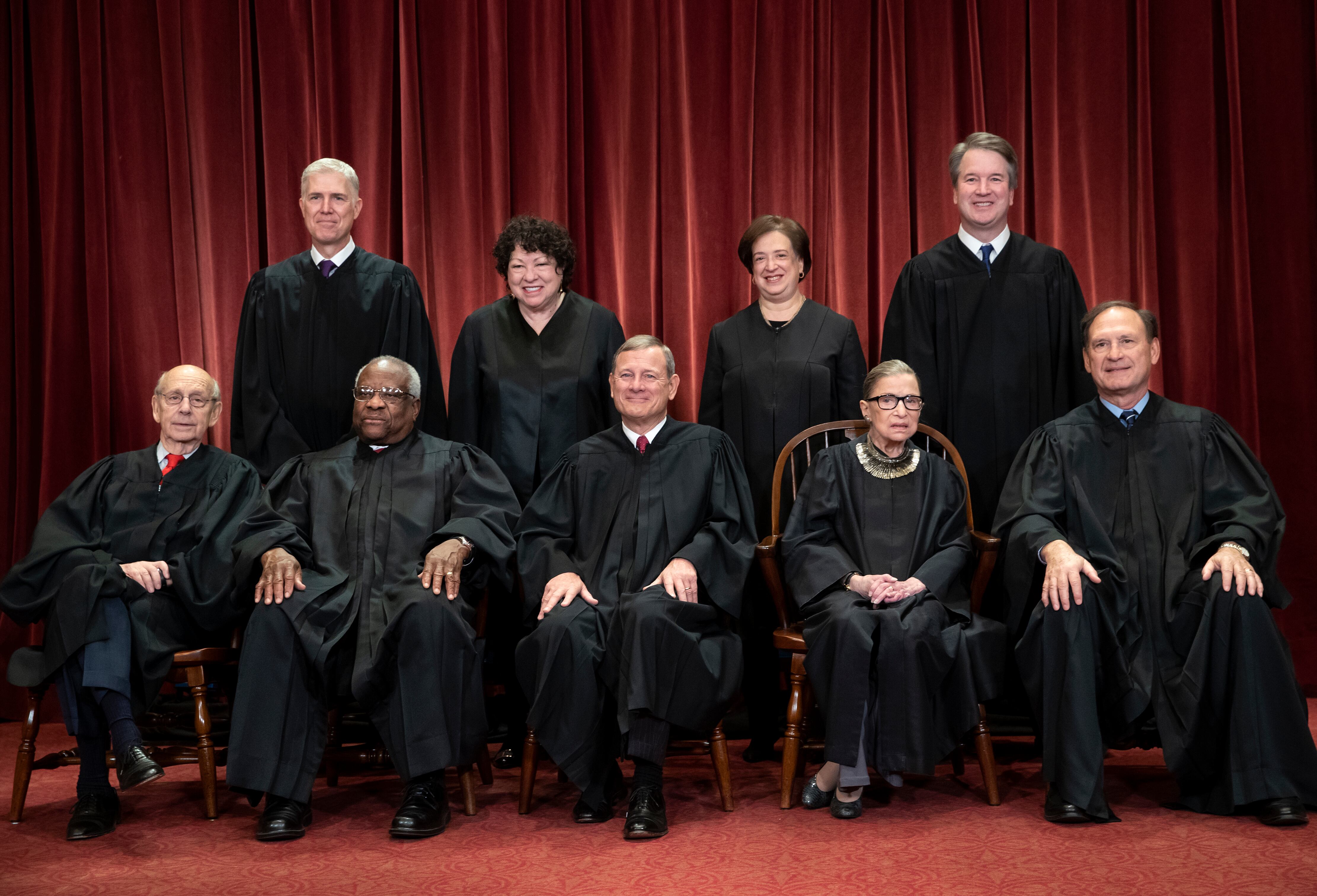
In this Nov. 30, 2018, file photo, the justices of the U.S. Supreme Court gather for a formal group portrait. Seated from left: Associate Justice Stephen Breyer, Associate Justice Clarence Thomas, Chief Justice of the United States John G. Roberts, Associate Justice Ruth Bader Ginsburg and Associate Justice Samuel Alito Jr. Standing behind from left: Associate Justice Neil Gorsuch, Associate Justice Sonia Sotomayor, Associate Justice Elena Kagan and Associate Justice Brett M. Kavanaugh. (AP Photo/J. Scott Applewhite, File)
By Mark Sherman
The Supreme Court said Monday it will hold arguments by teleconference in May in key cases, including President Donald Trump's bid to shield his tax and other financial records.
The court will make live audio of the arguments available for the first time. It had previously postponed courtroom arguments for March and April because of the coronavirus.
The justices and the lawyers arguing the cases all will participate remotely. The court said a live audio feed will be provided to news organizations.
The court has never live-streamed courtroom arguments and only rarely has it made the audio available on the same day.
Six of the nine justices are 65 and older, at higher risk of getting very sick from the illness, according to the Centers for Disease Control and Prevention.
Justices Ruth Bader Ginsburg, 87, and Stephen Breyer, 81, are the oldest members of the court.
The only other time Supreme Court arguments have been held outside the 85-year-old court building was in October 2001, when anthrax was detected in the court mailroom. That led the justices to hold arguments in the federal courthouse about a half mile from the Supreme Court, but only for one week.
In 1918, when the court still met inside the Capitol, arguments were postponed for a month because of the flu pandemic. Smallpox outbreaks in the late 1700s also caused postponement of court business.
Carlo and Baker cover the heartening news on the Covid front ahead of the holiday, plus President Biden punting student loan repayments again, a new space telescope and Love, Hate, Ate: Christmas Eve Eve Edition!
This year's worldwide semiconductor shortage limited the supply of everything from new cars to smartphones; and now, many in the chip industry expect the shortage to continue deep into 2022, and maybe even 2023. Semiconductor senior research analyst for Robert W. Baird & Co., Tristan Gerra, joins Cheddar News' Closing Bell to discuss.
The airline industry says it is contending with staff shortages that threaten to hamper operations amid the COVID resurgence, andDelta Airlines CEO Ed Bastian called on the CDC to revise its guidance for vaccinated workers who test positive from a 10-day quarantine to just five. Chuck Liberman, chief investment officer and managing partner at Advisors Capital Management LLC, joined Cheddar to talk about the current guidance on isolation and why he believes the omicron variant calls for more relaxed guidance given its reportedly mild symptoms.
Schools are shutting down in droves as the highly contagious omicron variant surges across the country. Denisha Merriweather, director of public relations and content marketing at the American Federation for Children, an advocacy organization for vouchers and tax credits for school choice, joined Cheddar's "Opening Bell" to discuss the impact of remote learning on children. She argued that school districts have to be more proactive about the steps they are taking to engage students, and if they are unable to form better teaching methods, parents should be able to find alternative schools.
The boys discuss President Biden's plans to send out free rapid tests as the testing supply chain starts to buckle ahead of the holidays. Also, why aren't Americans having more babies, and The Matrix returns.
With the Build Back Better plan essentially out of the picture, economists are highlighting what the country might lose without the provisions designed to strengthen it. Among other things, this includes no more monthly payments for tens of millions of families, no universal Pre-K for 6 million children a year, and no billions of dollars in tax incentives for climate initiatives. Grace Segers, staff writer for The New Republic, joined Cheddar to discuss the various impacts on the economy without President Biden's spending bill.
Electric vehicle companies took a tumble Monday after Senator Joe Manchin killed Biden's 'Build Back Better' plan. Shares of Tesla, Lucid, and Rivian all fell rapidly as the plan had included significant incentives for the growing EV sector. Rich Steinberg, former executive at Nissan, BMW and Electrify America joined Cheddar's Opening Bell to discuss.
Michael Robinson, Chief Technology Strategist at Money Map Press, joins Cheddar News' Closing Bell, where he explains why small and mid-cap stocks heating up during Tuesday's session is a very good sign for a stock market that ended the day's session sharply higher.