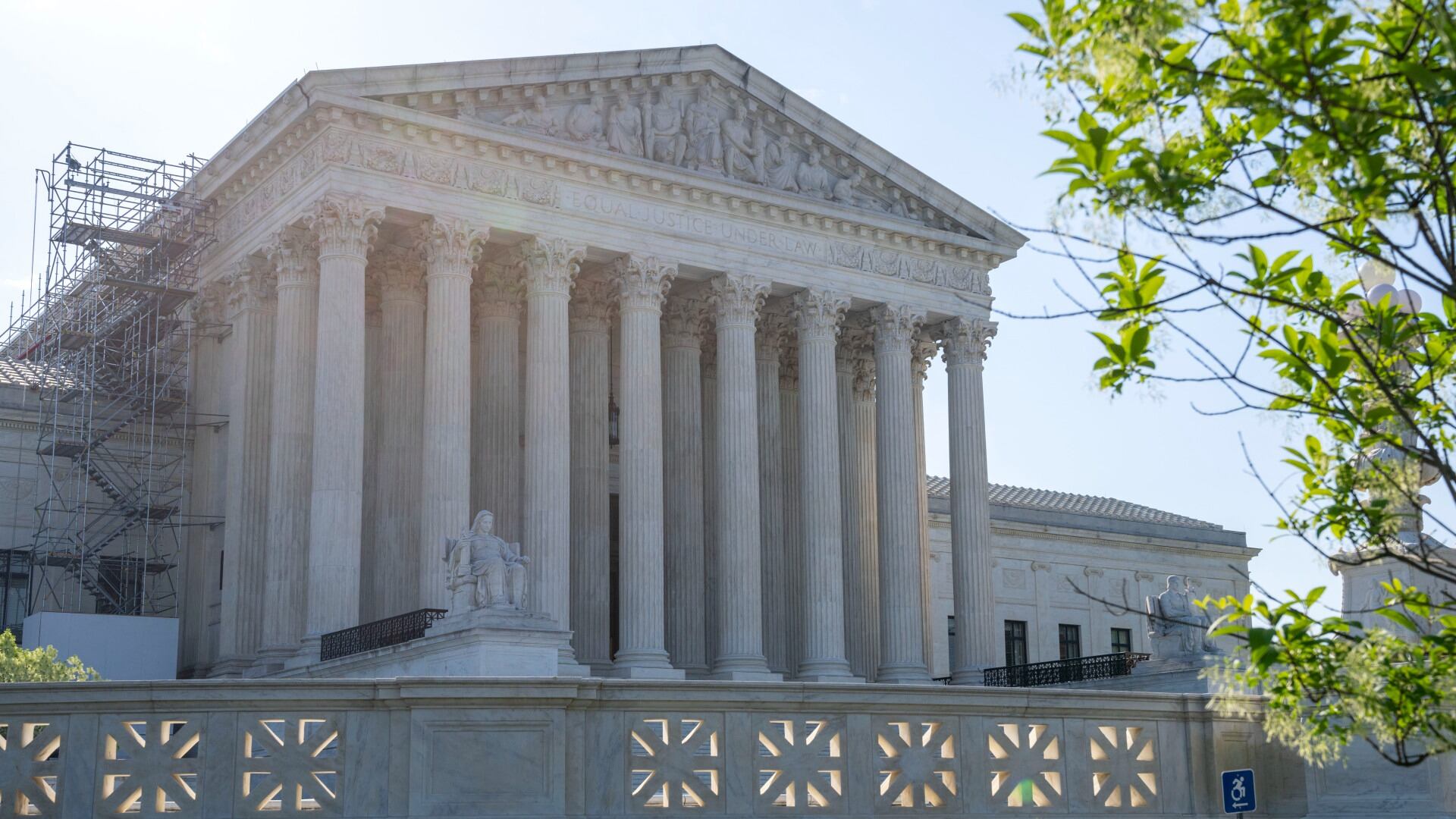
The Supreme Court is seen, Friday, April 21, 2023, ahead of an abortion pill decision in Washington. (AP Photo/Jacquelyn Martin)
The Supreme Court on Tuesday dismissed a case surrounding a Maine hotel that could have made it harder for people with disabilities to learn in advance whether a hotel's accommodations meet their needs.
Hotels and other business interests had urged the justices to limit the ability of so-called testers to file lawsuits against hotels that fail to disclose accessibility information on their websites and through other reservation services.
The information is required by a 2010 Justice Department rule. People who suffer discrimination can sue under the landmark Americans With Disabilities Act, signed into law in 1990.
The justices did not issue a decision on the substance of the case. Instead, they dismissed the case and threw out a lower court ruling in favor of tester lawsuits. The outcome leaves the issue unresolved nationally.
Federal courts in some parts of the country allow such lawsuits. In others, those suits are barred.
The case in front of the court involved whether Deborah Laufer, a woman with disabilities, has the right to sue a hotel in Maine that lacked the accessibility information on its website, despite having no plans to visit it.
In an effort to forestall an unfavorable ruling, Laufer withdrew her lawsuit against the hotel.
Nodi is giving kids a safe way to stay connected before they're ready for a smartphone. CEO Pascal Leonard Blum breaks down how the device works for families.
From coast to coast, gas prices are telling different stories. AAA's Aixa Diaz explains what's behind the numbers and what it means for American drivers.
AutoStore’s CPO Parth Joshi explains its new AI software layer designed to optimize warehouse robots in real time and unlock smarter, more efficient fulfillment
ROC CEO B. Scott Swann joins us live from the NYSE to discuss the company's IPO and how VisionAI is transforming facial recognition for defense and security.
If you asked anyone in 2007 what a “subprime mortgage” was, they wouldn’t have any idea. So here’s a question for you: Do you know what the private credit
Matternet founder and CEO Andreas Raptopoulos on the state of drone delivery in the U.S. and what it will take to make aerial delivery a mainstream reality.